


Listen to the article
Singapore Government Issues POFMA Correction to The Online Citizen Over IDF Analysis
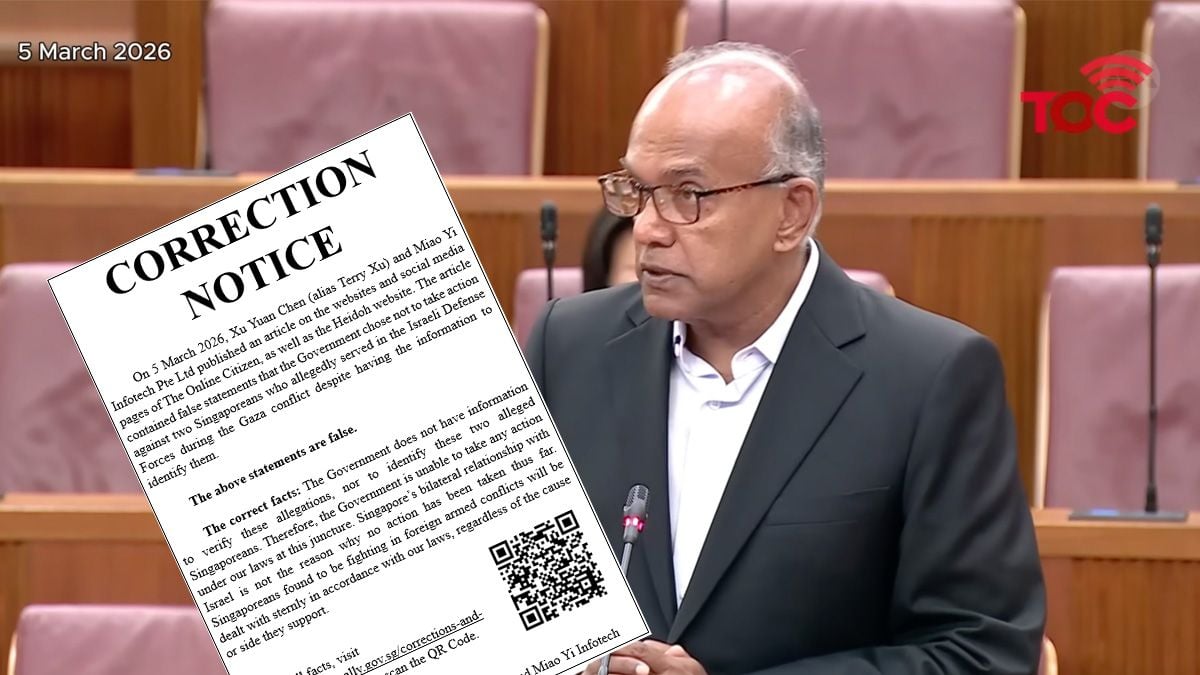
The Online Citizen (TOC) has been served with a Correction Direction under Singapore’s Protection from Online Falsehoods and Manipulation Act (POFMA) regarding its March 5 article analyzing government responses to reports of Singaporeans serving in the Israeli Defence Forces (IDF).
The correction order, issued by the POFMA Office under the authority of Coordinating Minister for National Security and Minister for Home Affairs K Shanmugam, requires TOC to publish prescribed notices across its website, social media platforms, and in The Straits Times.
While complying with the legal requirement, TOC has publicly disputed the Direction’s claims, stating they “do not accept that the subject statements in our article constitute false statements of fact.” The news outlet argues that the Direction misrepresents analytical commentary as direct factual assertions.
At the center of the dispute is TOC’s article titled “The Art of Saying Everything While Confirming Nothing,” which examined Minister Shanmugam’s parliamentary responses to questions about a Declassified UK report. That report had identified two Singapore passport holders in Israeli Defence Forces data.
The Direction identifies six statements from TOC’s article as false. These include claims that the government deliberately gave incomplete answers in Parliament, possessed identifying information about the Singaporeans in question, chose not to act under the Internal Security Act to preserve diplomatic relations with Israel, and decided against using POFMA against Declassified UK because the underlying report was true.
In its rebuttal, TOC maintains that its article offered analytical inferences based on publicly observable information rather than asserting direct knowledge of classified information or internal deliberations. “Our article did not claim access to classified information or internal deliberations. It analysed the wording of parliamentary answers, the operation of legal frameworks, and patterns of public enforcement,” TOC stated.
The publication points to a joint statement released by the Ministry of Home Affairs and Ministry of Defence on March 24 as relevant context. According to TOC, this statement confirmed that Singapore’s Internal Security Department had successfully identified and investigated Singaporean individuals based on publicly available online material, demonstrating investigative capabilities similar to those TOC had analyzed in its article.
This marks the 25th POFMA direction issued to The Online Citizen and its editor, according to the outlet’s records, and the second requiring publication in The Straits Times at TOC’s expense.
The case highlights ongoing tensions regarding the scope of Singapore’s fake news law. During the Second Reading of the POFMA bill in 2019, Minister Shanmugam had stated that “if the facts are accurate…and the views are expressed based on those facts, it is not within this Bill.” TOC argues its article falls within these parameters, offering analysis rather than false statements.
Media observers have noted that this case raises important questions about the distinction between factual reporting and analytical journalism in Singapore’s regulatory environment. Some press freedom advocates have expressed concern about the potential chilling effect on media commentary regarding government actions.
The case also underscores the complex geopolitical considerations at play, including Singapore’s diplomatic relationships with Israel and the legal framework for addressing Singaporeans potentially serving in foreign military forces.
TOC concluded its response by stating: “We are complying with this Direction because the law requires it. We are publishing this rebuttal because accuracy requires it.”
Fact Checker
Verify the accuracy of this article using The Disinformation Commission analysis and real-time sources.

6 Comments
This case highlights the challenges governments face in an era of widespread online misinformation. While protecting national security is important, care must be taken to not infringe on legitimate journalistic reporting and analysis. Transparency and accountability will be key.
I wonder if there are any independent oversight mechanisms in place to review POFMA directions and ensure they are not abused for political purposes. Maintaining public trust is crucial.
Interesting to see the Singapore government taking action against what it deems as false claims. While free speech is important, it’s understandable that they want to curb the spread of disinformation, especially on sensitive national security matters.
I’m curious to learn more about the specific claims in the TOC article that the government disputed. Was there a factual inaccuracy, or was it more a matter of interpretation?
The POFMA law seems to give the government broad powers to correct online falsehoods. While this may help combat misinformation, there are concerns about potential overreach and stifling of legitimate debate. It will be important to ensure a fair and transparent process.
Do you think the government’s response was proportionate, or did they go too far in compelling the TOC to publish corrections? Balancing national interests and press freedoms can be tricky.