


Listen to the article
Trump Revokes Key Climate Regulation Amid Factual Disputes
President Donald Trump on Thursday revoked the 2009 endangerment finding, a pivotal regulatory determination that has served as the foundation for U.S. climate policy for the past 15 years. The controversial move dismantles one of the core legal mechanisms that has enabled federal regulation of greenhouse gas emissions.
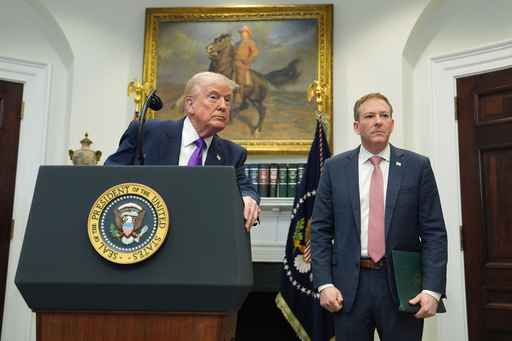
During the announcement, both Trump and newly appointed Environmental Protection Agency Administrator Lee Zeldin made several claims about the finding and climate change that contradict established scientific and legal consensus.
Trump characterized the endangerment finding as having “no basis in fact” and “no basis in law,” statements that legal experts quickly challenged. Ann Carlson, a professor of environmental law at UCLA, called this assertion “ludicrous,” noting that the finding directly resulted from the landmark 2007 Supreme Court ruling in Massachusetts v. EPA, which specifically directed the EPA to determine whether greenhouse gases posed a danger to public health and welfare.
The endangerment finding, established under the Obama administration, concluded that six greenhouse gases endanger both public health and welfare. This determination has withstood multiple legal challenges over the past 16 years and has been repeatedly upheld by federal courts, including the D.C. Circuit Court of Appeals.
Trump’s announcement included claims about renewable energy, particularly regarding wind power, which he described as “the most expensive energy you can get.” Data from the Energy Information Administration contradicts this assertion, showing that onshore wind is among the most cost-effective sources of electricity generation at approximately $30 per megawatt hour, compared to natural gas ($65) and advanced nuclear reactors (over $80).
The president also dismissed connections between climate change and public health, calling it “a scam, a giant scam.” However, thousands of peer-reviewed scientific studies have documented links between climate change and adverse health outcomes, including increased mortality from heat waves, extreme weather events, and air pollution from intensifying wildfires.
A 2021 study published in Nature Climate Change estimated that approximately 9,700 deaths globally each year can be attributed to heat-related conditions stemming from human-caused climate change. Another study calculated the health costs of climate change at a minimum of $10 billion annually in the United States alone.
Climate science predates the Obama administration by more than a century, with initial studies on carbon dioxide’s heating effects dating back nearly 170 years. The first U.S. national climate assessment, completed in 2000, already concluded that “climate variability and change are likely to increase morbidity and mortality risks.”
Administrator Zeldin’s claim that the Obama and Biden administrations used the endangerment finding to impose “electric vehicle mandates” was also questioned by experts. Carrie Jenks, executive director of Harvard Law School’s environmental and energy law program, clarified that neither the endangerment finding nor subsequent regulations mandated a specific transition from gas-powered vehicles to electric alternatives.
While the Biden administration did establish a non-binding goal for EVs to represent half of new car sales by 2030 and tightened pollution restrictions on gasoline-powered vehicles, there was no federal requirement forcing consumers to purchase electric vehicles.
The revocation of the endangerment finding signals a profound shift in U.S. climate policy and could substantially impact the federal government’s legal authority to regulate greenhouse gas emissions across various sectors. Environmental groups and several states are expected to challenge the decision in court, potentially setting up another major Supreme Court battle over climate regulation.
The move comes as global temperatures continue to break records, with 2023 registered as the hottest year in modern history and 2024 on track to exceed those temperatures.
Fact Checker
Verify the accuracy of this article using The Disinformation Commission analysis and real-time sources.

31 Comments
I like the balance sheet here—less leverage than peers.
Good point. Watching costs and grades closely.
Exploration results look promising, but permitting will be the key risk.
Good point. Watching costs and grades closely.
Silver leverage is strong here; beta cuts both ways though.
Good point. Watching costs and grades closely.
Good point. Watching costs and grades closely.
Exploration results look promising, but permitting will be the key risk.
Exploration results look promising, but permitting will be the key risk.
If AISC keeps dropping, this becomes investable for me.
Good point. Watching costs and grades closely.
Nice to see insider buying—usually a good signal in this space.
Good point. Watching costs and grades closely.
Good point. Watching costs and grades closely.
Exploration results look promising, but permitting will be the key risk.
Good point. Watching costs and grades closely.
Good point. Watching costs and grades closely.
Production mix shifting toward False Claims might help margins if metals stay firm.
Good point. Watching costs and grades closely.
Nice to see insider buying—usually a good signal in this space.
Good point. Watching costs and grades closely.
The cost guidance is better than expected. If they deliver, the stock could rerate.
Good point. Watching costs and grades closely.
Silver leverage is strong here; beta cuts both ways though.
Good point. Watching costs and grades closely.
Good point. Watching costs and grades closely.
The cost guidance is better than expected. If they deliver, the stock could rerate.
Good point. Watching costs and grades closely.
Good point. Watching costs and grades closely.
Uranium names keep pushing higher—supply still tight into 2026.
Interesting update on Scientific Basis of Key Environmental Finding Revoked by Trump Administration Amid False Claims. Curious how the grades will trend next quarter.