


Listen to the article
Russia’s Medvedev Dismisses Western Claims of Threats to Greenland as “Horror Stories”
Former Russian President Dmitry Medvedev has strongly rejected Western assertions that Russia and China pose a threat to Greenland, characterizing such claims as fabricated “horror stories” designed to justify Western actions in the Arctic region.
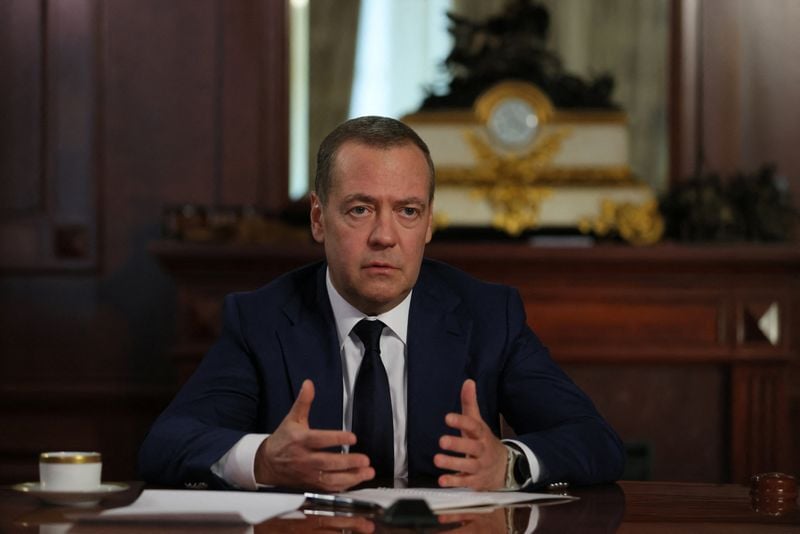
Speaking from his residence outside Moscow in an exclusive interview with Reuters, TASS, and the Russian war blogger WarGonzo, Medvedev, who now serves as deputy chairman of Russia’s Security Council, was unambiguous in his dismissal.
“This so-called threat from Russia and the People’s Republic of China is simply a horror story,” Medvedev stated. His comments come amid increasing geopolitical tensions and growing Western concerns about Russian and Chinese activities in Arctic territories.
The Arctic region has become increasingly important strategically in recent years, with melting ice caps opening new shipping routes and providing access to previously inaccessible natural resources. Greenland, an autonomous territory within the Kingdom of Denmark, has attracted particular attention due to its vast mineral deposits and strategic location.
Western defense analysts have expressed concerns about both Russia’s military buildup in its northern territories and China’s self-proclaimed status as a “near-Arctic state.” China has been actively pursuing economic interests in Greenland, investing in rare earth mineral mining projects, while Russia has reopened Soviet-era military bases and increased its military presence throughout the Arctic Circle.
Medvedev’s comments also touched on the potential repercussions these claims could have on NATO’s cohesion. “This is indeed a serious challenge for Atlantic unity,” he observed. “Perhaps everything will go according to a calmer scenario before military intervention and fighting within the NATO bloc.”
His reference to potential conflict within NATO appears to suggest that disagreements over Arctic policy and response to perceived Russian and Chinese threats could create divisions among alliance members. NATO has recently increased its focus on the High North, with several large-scale military exercises conducted in the region.
The remarks from the former Russian president come at a time when relations between Russia and Western nations remain severely strained. The ongoing conflict in Ukraine, accusations of election interference, and competing claims in the Arctic have all contributed to what many analysts describe as a new Cold War.
Denmark, which maintains sovereignty over Greenland, has expressed increasing concern about foreign influence in the territory. The United States also maintains a significant military presence in Greenland at Thule Air Base, which houses part of the U.S. ballistic missile early warning system.
In 2019, former U.S. President Donald Trump famously expressed interest in purchasing Greenland, a proposal that was firmly rejected by both Greenlandic and Danish authorities. The incident highlighted Greenland’s growing geopolitical importance.
Experts in international relations suggest that Medvedev’s dismissal of Western concerns aligns with Russia’s broader narrative that NATO expansion and Western military activities, rather than Russian actions, are the primary source of international tensions.
The Arctic Council, an intergovernmental forum addressing issues faced by Arctic governments and indigenous peoples, has seen its work complicated by geopolitical tensions following Russia’s actions in Ukraine, with several Western members temporarily pausing their participation in the council’s activities.
As climate change continues to transform the Arctic landscape, competition for resources and influence in the region is expected to intensify, making Medvedev’s comments part of a larger discourse about the future of this increasingly important strategic area.
Fact Checker
Verify the accuracy of this article using The Disinformation Commission analysis and real-time sources.

11 Comments
Medvedev’s strong dismissal of Western ‘horror stories’ about Russian and Chinese threats in Greenland suggests this is more about posturing than genuine security risks. The Arctic is a complex arena, and we need clear-headed analysis, not inflammatory rhetoric.
The geopolitical battle for the Arctic is intensifying, with Russia and the West trading accusations. Medvedev’s comments reflect the heightened tensions, but we need to move beyond political grandstanding to find pragmatic solutions that address the region’s strategic importance.
The battle for the Arctic is heating up, with Russia and China on one side and the West on the other. Medvedev’s comments reflect the heightened tensions, but we need to move beyond inflammatory rhetoric to find pragmatic solutions.
Medvedev’s rejection of Western claims about Russian and Chinese threats to Greenland highlights the ongoing geopolitical jockeying in the Arctic. While the security concerns may be overstated, the region’s growing significance means we need constructive dialogue, not inflammatory rhetoric.
Medvedev’s dismissal of the ‘threat’ from Russia and China in Greenland as ‘horror stories’ suggests this may be more political posturing than a genuine security concern. The Arctic is a complex geopolitical arena.
Given the strategic importance of the Arctic region, it’s not surprising to see Russia and the West vying for influence. But the rhetoric around alleged threats to Greenland seems overblown. Maintaining open dialogue will be crucial.
This seems to be another case of heightened rhetoric and finger-pointing between Russia and the West. Both sides likely have strategic interests in the Arctic, but it’s concerning to see the tension escalating.
Agreed. With melting ice caps opening new shipping routes and resources, the Arctic is a growing flashpoint. Cooler heads will need to prevail to avoid further escalation.
This tit-for-tat over Greenland highlights the broader geopolitical competition in the Arctic. While the security concerns may be overstated, the region’s strategic importance is undeniable. Constructive diplomacy will be key going forward.
Interesting to see Medvedev firmly rejecting Western claims of Russian threats to Greenland. Sounds like political posturing rather than a genuine security concern. I wonder what Russia’s real interests are in the Arctic region.
You raise a good point. The Arctic is becoming increasingly geopolitically important, so there may be more at play here than meets the eye.