


Listen to the article
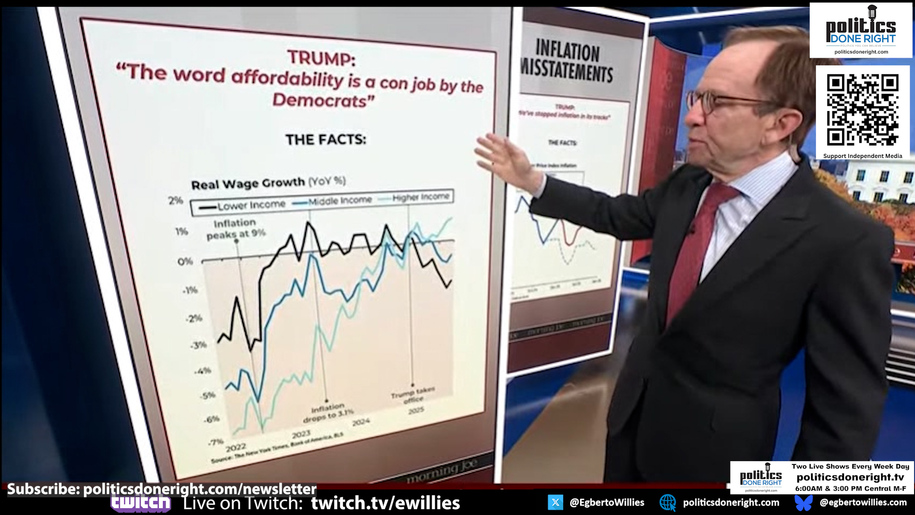
Financial expert Steve Rattner has delivered a pointed fact-check of former President Donald Trump’s economic claims, systematically refuting assertions about inflation, tariffs, and healthcare policy through data-driven analysis.
In a detailed examination that has gained attention across economic and political circles, Rattner challenged Trump’s frequently repeated claim that he inherited “the worst inflation in history” when taking office. Using historical economic data, Rattner demonstrated that inflation rates at the start of Trump’s presidency were nowhere near historic highs, contextualizing the misleading nature of such statements.
“What we’re seeing is a deliberate distortion of economic reality,” said an economist familiar with Rattner’s analysis, who requested anonymity to speak freely. “When public figures make claims that directly contradict established economic measurements, it creates confusion about how our economy actually functions.”
Rattner’s analysis took particular aim at Trump’s assertions regarding tariff policies. The former president has repeatedly suggested that tariffs imposed during his administration would effectively serve as a revenue mechanism capable of funding significant government operations. Rattner’s breakdown revealed the mathematical impossibility of these claims, showing that even the most aggressive tariff scenarios couldn’t generate the revenue Trump suggested.
Trade experts note that tariffs typically function as taxes paid primarily by domestic consumers and businesses rather than foreign entities. The Peterson Institute for International Economics has previously estimated that Trump-era tariffs cost American households hundreds of dollars annually through higher prices.
Another focus of Rattner’s critique centered on Trump’s claims about stopping inflation “in its tracks” during his presidency. Economic data from the Bureau of Labor Statistics contradicts this assertion, showing that while inflation remained relatively low during portions of Trump’s term, this reflected broader economic trends rather than specific policy interventions.
The healthcare sector received similar scrutiny in Rattner’s assessment. Trump has repeatedly claimed that the Affordable Care Act primarily enriched insurance companies while promising his own policies would slash drug prices by unprecedented percentages. Rattner’s analysis examined actual healthcare spending and pharmaceutical pricing data that significantly undermined these claims.
Healthcare policy analysts point out that prescription drug prices rose during Trump’s administration despite promises of dramatic reductions. The administration’s most ambitious drug pricing proposals faced significant implementation challenges and legal obstacles.
“What we observe in this pattern of statements is a disconnect between policy promises and economic realities,” said a healthcare economist at a Washington think tank. “When public officials make claims about pricing that diverge from market fundamentals, it becomes difficult to develop effective policy solutions.”
The broader significance of Rattner’s analysis extends beyond mere fact-checking. Media analysts suggest it highlights the challenge democratic systems face when political messaging relies heavily on factually contested claims. When basic economic indicators become disputed territory, public discourse struggles to address underlying policy challenges.
Financial markets have historically responded to policy clarity rather than rhetoric. Market analysts note that uncertainty about economic policy direction—particularly regarding tariffs and trade—contributed to market volatility during Trump’s presidency despite strong overall performance.
Rattner’s breakdown serves as a reminder of the critical role data-driven analysis plays in evaluating economic policy claims. As election seasons approach and economic messaging intensifies, the ability to distinguish between rhetorical flourish and substantive policy becomes increasingly important for voters navigating competing economic visions.
Neither Trump’s team nor Rattner responded to requests for additional comment on the specific points of contention in the analysis.
Fact Checker
Verify the accuracy of this article using The Disinformation Commission analysis and real-time sources.

9 Comments
Rattner’s examination of Trump’s statements on inflation, tariffs, and drug prices is a valuable contribution to the public discourse. Keeping political rhetoric grounded in verifiable data is crucial for sound economic policymaking.
Interesting analysis from Rattner. It’s important to rely on factual data rather than unsubstantiated claims, especially when it comes to economic policy. I appreciate the detailed examination and contextual evidence provided.
As someone interested in commodities and energy markets, I find Rattner’s fact-check on Trump’s statements to be a useful counterpoint. Objective economic analysis is essential for evaluating the impacts of policies in these sectors.
Absolutely. Fact-based assessments of economic performance and policy effects are crucial for anyone tracking developments in mining, energy, and related industries.
It’s refreshing to see an expert like Rattner providing a detailed, evidence-based rebuttal of Trump’s assertions. Fact-checking is essential for maintaining an accurate understanding of economic conditions and policy impacts.
This article underscores the need for rigorous, data-driven evaluation of economic claims, especially when they come from high-profile political figures. Rattner’s analysis seems thorough and well-substantiated.
Rattner makes a compelling case that Trump’s statements on inflation, tariffs, and drug prices don’t align with the economic data. Fact-checking and calling out misleading rhetoric is crucial for informed public discourse.
I agree, it’s concerning when political figures make claims that contradict established economic metrics. Maintaining a clear, evidence-based understanding of economic conditions is vital.
This article highlights the importance of scrutinizing economic policy claims, rather than accepting them at face value. Rattner’s analysis provides valuable context and nuance that is often missing from political rhetoric.