


Listen to the article
Philippine Maritime Chief Dismisses Chinese Claims in Ongoing South China Sea Dispute
National Maritime Council (NMC) chief Alexander Lopez has declined to engage in point-by-point rebuttals of recent accusations from the Chinese Embassy in Manila, indicating a shift toward more substantive dialogue in the escalating territorial dispute over the South China Sea.
“We will not answer that point by point because we have previously answered that, so no need to come with those rebuttals anymore,” Lopez stated during a public briefing. “We want to come up with a higher ground, we discuss issues and we do not discuss personalities.”
The diplomatic tension between the Philippines and China has intensified following incidents in contested waters. On January 8, Chinese Embassy Deputy Spokesperson Guo Wei accused the Philippine government of “staging provocations” using Filipino fisherfolk, a claim that came after the Philippines reported the year’s first Chinese harassment incident in Scarborough Shoal.
The NMC quickly denounced Guo’s assertion as “preposterous and completely false,” defending Filipino fishermen as “civilians lawfully pursuing their livelihoods within the Philippines’ maritime zones.” This statement prompted further criticism from the Chinese Embassy, which questioned the very concept of “maritime zones,” claiming the term does not exist in the United Nations Convention on the Law of the Sea (UNCLOS).
Lopez clarified this misrepresentation during the briefing. “We are actually using maritime zones and this term is commonly used in academia and the government,” he explained, noting that while the exact term might not appear in UNCLOS, it collectively refers to territorial seas, contiguous zones, exclusive economic zones (EEZ), and extended continental shelves—all concepts firmly established in international maritime law.
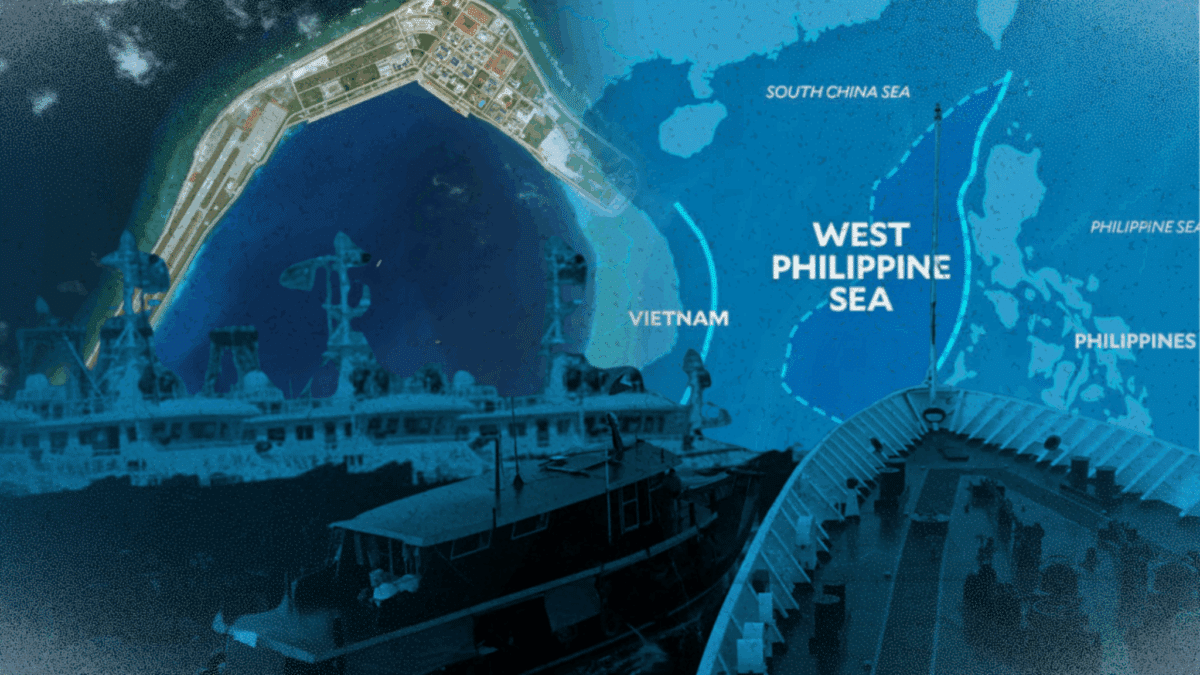
The conflict highlights the broader territorial dispute centered on China’s expansive claims. Beijing asserts sovereignty over nearly the entire South China Sea through its controversial “nine-dash line” policy, which was updated to a “ten-dash line” in 2023 to include areas around self-ruled Taiwan.
Mamamayang Liberal party-list Representative Leila De Lima entered the fray by dismissing China’s arguments as irrelevant in light of the fundamental issue. “The problem from the very start is China’s nine-dash line claim,” De Lima stated, characterizing it as a “fairy tale” that Beijing continues to promote in “serious international legal forums.”
De Lima’s comments reference the landmark 2016 ruling by an international tribunal that found in favor of the Philippines, effectively invalidating China’s sweeping territorial claims in the region. Despite this ruling, Beijing has continued to assert control through various means, including coast guard operations and maritime militia presence.
The dispute holds significant implications for regional stability and international maritime law. The South China Sea is one of the world’s most strategic waterways, facilitating approximately $5 trillion in annual global trade. It also contains valuable fishing grounds and potential energy reserves that are crucial to the economies of surrounding nations.
For the Philippines, the matter is not merely geopolitical but directly impacts thousands of fisherfolk who have traditionally operated in these waters. The protection of their livelihoods has become a central component of Manila’s position in the ongoing territorial dispute.
As tensions persist, the NMC’s approach signals a potential strategic shift in Philippine diplomacy—moving away from tit-for-tat exchanges toward emphasizing substantive issues and international legal frameworks, while continuing to assert Philippine sovereignty over its maritime territories in accordance with international law.
Fact Checker
Verify the accuracy of this article using The Disinformation Commission analysis and real-time sources.

8 Comments
The Chinese Embassy’s claims about the Philippines “staging provocations” seem rather dubious. It’s good to see the Philippine Maritime Council taking a firm yet measured stance in defending the rights of Filipino fishermen.
Dismissing the need for “point-by-point rebuttals” and instead aiming for a “higher ground” discussion is a wise strategy. Escalating the rhetoric is unlikely to resolve this long-standing geopolitical conflict.
This ongoing dispute over the South China Sea is a complex and sensitive issue. I’m glad to see the Philippine authorities taking a more constructive approach and trying to elevate the dialogue beyond just trading accusations.
Interesting to see the Philippines pushing back against China’s false claims in the West Philippine Sea. It’s important to have an open and substantive dialogue on this complex issue rather than just trading accusations.
I agree, focusing the discussion on the facts and merits rather than personalities is the right approach. Hopefully this leads to a more constructive resolution of the territorial dispute.
It’s encouraging to see the Philippines taking a firm but measured stance in response to China’s disputed claims. Avoiding pointless rebuttals and instead pursuing a “higher ground” dialogue is a wise approach.
Kudos to the Philippine Maritime Council for refusing to get dragged into a tit-for-tat exchange over the Chinese Embassy’s claims. Focusing on the substantive issues at hand rather than personalities is the right way forward.
I hope this signals a shift toward more meaningful and productive discussions between the Philippines and China on the South China Sea territorial dispute. Deescalating the rhetoric is crucial for finding a peaceful resolution.