


Listen to the article
European Officials Refuse to Retract False Claims Against UN Rapporteur Despite Evidence
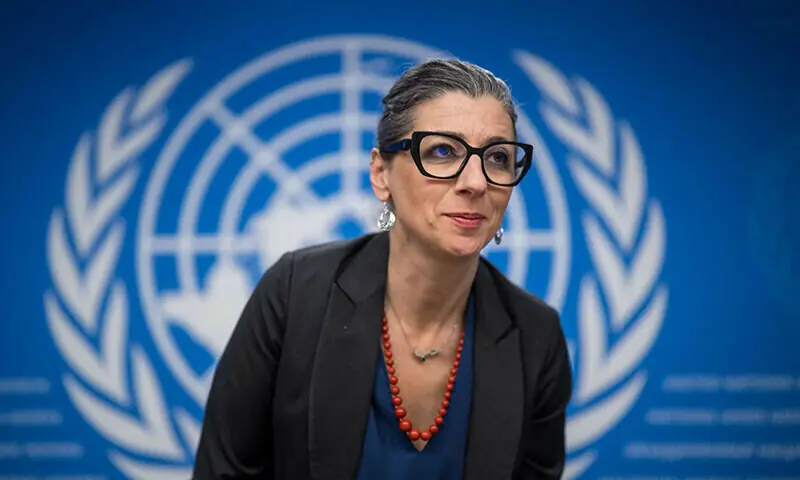
Senior European government officials who led accusations against United Nations Special Rapporteur for the Palestinian territories Francesca Albanese have maintained their positions despite mounting evidence that their claims were based on fabricated information.
Multiple international media outlets, including France 24 and Reuters, have verified that Albanese never described Israel as the “common enemy of humanity” during a recent forum in Qatar—the accusation that prompted calls for her resignation from officials across Europe. Transcripts of the event reveal she was actually referring to systems of finance, algorithms, and weaponry as the “common enemy.”
“A lie was exposed. Instead of retracting it, the SYSTEM that enabled the genocide attacks the messenger,” Albanese wrote on social media platform X. “France knows it stepped in something foul, but pride forbids correction.”
Amnesty International has called for immediate retractions from ministers in Austria, Czechia, France, Germany, and Italy, with Secretary General Agnès Callamard describing their silence as “political cowardice.” Callamard highlighted the contrast between the swift condemnation of a UN expert based on misinformation and the reluctance to hold Israel accountable for actions Amnesty has previously characterized as genocide and apartheid.
“The ministers that have spread disinformation must act beyond merely deleting their comments on social media—as some have done,” Callamard stated. “They must publicly apologize and retract any calls for Francesca Albanese’s resignation.”
The controversy has escalated to legal action in France, where the Association of Lawyers for the Respect of International Law (Jurdi) has filed a criminal complaint against French Foreign Minister Jean-Noël Barrot. The complaint accuses Barrot of disseminating false information by a public authority after he told the French parliament that Albanese had made “outrageous and reprehensible remarks” targeting Israel as a nation.
The legal team argues that Barrot’s misrepresentation could endanger Albanese’s safety, particularly given the highly charged political climate surrounding discussions of the Israeli-Palestinian conflict.
The Organisation of Islamic Cooperation (OIC) has also condemned the allegations, warning that such distortions risk undermining the credibility and integrity of the UN Human Rights Council. In a statement, the 57-member bloc emphasized that the accusations were “based on misrepresented and fabricated claims” regarding remarks Albanese never made.
Support for the UN rapporteur has extended beyond diplomatic and legal circles. Over 100 prominent entertainment industry figures—including actors Mark Ruffalo, Susan Sarandon, and Javier Bardem—have signed an open letter defending Albanese’s work. Organized by Artists for Palestine, the letter contends that Albanese is being targeted specifically for her defense of Palestinian rights.
The incident occurs against the backdrop of the ongoing conflict in Gaza, where the death toll has reportedly surpassed 72,000. Albanese noted in her response that three European governments had accused her with a “virulence” they had never applied to those responsible for violence in Gaza.
This diplomatic standoff highlights the intensely polarized nature of international discourse surrounding the Israeli-Palestinian conflict, with UN officials increasingly caught in political crossfire while attempting to fulfill their mandates.
As pressure mounts from human rights organizations, legal entities, and public figures, the European officials who launched the accusations face growing calls to acknowledge the factual record and issue formal retractions.
Fact Checker
Verify the accuracy of this article using The Disinformation Commission analysis and real-time sources.

10 Comments
It’s concerning to see senior government officials refuse to correct clearly inaccurate claims, even in the face of evidence. Transparency and accountability should be paramount, not political posturing.
This situation highlights the need for rigorous fact-checking and due diligence, especially when making serious allegations against public figures. I hope the officials involved will rectify this lapse in judgment.
While I understand the desire to defend one’s position, the refusal to correct false claims is troubling. Admitting mistakes and setting the record straight would be the ethical path forward in this case.
Well said. Maintaining credibility should take precedence over political pride or saving face. Transparency and accountability are essential for upholding public trust.
The refusal to correct false claims against this UN official is troubling. Accountability and integrity in public discourse are essential, regardless of political affiliations. I’m curious to see how this develops.
The UN rapporteur’s response of calling out the ‘system that enabled the genocide’ is intriguing. I’m curious to learn more about the broader context and dynamics at play here.
This is a concerning situation where officials doubled down on false claims despite evidence. Transparency and accountability are crucial, especially for public figures. I hope they will correct the record and issue retractions.
This case highlights the importance of verifying information before making serious accusations, especially against respected international figures. The officials involved should acknowledge their error and set the record straight.
I agree. Retractions and apologies would be the ethical response here. Maintaining credibility requires admitting mistakes, not doubling down on falsehoods.
It’s unfortunate to see a UN rapporteur facing such unfounded attacks. Maintaining credibility and public trust should be a priority, not digging in on disproven allegations. I hope the truth prevails here.