


Listen to the article
In the shadow of ongoing Middle East tensions, a troubling wave of misinformation has swept across social media platforms, with two particularly outlandish claims gaining significant traction: that Israeli Prime Minister Benjamin Netanyahu has been killed and that Tel Aviv has been reduced to rubble. Neither assertion bears any resemblance to reality, yet both continue to spread virally online.
The false reports of Netanyahu’s death have become something of a wartime tradition, recurring during each major conflict involving Israel. This latest iteration originated from Iran’s Tasnim News Agency, a media outlet with direct ties to the Islamic Revolutionary Guard Corps. The agency claimed the prime minister had been killed in a missile strike, a fabrication that quickly gained momentum across social networks.
Evidence clearly contradicts these reports. An image purportedly showing Netanyahu being pulled from debris was identified as an AI-generated fake. In fact, the Prime Minister has maintained a visible public schedule, making appearances in Beit Shemesh and Be’er Sheva, and conducting a televised press conference just last week.
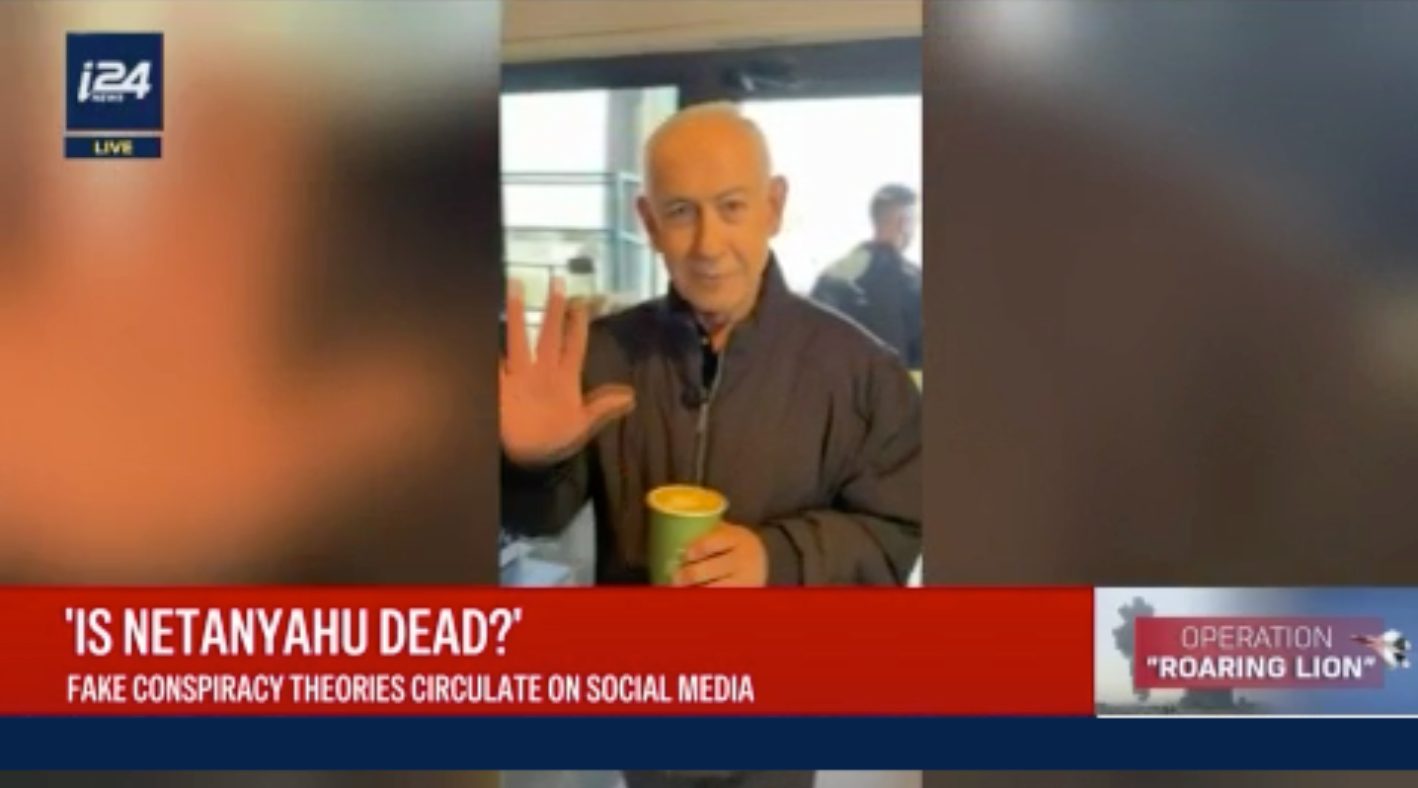
Even Netanyahu’s public appearances have become fodder for conspiracy theorists. After his press conference, social media users began circulating poorly doctored images claiming to show him with six fingers, suggesting the footage had been artificially generated. In response, Netanyahu released video footage of himself at a coffee shop, demonstrating he is very much alive and anatomically normal.
Equally persistent are the fabricated claims about Tel Aviv’s destruction. AI-generated videos portraying the city as “flattened” have become one of the most widely circulated falsehoods of the current conflict. These videos falsely suggest that Israeli media censorship is hiding widespread devastation from the public.
The reality in Tel Aviv stands in stark contrast to these claims. While missile strikes did destroy one building and damage several others, the city remains largely intact. Both local and international media reported on the actual damage within hours of the incidents, contradicting assertions of a media blackout.
Despite this, the false narrative continues to gain traction. Former British MP George Galloway, who frequently appears on Iranian and Russian state television, has been particularly vocal in spreading misinformation. He claimed “Tel Aviv now looks like Gaza,” citing supposed friends who live “on Sheinkin Street…near Dizengoff Square.” This statement ignores the geographical reality that these locations are a 15-minute walk apart, and both areas continue to have operational cafes and shops.
The rapid spread of such falsehoods highlights fundamental flaws in how information circulates on social media platforms. On X (formerly Twitter), the algorithm assigns “weight” to posts based on user interaction: half a point for a like, 13.5 for a reply, and 75 points if the author responds. This system inadvertently rewards controversial content, as even attempts to debunk false claims contribute to their algorithmic prominence.
The monetization model of platforms like X further complicates matters. Content creators seeking financial gain have strong incentives to publish sensationalized material regardless of its accuracy. Meanwhile, state actors with geopolitical agendas exploit these vulnerabilities to shape public discourse to their advantage.
For users navigating this landscape, distinguishing authentic content from fabrications has become increasingly challenging as AI-generated material grows more sophisticated. Visual anomalies – such as cars with distorted shapes or physically impossible lighting effects – often reveal synthetic videos. For textual claims, verification through trusted sources remains essential.
Traditional news organizations including CNN, Fox, and i24NEWS employ multiple layers of fact-checking before publishing information. Social media platforms, by contrast, prioritize immediacy over accuracy, creating an environment where falsehoods can achieve widespread circulation before corrections follow.
As AI technology continues to evolve, the challenge of separating fact from fiction will likely intensify. The current spread of misinformation regarding Netanyahu and Tel Aviv serves as a stark reminder of how easily manipulated information can shape public perception during times of conflict. For those seeking accurate information, reliance on verified, legitimate sources remains the most effective defense against an increasingly sophisticated landscape of digital deception.
Fact Checker
Verify the accuracy of this article using The Disinformation Commission analysis and real-time sources.

8 Comments
It’s concerning how quickly these types of false reports can go viral online. Fact-checking and critical thinking are so important to avoid amplifying misinformation, especially when it involves political or security-related issues.
Absolutely. Responsible reporting and public discourse are essential to prevent the spread of harmful rumors and disinformation.
While social media can be a powerful tool, it also enables the rapid spread of unverified claims. In sensitive situations like this, it’s crucial that people seek out credible news sources and be wary of unsubstantiated rumors.
It’s alarming to see how quickly these types of false claims can gain traction online. Fact-checking and media literacy are crucial skills in today’s digital age to avoid being misled by unsubstantiated rumors.
The rapid spread of these false death claims on social media is very concerning. It’s a stark example of how misinformation can spiral out of control, even when the facts clearly contradict the rumors.
Agreed. In such a charged geopolitical climate, the spread of disinformation can have serious consequences. Responsible reporting and public discourse are essential to combat these issues.
This is a good reminder of the dangers of misinformation, especially when it comes to issues of national security and leadership. It’s crucial that the public stays vigilant and relies on authoritative, fact-based sources.
Disturbing to see these false death rumors spreading on social media. It’s important to rely on official, verified sources and fact-check claims before sharing. Misinformation can have serious consequences, especially during tense geopolitical situations.