


Listen to the article
Religious tensions in Sri Lanka have sparked false claims that a Muslim politician was appointed to oversee Buddhist affairs, highlighting the country’s ongoing sectarian divisions.
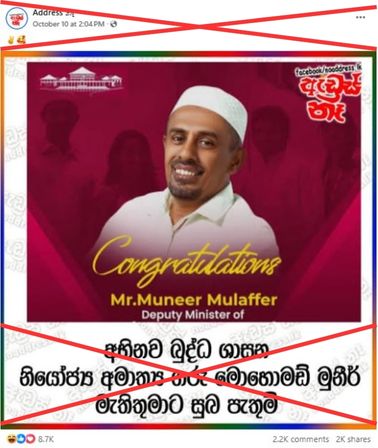
Misinformation spread rapidly across social media platforms in October 2025 after President Anura Kumara Dissanayake announced a cabinet reshuffle. A widely shared Facebook post congratulated Muneer Mulaffer, a Muslim politician, on supposedly becoming the “deputy minister of Buddhist Affairs,” generating over 2,000 shares and numerous inflammatory comments.
The manipulated post included an altered image of Mulaffer wearing a kufi cap with “congratulations” superimposed on it. The original image was taken from Mulaffer’s official Facebook account, posted in November 2024 when he was appointed deputy minister for national integration.
“Mr. Muneer Mulaffer has been appointed as the Deputy Minister of Religious and Cultural Affairs, while the area of Buddhist Affairs does not fall under his responsibilities,” clarified Prasanna Perera, a spokesperson for the President’s Media Division. “The Subject of Buddhist Affairs is overseen by Mr. Gamagedara Dissanayake, who serves as the Deputy Minister of Buddhasasana, Religious and Cultural Affairs.”
The Ministry of Buddhasasana, Religious and Cultural Affairs was primarily established to promote and protect Buddhist teachings but has since expanded to oversee broader religious and cultural matters. According to human rights researcher D.M. Dissanayake, Mulaffer’s actual appointment reflects the government’s efforts to ensure representation for the Muslim community.
“As a multi-religious and culturally diverse country, communities with other religious beliefs and cultures felt they were left behind because they had no assigned person to address their issues,” Dissanayake explained. “The government has appointed a new deputy minister to attend to matters related to Muslims, and he will mainly look after that section.”
The false claims drew Islamophobic comments from social media users who appeared to believe the misinformation. “Honestly, how can this be? In this Sinhala-Buddhist country, don’t they have enough brains?” wrote one commenter. Another claimed Mulaffer would “make the almsgiving to the temples Halal and ban women from coming to the temples.”
This incident underscores the fragile state of interfaith relations in Sri Lanka, which has a long history of ethnic and religious tensions. The nation experienced severe ethnic violence during the 1983 “Black July” massacre, which triggered a civil war resulting in approximately 100,000 deaths.
More recently, clashes between the Buddhist majority and Muslim minority in 2018 led to a nationwide state of emergency. The 2019 Easter Sunday attacks further inflamed tensions, with Muslims increasingly becoming targets of online hate speech.
The fact-checking organization Fact Crescendo also debunked the claims about Mulaffer’s appointment, confirming they were false. This incident adds to a pattern of misinformation surrounding Sri Lankan politicians, with similar false claims having been debunked previously.
Sri Lanka’s population is predominantly Buddhist, with significant Hindu, Muslim, and Christian minorities. The spread of such false information threatens to undermine efforts at national reconciliation in a country still recovering from decades of conflict.
Government officials have not commented on whether they plan to address the spread of this misinformation or take measures to prevent similar incidents in the future. Attempts to reach Mulaffer and his spokesman for comment were unsuccessful.
Fact Checker
Verify the accuracy of this article using The Disinformation Commission analysis and real-time sources.

9 Comments
It’s disappointing to see a Muslim politician targeted by a disinformation campaign. Attempts to stoke religious animosity are concerning. I appreciate the government’s prompt response to set the record straight. Fact-based reporting is crucial to counter such manipulative tactics.
You make a good point. Fact-checking and transparency are essential to combat the spread of false narratives that can heighten tensions. Responsible journalism has an important role to play in these situations.
Manipulated images and posts that distort reality are a serious problem. I’m glad the government spokesperson clarified the accurate details about the minister’s responsibilities. Transparency and accountability are key to addressing such divisive misinformation campaigns.
Religious tensions and sectarian divisions are complex issues that require nuanced understanding and open dialogue, not the spread of false claims. I hope this incident prompts deeper discussions on fostering greater religious harmony and respect in Sri Lanka.
This disinformation campaign targeting a Muslim politician is deeply concerning. I hope this incident leads to constructive discussions on strengthening democratic institutions, media literacy, and inclusive governance in Sri Lanka. Fact-based reporting is essential to counter such manipulative tactics.
Disinformation campaigns that exploit religious and political divisions are a serious issue that deserves attention. I hope this incident prompts broader discussions on media literacy, digital ethics, and strengthening democratic institutions in Sri Lanka.
While I’m concerned about the divisive nature of this disinformation campaign, I’m encouraged to see the government provide a clear and factual response. Addressing the root causes of such tensions will require sustained efforts on multiple fronts.
This is an unfortunate example of how misinformation and disinformation can spread rapidly, especially on social media. It’s important to verify claims before sharing or engaging with them. Fact-checking is crucial to combat the spread of false narratives.
Manipulating images and spreading false claims is a troubling tactic to sow discord. I’m glad the authorities clarified the facts around this minister’s role and responsibilities. Building trust and understanding between communities is crucial to counter such divisive narratives.