


Listen to the article
Malaysian Lawmaker Falsely Accused of Supporting Halal Certification for Pork
Social media platforms across Malaysia have become battlegrounds for misinformation as ethnically Chinese lawmaker Teresa Kok faces fabricated claims that she advocated for halal certification of pork products – a statement that would be deeply controversial in the Muslim-majority nation where pork consumption is religiously forbidden.
The Democratic Action Party (DAP) representative, who serves in Malaysia’s ruling coalition, has firmly denied making any such statement and has filed an official police report addressing the false claims. Berita Harian, the Malay-language daily newspaper whose format was mimicked in the fabrication, has likewise issued a clear denial that it ever published such content.
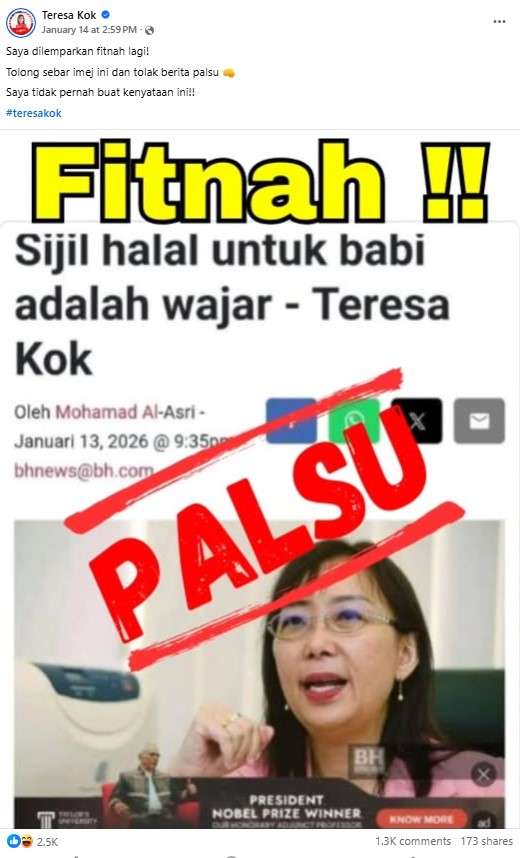
The fabricated report began circulating on Facebook on January 14, 2026, featuring an image of Kok alongside a sensationalized Malay-language headline declaring: “Halal certification for pork is necessary.” The post’s caption directly criticized Prime Minister Anwar Ibrahim and his Parti Keadilan Rakyat (PKR), stating: “Ahh, that’s it… What do the PKR gang say, Anwar Ibrahim… this is what you all wanted.”
The timing and nature of these false claims underscore Malaysia’s complex religious and political landscape, where more than half of the country’s 34 million citizens are Muslims who follow strict halal dietary requirements. Under Islamic law, halal meat must be slaughtered according to specific religious protocols, while pork and all pork-derived products are completely prohibited.
Berita Harian quickly addressed the circulation of the doctored headline in a January 15 article titled “Teresa lodges police report, Berita Harian explains manipulated headline.” The newspaper clarified that its original September 2024 article had been deceptively altered, providing screenshot comparisons showing the authentic headline had actually read “Investigation regarding halal certificate is inappropriate.”
The original reporting had covered Kok’s defense of her statements regarding a proposal to make halal certification mandatory, following police investigations triggered by multiple complaints against her. This context reveals how the fabricated headline exploited existing tensions around a legitimate policy debate.
Kok responded swiftly to the false claims on her official Facebook page, writing in Malay: “I’ve been slandered again! Please share this image and reject the fake news. I have never made this statement!!”
This isn’t the first time the outspoken lawmaker has faced targeted attacks over her remarks. She recently filed a defamation suit against Akmal Salleh, youth chief of the United Malays National Organisation (UMNO), a partner in the ruling coalition, after he called her an “embarrassment to the country.” Akmal’s criticism came after Kok suggested the government reconsider making halal certification mandatory for food establishments, specifically exempting those serving pork and alcohol. This case is scheduled for hearing next month.
The fabricated headlines spread quickly across multiple platforms, including TikTok, highlighting the challenge of containing digital misinformation in Malaysia’s polarized political environment. The incident also reflects broader tensions within the country’s diverse population and ruling coalition, where ethnic and religious sensitivities often intersect with political discourse.
This is not an isolated incident of misinformation in Malaysian social media. Similar tactics using doctored or entirely fabricated news reports have become increasingly common in the country’s digital landscape, prompting media literacy advocates to call for greater scrutiny of viral political content.
As Malaysia continues to navigate complex questions of religious policy and political representation, the spread of such fabrications threatens to inflame tensions and undermine legitimate public discourse around sensitive cultural issues.
Fact Checker
Verify the accuracy of this article using The Disinformation Commission analysis and real-time sources.

9 Comments
This is a concerning case of misinformation targeting a Malaysian lawmaker. Fabricating statements that would be highly controversial in the country’s Muslim-majority context is irresponsible and could sow division. I hope the authorities can swiftly address this issue and hold the perpetrators accountable.
It’s disheartening to see political discourse in Malaysia deteriorate into the realm of fabricated scandals. I hope this incident serves as a wake-up call to strengthen fact-checking mechanisms and promote more ethical use of social media platforms.
Well said. Spreading misinformation, especially around religious matters, is a concerning trend that can have serious consequences for social cohesion. Fact-based, nuanced reporting is essential to counter these divisive tactics.
The fabrication of such controversial statements is highly irresponsible and could inflame tensions in Malaysia’s diverse society. I hope the authorities can determine the source of these false claims and take appropriate action to prevent the further spread of disinformation.
Agreed. Spreading misinformation about sensitive issues like religion can have serious repercussions. It’s essential that the public has access to reliable, fact-based information to make informed decisions and maintain social harmony.
This case highlights the importance of verifying information, especially when it involves sensitive cultural or religious topics. I’m glad the lawmaker and newspaper acted swiftly to address the false claims. Maintaining transparency and trust in public institutions is crucial.
This is a clear example of the dangers of unchecked misinformation in the digital age. I commend the lawmaker and newspaper for their swift response in addressing these false claims. Strengthening media literacy and fact-checking initiatives should be a priority to combat such divisive tactics.
Spreading false claims about officials supporting religiously forbidden acts is a serious matter. I’m glad the lawmaker and newspaper have firmly denied these allegations. Fact-checking and combating disinformation are crucial for maintaining public trust and social harmony.
Absolutely. Misinformation can have real-world consequences, especially when it touches on sensitive religious or cultural issues. Responsible journalism and digital literacy are key to preventing the spread of such harmful falsehoods.