


Listen to the article
Trump Accuses Iran of Using AI to Fabricate Military Victories and Propaganda
President Donald Trump accused Iran on Sunday of deploying artificial intelligence technology to create misleading propaganda about military achievements and public support, escalating tensions between the administration and media outlets covering Middle Eastern affairs.
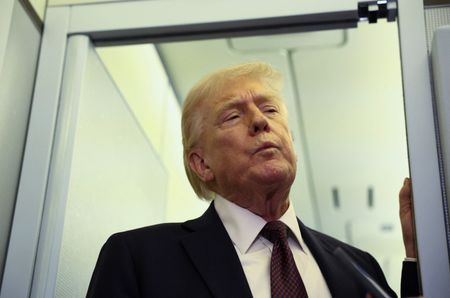
Speaking to reporters during a flight on Air Force One, Trump warned about the potential dangers of artificial intelligence technology. “AI can be very dangerous, we have to be very careful with it,” the president stated, emphasizing what he sees as a growing threat to information integrity.
The airborne remarks followed a series of posts on Trump’s Truth Social platform where he alleged, without providing specific evidence, that Western news organizations were collaborating with Iran to distribute AI-generated false information. These accusations come at a time of heightened tension in the region, with ongoing conflicts involving the United States, Israel, and Iran.
In his social media messages and press interactions, Trump outlined three specific instances where he claimed Iran had employed AI technology to deceive audiences. He alleged that Iran displayed non-existent “kamikaze boats” and created false imagery purporting to show a successful strike against the USS Abraham Lincoln aircraft carrier.
“Iran is using AI to create fake images,” Trump declared, suggesting that news outlets disseminating such reports should face serious consequences, even going so far as to mention treason charges for those involved in spreading what he characterized as dangerous misinformation.
Reuters has independently verified footage from Iraq’s Basra port showing Iranian vessels loaded with explosives apparently targeting two fuel tankers, an attack that resulted in at least one crew member fatality. While Iranian state media did report claims of attacks against the USS Abraham Lincoln, most Western news organizations did not carry these reports, casting doubt on the president’s assertion of widespread media complicity.
Trump further claimed that photographs showing “250,000” Iranian citizens rallying in support of new Supreme Leader Mojtaba Khamenei were “totally AI generated” and that such gatherings “never took place.” This statement contradicts documented evidence of pro-government rallies throughout Iran since the conflict began, though Reuters searches found no major Western news reports citing the specific 250,000 attendance figure mentioned by the president.
Various reputable news organizations have published photographs showing crowds gathering in Tehran following Khamenei’s appointment to leadership. The president did not specify which particular Iranian news reports or images prompted his allegations.
The accusations come amid growing friction between the Federal Communications Commission and television broadcasters. FCC Chairman Brendan Carr issued warnings on Saturday threatening to revoke broadcasting licenses for stations that failed to modify their reporting approach to the administration’s satisfaction, a move that has raised concerns about press freedom.
Trump has a documented history of challenging news organizations when their coverage appears unfavorable to his administration. He has previously demanded the removal of broadcast licenses from outlets he considers biased, raising concerns among media watchdogs about potential government overreach into journalistic independence.
The allegations about AI-generated propaganda highlight growing concerns about the technology’s potential to create convincing false narratives in geopolitical conflicts. As AI tools become more sophisticated and widely available, distinguishing between authentic and artificially created content presents an increasingly complex challenge for news organizations, governments, and the public.
The White House has not yet responded to requests for additional evidence supporting the president’s claims about Iranian use of AI technology.
Fact Checker
Verify the accuracy of this article using The Disinformation Commission analysis and real-time sources.

6 Comments
While the threat of AI-driven propaganda is real, these specific claims seem to lack concrete proof so far. Responsible journalism should focus on verifying the details before amplifying such politically-charged allegations.
Interesting allegations from President Trump. The use of AI for disinformation is certainly a growing concern, though evidence is still limited. It will be important to scrutinize these claims carefully and see if any substantive proof emerges.
The potential for AI to be misused for propaganda is quite concerning. Still, these allegations require solid evidence to be credible. I hope the media and authorities can get to the bottom of this and provide clarity on Iran’s activities, if any.
AI-generated propaganda is a worrying prospect, if true. However, Trump’s claims seem to lack specifics. I hope robust journalistic investigation can shed light on the facts here and determine the extent of Iran’s alleged AI misuse.
I agree, more transparency and facts are needed. Relying on unsubstantiated allegations from political figures is risky. Rigorous fact-checking will be crucial to understanding the truth of this situation.
Accusations of AI-enabled disinformation campaigns are serious. However, Trump’s history of making unverified claims gives me pause. I’ll be interested to see if independent verification can corroborate these allegations against Iran.