


Listen to the article
In a rapidly escalating military conflict, Israel and the United States launched joint operations against Iranian targets on Saturday, February 28, striking military infrastructure across the country. Within hours, competing narratives emerged about one strike in particular – an attack on a facility in Minab, southern Iran, that has become the center of international controversy.
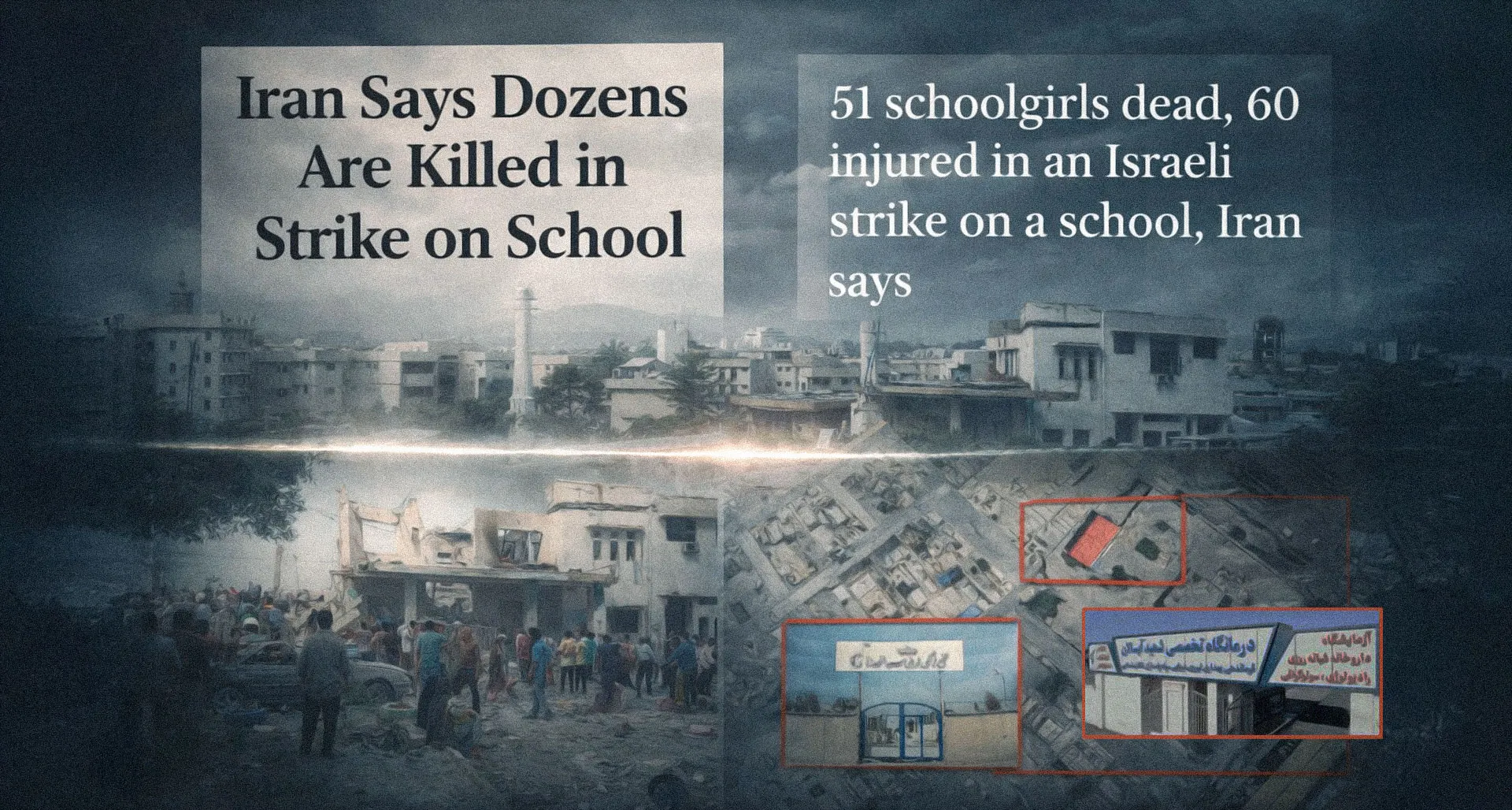
Iran’s state broadcaster IRIB quickly claimed that U.S. forces had deliberately targeted the Shajareh Tayyebeh school, allegedly killing dozens of young girls. The story spread rapidly through international media, with outlets like Al Jazeera amplifying the narrative that Western forces had struck a civilian educational facility.
However, crucial context was missing from these initial reports. Independent analysts and anti-regime sources have since confirmed that the school was not a standalone facility but part of a larger Islamic Revolutionary Guard Corps (IRGC) compound. Geolocation evidence places the school directly adjacent to the Sayyid al-Shohada barracks of the IRGC Navy’s Asef Brigade, a fact omitted from initial reporting.
“The school appears integrated with several buildings belonging to the IRGC, including military facilities and a medical clinic,” noted researcher Emily Schrader, who shared satellite imagery of the compound on social media.
This pattern of military-civilian dual-use facilities has been documented throughout Iran in recent months. As domestic protests erupted in early 2026, observers reported seeing regime forces moving weapons and military equipment into protected locations like schools and hospitals – a tactic similar to that employed by Iranian proxies Hamas and Hezbollah.
Casualty figures remain disputed and unverified. The Telegraph cited Iranian sources claiming 165 total casualties, including 81 pupils. This discrepancy – with 84 unidentified casualties – has raised questions about who else might have been present in the compound during the strike.
“Which raises an obvious question: who were the 84 adults supposedly killed there?” researcher Mark Zlochin pointed out, highlighting the lack of transparency around the identities of the non-student casualties.
The information environment surrounding the incident has been further complicated by the spread of disinformation from multiple directions. The Iranian Embassy in Austria shared what appears to be an AI-generated image of a schoolgirl’s backpack, which analysts identified as containing a Google Gemini watermark. Meanwhile, opposing narratives suggesting that an errant Iranian missile was responsible for the damage have also been debunked by independent researchers.
What is clear is that Western media outlets initially reported the Iranian regime’s claims with minimal skepticism, despite having previously acknowledged the difficulty of verifying information from the same regime that has been violently suppressing domestic protests.
“‘Iran says,’ and the media repeats. Without verification,” noted media watchdog HonestReporting. “An evil regime that only weeks ago was killing its own people and covering it up is now trusted not to create false narratives against Israel?”
The incident highlights the challenges of wartime reporting in the digital age, where claims can circle the globe before verification is possible. The pattern echoes coverage challenges seen during the Israel-Hamas conflict, where initial accusations often received widespread attention while subsequent corrections or contextual information struggled to gain similar traction.
Military analysts note that while civilian casualties in conflict are tragic regardless of circumstance, understanding the full context – including the apparent placement of civilian facilities within military compounds – is essential for accurately assessing responsibility and intent.
As Israel and Iran continue their military engagement, the battle over information and perception remains nearly as consequential as the physical conflict, with implications for international support and potential diplomatic interventions in the widening regional crisis.
Fact Checker
Verify the accuracy of this article using The Disinformation Commission analysis and real-time sources.

10 Comments
This story highlights the need for thorough, fact-based reporting, especially when it comes to claims of civilian casualties during military conflicts. Rushing to judgment can have serious consequences.
This incident highlights the challenge of separating truth from propaganda during military conflicts. Independent analysis seems key to understanding what really happened.
Yes, the geolocation evidence suggesting the school was part of an IRGC compound is an important detail that was initially overlooked. Careful reporting is crucial.
The geolocation evidence suggesting the school was part of an IRGC compound is a significant detail that changes the context. Careful reporting is key in these situations.
Yes, the initial reports seemed to overlook important context. Verifying facts before amplifying narratives is so important, especially on sensitive issues.
This incident underscores the importance of scrutinizing media narratives, especially around military conflicts. Independent analysis and verification of facts is crucial.
The rapid spread of the school attack narrative, before the full context was established, is concerning. We need to be vigilant about verifying claims, especially in sensitive situations.
Absolutely. Jumping to conclusions or amplifying unverified stories can have serious consequences. Thoughtful, nuanced reporting is essential.
Interesting to see the scrutiny around the claims of the school attack in Iran. It’s crucial to get the full context and verify the details before jumping to conclusions.
Absolutely, verifying facts and not amplifying unsubstantiated narratives is so important, especially in a volatile geopolitical situation.