


Listen to the article
Fact Check: Manipulated Video Falsely Claims India Shared Iranian Ship’s Location Before Attack
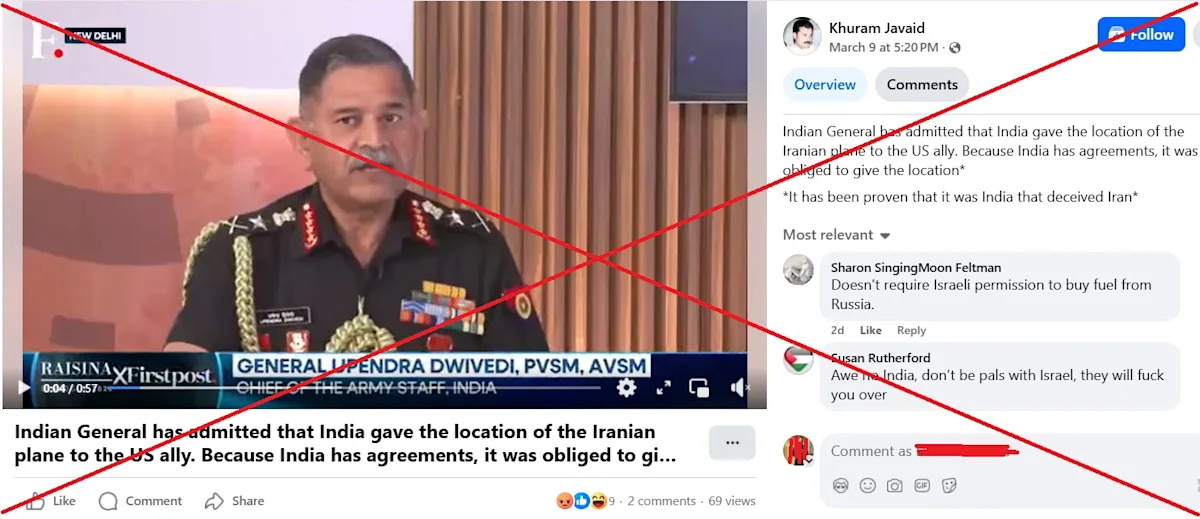
A deceptive video circulating on social media falsely suggests India’s Chief of Army Staff Upendra Dwivedi admitted to providing Israel with the location of an Iranian naval vessel before it was sunk by a US submarine. Analysis reveals the video was digitally altered using artificial intelligence.
The manipulated clip, which began spreading on Facebook and other platforms on March 13, 2026, shows General Dwivedi appearing to state that while the Iranian ship’s sinking was “unfortunate,” India had fulfilled its “duty to inform Israel about their exact location as a part of our newer strategic deal.”
The fabricated footage emerged after a significant escalation in the US-Israeli conflict with Iran. On March 4, 2026, the US submarine torpedoed the IRIS Dena, an Iranian frigate, in international waters off Sri Lanka’s southern coast. The attack killed at least 84 Iranian sailors, with 64 still missing and 32 survivors remaining in Sri Lanka for the time being.
A thorough investigation by journalists found the original video, titled “India’s Army Chief Speaks on Op Sindoor, Pakistan and Future of Warfare,” was published by Indian news outlet Firstpost on March 7, 2026. In the authentic interview, Dwivedi discusses “Operation Sindoor” – India’s four-day military conflict with Pakistan in May 2025 – and makes no mention of Iran, Israel, or any naval incidents.
Technical analysis of the manipulated video revealed telltale signs of AI manipulation. The general’s voice sounds unnaturally flat, and his lip movements don’t synchronize with the spoken words. When subjected to the Hiya voice-cloning detection tool, the analysis determined a 99 percent probability that the audio was artificially generated.
The incident highlights the regional complexities following the attack on the Iranian vessel. After the IRIS Dena was sunk, Sri Lanka permitted a second Iranian warship, the IRIS Bushehr, to enter its waters and is providing safe harbor for the ship and its crew of more than 200 sailors.
Meanwhile, India has allowed a third Iranian vessel, the IRIS Lavan, to dock in one of its ports after the ship reported engine problems. Both Sri Lanka and India have cited “humanitarian considerations” in their decisions to shelter the Iranian sailors amid concerns of further US attacks.
All three Iranian ships had participated in a multinational naval exercise hosted by India before hostilities erupted in the Middle East.
This fabricated video represents part of a broader pattern of misinformation surrounding the ongoing conflict involving Iran. Digital manipulation technologies, particularly AI-generated content, pose increasing challenges for accurate public information during international crises.
The deceptive nature of the video underscores the importance of verifying information sources, particularly when content appears to make extraordinary claims about sensitive geopolitical situations. In this case, what was presented as an official admission of involvement in military action was in fact completely manufactured using increasingly accessible AI technology.
Fact Checker
Verify the accuracy of this article using The Disinformation Commission analysis and real-time sources.

9 Comments
This is a stark reminder of the dangers of deepfake technology. It’s alarming to see how easily disinformation can be created and spread, even involving high-ranking officials. We must stay vigilant and fact-check claims, no matter how convincing they may seem.
I’m curious to know more about the investigation into this deepfake video. What steps are being taken to identify the source and hold the perpetrators accountable? Transparency and accountability are essential in these cases.
I’m curious to know if there are any international efforts or frameworks in place to address the challenge of deepfakes and hold perpetrators accountable. Coordinated global action may be necessary to combat this growing threat.
This incident highlights the need for robust digital forensics capabilities to detect and counter deepfakes. As these technologies become more advanced, our ability to discern fact from fiction must keep pace.
I’m glad to see this deepfake video was quickly identified and debunked. However, the damage it could have caused is concerning. We must remain vigilant and continuously improve our defenses against such malicious content.
This incident serves as a wake-up call for the need to invest in advanced AI-based detection tools and strengthen media verification processes. The proliferation of deepfakes poses a serious threat to our information ecosystem.
Manipulated videos like this are becoming increasingly sophisticated and worrying. We need to be very cautious about what we see online, especially when it comes to sensitive geopolitical issues. I’m glad this was fact-checked.
Wow, this is a concerning deepfake video targeting the Indian military. It’s crucial to verify the facts and not spread misinformation, even if it aligns with someone’s agenda. I hope the authorities investigate this thoroughly.
This is a stark reminder of the need for media literacy and critical thinking skills. As citizens, we must be able to identify manipulated content and verify claims, especially when they involve sensitive geopolitical issues.