


Listen to the article
India’s UN Representative Condemns Pakistan’s “False Account” of Operation Sindoor
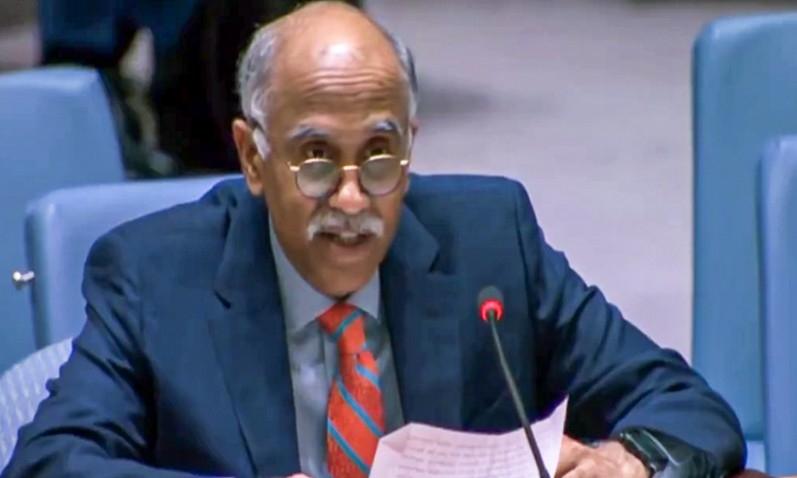
India’s Permanent Representative to the United Nations, Ambassador Harish Parvathaneni, has delivered a sharp rebuke to Pakistan over what he termed a “false and self-serving account” of Operation Sindoor during the UN Security Council Open Debate on Monday.
In his statement, Parvathaneni asserted that Pakistan maintains a “single-point agenda” aimed at harming India and its citizens. He emphasized that Pakistan has “no locus standi” to comment on India’s internal affairs, reaffirming that Jammu and Kashmir “has been, is, and will always be an integral and inalienable part of India.”
The ambassador’s remarks came in direct response to Pakistan’s characterization of Operation Sindoor, a military action India launched on May 7, 2025. According to Parvathaneni, the operation targeted nine terrorist camps located in Pakistan and Pakistan-occupied Jammu and Kashmir following a deadly terrorist attack in Pahalgam on April 22.
“Pakistan-backed terrorists killed 26 civilians in the Pahalgam attack,” Parvathaneni noted, adding that the UN Security Council itself had condemned the act. “This august body itself called for holding the perpetrators, organizers, financiers, and sponsors of this reprehensible act of terrorism accountable and brought to justice. That is exactly what we did.”
The Indian envoy described India’s military response as “measured, non-escalatory and responsible,” emphasizing that the operation was focused exclusively on dismantling terrorist infrastructure and neutralizing those involved in planning and executing attacks against Indian civilians.
Parvathaneni revealed that despite Pakistan’s initial threats of further attacks following Operation Sindoor, by May 9, Pakistani military officials had contacted India seeking a cessation of hostilities. “The destruction caused to multiple Pakistani airbases by the Indian operation, including images of destroyed runways and burnt-out hangars, is in the public domain,” he stated.
The ambassador specifically addressed Pakistan’s characterization of the situation as a “new normal” in bilateral relations, firmly rejecting this notion. “It is not normal to tolerate Pakistan’s continued use of terrorism as an instrument of state policy,” he declared, cautioning that the Security Council should not become a platform for legitimizing terrorism.
Reaffirming India’s position on protecting its national interests, Parvathaneni stated, “We will do whatever required to protect and ensure the safety and security of our citizens.”
The ambassador also addressed the status of the Indus Waters Treaty, a longstanding water-sharing agreement between the two nations. According to Parvathaneni, India had honored the agreement in good faith for 65 years but was ultimately forced to place it in abeyance due to “repeated violations linked to cross-border terrorism.”
The deterioration of the Indus Waters Treaty represents a significant escalation in already strained bilateral relations. The treaty, brokered by the World Bank in 1960, has survived multiple conflicts between the two nuclear-armed neighbors and has been considered one of the few successful examples of cooperation between India and Pakistan.
Tensions between the two South Asian nations have remained persistently high since the 2019 Pulwama attack and India’s subsequent revocation of Jammu and Kashmir’s special status. Operation Sindoor marks one of the most significant military engagements between the countries in recent years.
In concluding his remarks, Ambassador Parvathaneni emphasized the importance of strengthening international law and reforming multilateralism, which he described as essential for the United Nations to effectively uphold global peace and security amid such regional tensions.
The exchange at the UN Security Council highlights the ongoing diplomatic challenges in the region and underscores the complex interplay of terrorism, territorial disputes, and international relations that continue to define India-Pakistan relations.
Fact Checker
Verify the accuracy of this article using The Disinformation Commission analysis and real-time sources.

6 Comments
This is a complex geopolitical issue with a long history. I hope both sides can engage in constructive dialogue to find a peaceful resolution that addresses the legitimate security concerns of all parties involved.
Allegations of false claims and distorted narratives are all too common in this region. What’s needed is a clear-eyed, impartial assessment of the facts to understand the motivations and actions of all the key players.
India has every right to defend its sovereignty and citizens against terrorist threats. Pakistan’s allegations seem to be yet another attempt to deflect attention from its own role in harboring extremists.
While the loss of civilian life is always tragic, it’s clear that India’s military action was a targeted response to a specific terrorist attack. Pakistan should focus on addressing the root causes of extremism within its borders instead of making baseless accusations.
It’s concerning to see the UN Security Council being used as a platform for political posturing rather than substantive problem-solving. I hope the international community can encourage India and Pakistan to de-escalate tensions through diplomatic channels.
India’s rebuttal seems well-supported by the details provided. However, I would caution against assuming that any single version of events is the full and accurate picture. More transparency from all sides would help build trust.