


Listen to the article
False Claims of IDF Torture Spread Rapidly, Corrections Lag Behind
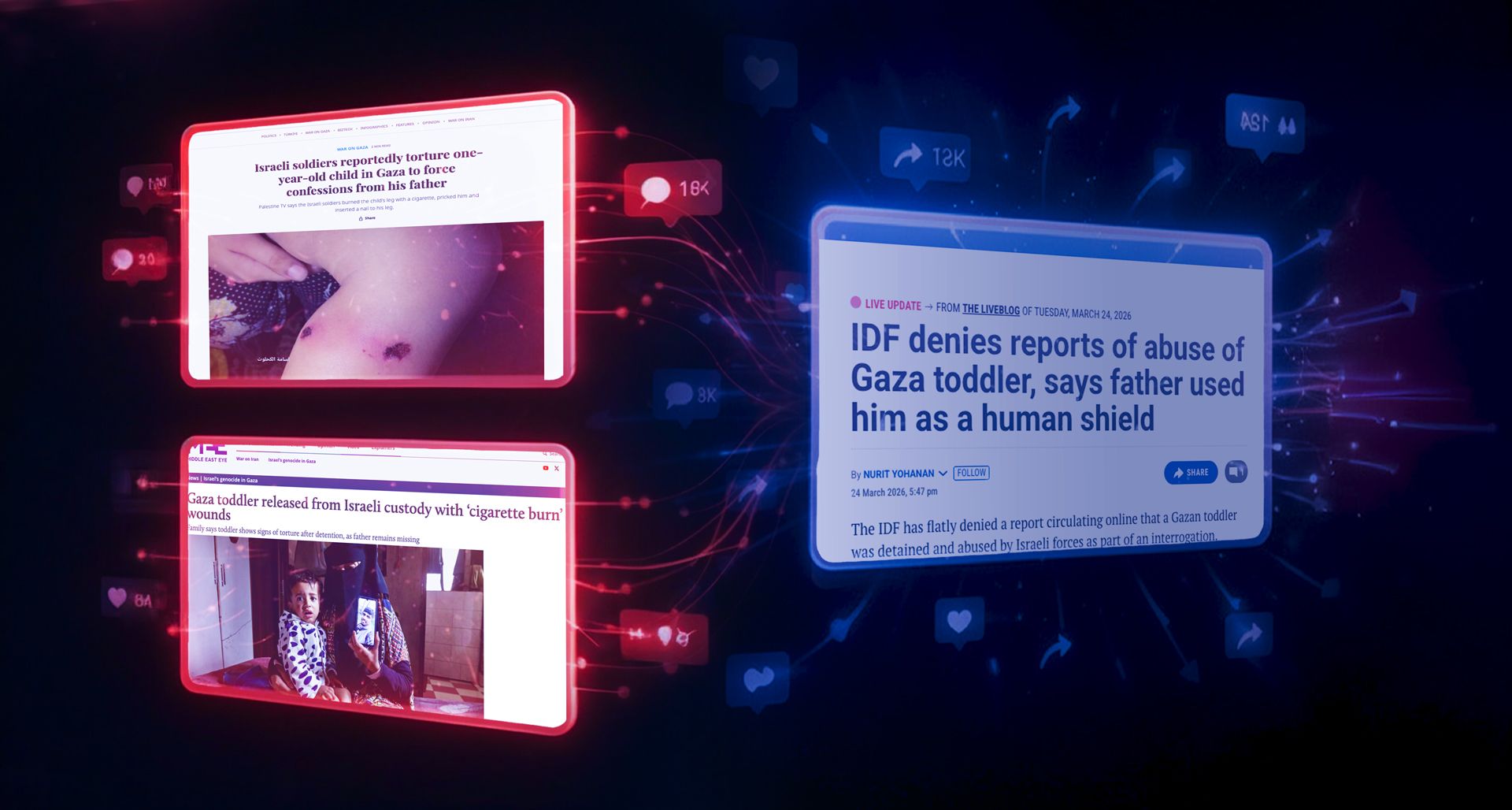
A disturbing allegation that Israeli soldiers tortured a one-year-old Gazan toddler circulated widely across regional media outlets and social platforms this week, generating significant outrage before being categorically denied by the Israel Defense Forces (IDF).
The claim initially appeared in reporting by TRT World, Turkey’s public broadcaster, which alleged Israeli soldiers had inflicted cigarette burns on a Palestinian toddler to pressure his father during interrogation. The story quickly gained traction across several pro-Palestinian media outlets, including Palestine TV, Middle East Eye, Palestine Chronicle, and Al Jazeera.
According to medical experts consulted when the images first appeared, the wounds shown in widely shared photographs did not match the described injuries. A medical professional noted that cigarette burns typically appear as regular-shaped circles, unlike the irregular wounds depicted in the photos. Additionally, the expert observed that if a nail had been used to puncture the skin as alleged, the resulting redness and swelling would have been significantly more severe.
The IDF issued a comprehensive rebuttal several days after the initial reports, providing a markedly different account of what transpired. According to Israeli military officials, the toddler’s father had approached troops near Gaza’s Yellow Line while holding the child. When he failed to stop after warnings, soldiers fired warning shots, and fragments from these shots caused the child’s injuries.
Military officials further stated that the father later identified himself as a Hamas operative who had participated in the October 7, 2023 attack on Israel. The IDF claimed he admitted to using his child as a human shield when approaching Israeli forces.
To support their version of events, the IDF released video footage showing the child being transferred to the Red Cross after receiving medical care from Israeli personnel—a detail that contradicts the allegations of deliberate abuse while in custody.
Despite the release of this contradictory evidence, the outlets that originally published the allegations largely failed to update their reporting or acknowledge the Israeli military’s denial. This pattern illustrates a troubling aspect of modern information flow: emotionally charged accusations spread rapidly, while corrections and alternative accounts struggle to reach the same audience.
The original story appears to have originated from Gazan independent photojournalist Osama Al Kahlout, who documented the child’s injuries and interviewed the mother, who attributed the wounds to Israeli forces. This material was then disseminated through various regional media channels and amplified by social media accounts sympathetic to the Palestinian cause.
Media analysts note that this case exemplifies several problems in conflict reporting. Photographs of injuries, while powerful, do not establish how those injuries occurred. Testimony collected in conflict zones, particularly in areas controlled by groups like Hamas, requires careful verification. Such verification processes were largely absent in the initial wave of coverage.
It’s worth noting that major Western mainstream news outlets largely avoided amplifying the unverified claims, suggesting that established editorial standards still function as intended in many newsrooms.
The episode demonstrates how quickly allegations can gain momentum when they align with existing narratives, especially when children are involved. It also highlights the persistent challenge facing corrections and clarifications, which rarely travel as far or as fast as the original claims, even when supported by official statements and evidence.
As the Israel-Hamas conflict continues, media consumers face the ongoing challenge of distinguishing between verified information and emotional appeals designed to provoke outrage. The responsibility ultimately falls not only on those debunking false claims but also on news consumers and publishers to demand proper verification before amplifying potentially inflammatory allegations.
Fact Checker
Verify the accuracy of this article using The Disinformation Commission analysis and real-time sources.

5 Comments
This highlights the need for rigorous fact-checking, even on emotive stories involving alleged human rights abuses. The medical evidence seems to contradict the initial reports, which raises concerns about the accuracy of the claims. Responsible journalism is crucial in sensitive geopolitical contexts.
It’s concerning to see these kinds of accusations spreading rapidly without proper verification. In a conflict zone, it’s crucial that media outlets and the public exercise due diligence before amplifying potentially inflammatory claims. Jumping to conclusions rarely leads to constructive outcomes.
You make a good point. The medical experts’ analysis casts significant doubt on the original claims. We should be wary of emotive stories that lack corroborating evidence, especially when they touch on such a charged political situation.
This is a troubling story, if true. However, the lack of verification and the discrepancies noted by medical experts raise serious doubts about the accuracy of these claims. We should be cautious about spreading unverified allegations, no matter how politically charged the situation may be.
Agreed. Rushing to judgment without clear evidence can do more harm than good, especially in such a sensitive geopolitical context. Responsible reporting and fact-checking are essential.