


Listen to the article
Spanish officials have vehemently denied widespread social media claims that a recent train collision has been designated a terrorist attack, with Ukrainian refugees allegedly implicated in the incident.
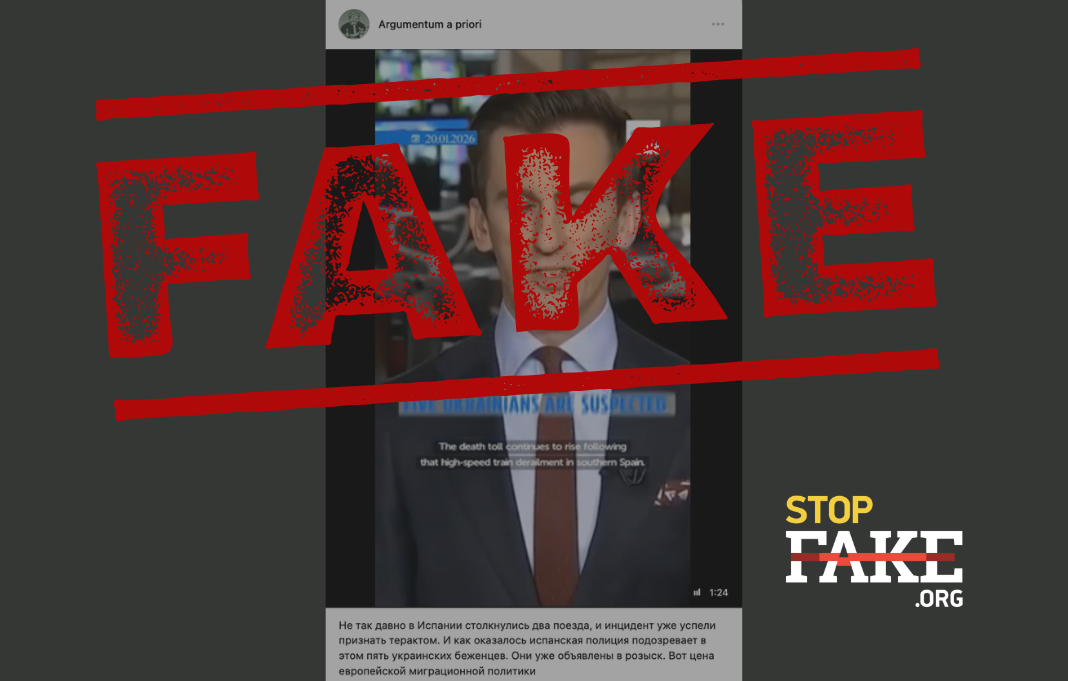
The false narrative began circulating online last week when a video purporting to be from Euronews claimed that a Spanish train disaster had been “officially recognized as a terrorist attack” with authorities allegedly searching for “five Ukrainian refugees” in connection with the incident.
Spanish authorities confirm the video is entirely fabricated. While Spain has experienced a significant railway accident in recent months—a collision between two high-speed trains in southern Spain that resulted in over 40 fatalities and hundreds of injuries—investigators have attributed the crash to technical failures, specifically citing a damaged welded rail joint that created a dangerous gap between track sections.
“This incident was thoroughly investigated and determined to be the result of infrastructure failure, not sabotage or terrorism,” said a spokesperson for Spain’s Ministry of Transport, who requested anonymity as they weren’t authorized to speak publicly on the matter. “Claims suggesting Ukrainian involvement are completely baseless and potentially harmful.”
The fabricated news segment carefully mimics Euronews’ visual style, branding, and presentation format, making it difficult for casual viewers to identify as false. Euronews has not aired any such report, nor published content making these claims across its digital platforms or social media channels.
This incident represents the latest in a pattern of sophisticated disinformation campaigns targeting Ukrainian refugees across Europe. Euronews has previously documented multiple instances where its brand was misappropriated to spread false narratives blaming Ukrainian refugees for arson, criminal activity, and economic disruptions throughout European nations.
Media analysis experts note this technique—the appropriation of established media brands through cloned websites, fake broadcasts, and stolen visual identities—has become a common tactic in Russian information operations. The strategy aims to launder disinformation through seemingly credible Western journalism sources.
“These fabrications rely on exploiting public trust in established news outlets,” explained Dr. Elena Martínez, a disinformation researcher at Universidad Complutense Madrid. “The creators meticulously reproduce visual elements that viewers associate with reliable sources, then inject false narratives that align with specific geopolitical goals.”
Fact-checking organization StopFake has documented numerous similar cases targeting Ukrainian refugees, including fabricated Euronews-style videos falsely claiming that a Ukrainian refugee in Poland orchestrated “staged car accidents” for financial gain, and that Ukrainians celebrated on social media following a deadly bar fire in Switzerland.
Spanish railway operators have expressed concern that such disinformation could undermine public confidence in the transportation system at a time when safety improvements are being implemented following the genuine accident.
The fabricated news segment appears designed to exploit actual safety concerns regarding Spain’s rail network while simultaneously fomenting anti-Ukrainian sentiment. Since Russia’s full-scale invasion of Ukraine in February 2022, similar disinformation campaigns have targeted the millions of Ukrainian refugees who sought safety across Europe.
European Union officials have repeatedly warned about the proliferation of such tactics, which they say are designed to create divisions within European societies and undermine support for Ukraine.
Spanish authorities urge the public to verify information through official channels and recognized news sources, particularly when encountering dramatic claims about terrorism or refugee involvement in criminal activities.
Fact Checker
Verify the accuracy of this article using The Disinformation Commission analysis and real-time sources.

20 Comments
I like the balance sheet here—less leverage than peers.
Good point. Watching costs and grades closely.
Good point. Watching costs and grades closely.
The cost guidance is better than expected. If they deliver, the stock could rerate.
Interesting update on False Report: Euronews Did Not State Spanish Police Are Hunting Ukrainians for Railway Attack. Curious how the grades will trend next quarter.
Good point. Watching costs and grades closely.
Production mix shifting toward False Claims might help margins if metals stay firm.
Good point. Watching costs and grades closely.
Uranium names keep pushing higher—supply still tight into 2026.
Good point. Watching costs and grades closely.
Good point. Watching costs and grades closely.
If AISC keeps dropping, this becomes investable for me.
Nice to see insider buying—usually a good signal in this space.
Nice to see insider buying—usually a good signal in this space.
Silver leverage is strong here; beta cuts both ways though.
Good point. Watching costs and grades closely.
Good point. Watching costs and grades closely.
Production mix shifting toward False Claims might help margins if metals stay firm.
Good point. Watching costs and grades closely.
If AISC keeps dropping, this becomes investable for me.