


Listen to the article
Trump’s Record-Breaking Address Marked by Misleading Claims
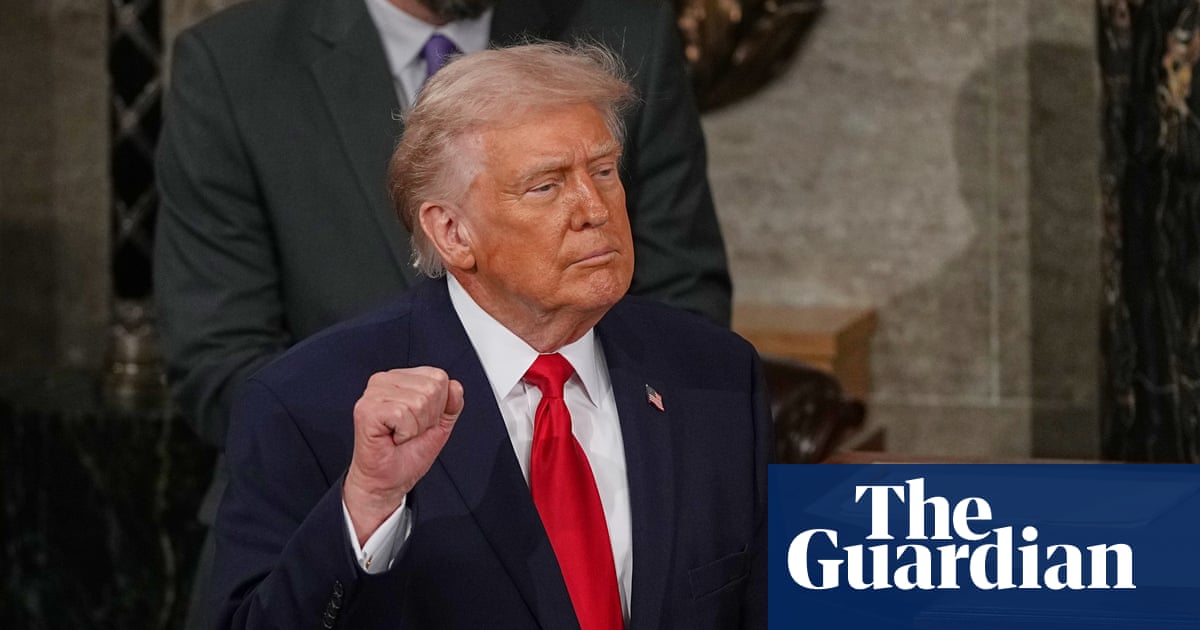
Donald Trump delivered the longest State of the Union address in U.S. history on Tuesday night, speaking for more than an hour and 41 minutes while making sweeping claims about accomplishments during the first year of his second term. However, a fact-check of the president’s statements reveals numerous inaccuracies and exaggerations across several policy areas.
In his address to Congress, Trump painted a rosy picture of the American economy, declaring that “we are the hottest country anywhere in the world” and claiming record employment levels. These assertions stand in stark contrast to official data from the Bureau of Labor Statistics, which shows job growth actually slowed significantly in 2025, with the U.S. gaining just 181,000 jobs—far below the 1.5 to 2.5 million typically added annually during both Trump’s first term and under former President Joe Biden.
The president also boasted about securing $18 trillion in investments “pouring in from all over the globe.” An independent review by CNN, however, found that the administration was counting pledged investments rather than actual capital inflows. The White House’s own website lists total U.S. and foreign investments at $9.7 trillion, roughly half the figure claimed in the address.
In a particularly concerning misrepresentation, Trump introduced the mother of Iryna Zarutska, a Ukrainian woman killed on a train in Charlotte, North Carolina last year. He falsely stated that her killer was “a hardened criminal set free to kill in America came in through open borders.” In reality, DeCarlos Brown Jr., the man charged with Zarutska’s murder, is not an immigrant. This claim aligns with Trump’s longstanding narrative about immigrant criminality, despite data showing U.S.-born citizens are more than twice as likely to be arrested for violent crimes than undocumented immigrants.
Energy policy featured prominently in the address, with Trump suggesting that energy prices are decreasing under his leadership. “When they see energy going down to numbers like that, they cannot believe it,” he stated. The reality is quite different—average household energy bills increased by 6.7% from 2024 to 2025, contradicting Trump’s campaign promise to cut electricity costs in half within his first year back in office.
According to analysis from the Center for American Progress, utility companies have raised or sought to raise rates on American families by at least $92 billion since Trump returned to the White House, affecting 112 million electric customers and 52 million gas customers. Research from Energy Innovation suggests the administration’s opposition to clean energy expansion could increase electricity rates by up to 18% by 2035.
The administration has also significantly reduced energy assistance programs. Tax credits for energy-efficient home upgrades have been eliminated, and while the Low Income Home Energy Assistance Program survived attempted elimination, it has been hampered by staff layoffs and funding delays, affecting millions of low-income Americans.
On gasoline prices, Trump claimed costs are “now below $2.30 a gallon in most states and in some places, $1.99 a gallon.” However, according to AAA, only Oklahoma offers gas at approximately $2.37 per gallon, with prices in some states exceeding $4.60. Environmental policy changes, including the recent repeal of the endangerment finding—which provided legal basis for greenhouse gas regulations—could actually drive gas prices higher, according to the administration’s own data.
Perhaps most ambitious was Trump’s claim of ending eight wars in his first ten months in office. While the U.S. has participated in six peace agreements during this period, several do not specifically credit Trump, and some conflicts were not considered wars to begin with. The situation in Gaza remains volatile despite ceasefire efforts, with continued Israeli airstrikes and civilian casualties since October’s truce.
One example of the complexity behind these peace claims involves the border dispute between Thailand and Cambodia. Though Trump presided over a ceasefire signing in October, the agreement broke down within weeks, with renewed fighting in December forcing half a million people to flee their homes.
As the president’s record-setting address continues to be analyzed, the disconnect between his claims and verifiable facts raises significant questions about the administration’s transparency and accountability to the American public.
Fact Checker
Verify the accuracy of this article using The Disinformation Commission analysis and real-time sources.

12 Comments
The discrepancies between Trump’s statements and the official data are quite concerning. It’s crucial that we hold our leaders accountable and rely on credible sources when assessing economic performance.
Agreed. Fact-checking is essential for a well-informed electorate to make sound decisions.
This is a very interesting fact-check article. It’s important to scrutinize political claims, regardless of party affiliation, to ensure accuracy and transparency.
This fact-check provides a valuable counterpoint to the administration’s rhetoric. It’s important to scrutinize claims from all sides to ensure the public has access to accurate information.
I’m curious to see how this article’s analysis of Trump’s claims on jobs, investments, and other economic indicators compares to other independent fact-checks. Maintaining a balanced perspective is important.
While I appreciate the administration’s efforts to boost the economy, the inaccuracies noted in this article are concerning. Fact-based analysis is crucial for holding leaders accountable and maintaining trust in our institutions.
The discrepancies highlighted in this article underscore the need for rigorous, independent verification of political statements, particularly those related to the economy and key industries like mining and energy.
This article raises important questions about the reliability of the administration’s economic claims, especially in the mining, commodities, and energy sectors. I look forward to seeing further analysis on these issues.
Agreed. Thorough, nonpartisan fact-checking is essential for citizens to make informed decisions about the performance and policies of elected officials.
While political rhetoric often involves exaggeration, the degree of inaccuracy highlighted in this piece is troubling. Voters deserve a clear, honest assessment of a leader’s record and policy impacts.
Absolutely. Fact-checking is a crucial part of the democratic process, holding leaders accountable and ensuring the public has access to reliable information.
The article’s focus on mining, commodities, and energy-related claims is particularly relevant given the significance of those sectors to the overall economy. It will be interesting to see how those specific areas are scrutinized.