


Listen to the article
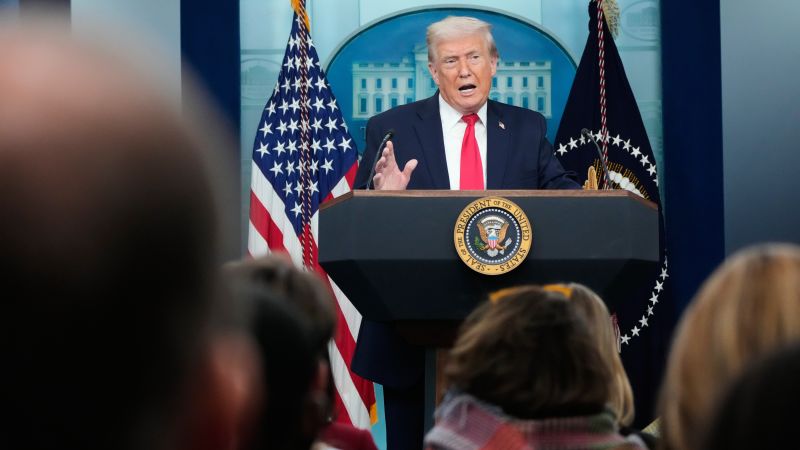
President Trump marked the first anniversary of his return to office with a wide-ranging press conference at the White House, where his celebratory remarks were undermined by numerous inaccurate claims about economic figures, foreign policy achievements, and other matters of national importance.
During his address to reporters, the President sought to highlight what he characterized as significant progress under his leadership but repeatedly cited statistics and accomplishments that fact-checkers have disputed.
On economic matters, Trump claimed the national average gas price was $2.31 per gallon, when AAA data shows it actually stands at $2.82. He further asserted that gas prices had fallen to $1.99 in some areas of the country, though GasBuddy analysts report fewer than 100 stations nationwide are selling gas below $2 per gallon.
The President’s claims about prescription drug pricing contained mathematical impossibilities. His assertion that he secured price reductions of “300, 400, 500, and even 600%” contradicts basic math principles, as a 100% reduction would mean free medication, and anything beyond would mean consumers would be paid to take medications.
On inflation, Trump alternated between claiming “we have no inflation” and acknowledging “very little inflation,” despite Consumer Price Index data showing prices were 2.7% higher in December than a year earlier. He incorrectly characterized the inflation he inherited as “the highest in history,” when it had actually fallen to 3.0% by the time he took office in January 2025, down significantly from its 9.1% peak in June 2022.
The President’s investment claims were similarly exaggerated. He stated $18 trillion is being invested in the US due to his election, though the White House’s own website lists the figure at $9.6 trillion – itself considered a major overstatement by analysts who reviewed the underlying data.
In foreign affairs, Trump claimed to have “ended eight unendable wars,” a number experts consider inflated. Several conflicts on his list were either diplomatic disputes rather than actual wars, or conflicts that have continued despite temporary agreements. He incorrectly suggested no previous president had settled even one war, overlooking numerous historic peace agreements brokered by his predecessors.
The President also made a puzzling claim about renaming the Gulf of Mexico to the Gulf of America, justifying it by stating the US controls “92% of the shoreline” – a figure oceanography experts describe as plainly incorrect, as the US portion comprises less than half of the total Gulf coastline.
On NATO, Trump claimed member nations “pay the 5%” of GDP for defense, when in fact only three members currently meet even the 3.5% core defense spending target, with the rest given until 2035 to reach that threshold.
Throughout his remarks, the President repeated his unsupported claim that the 2020 election was “rigged,” asserted without evidence that foreign countries emptied their prisons to send migrants to the US, and incorrectly suggested NPR and PBS have closed operations after his funding cuts.
As the President enters the second year of his term, these factual discrepancies highlight the continuing challenge of separating rhetoric from reality in his public communications.
Fact Checker
Verify the accuracy of this article using The Disinformation Commission analysis and real-time sources.

7 Comments
This report illustrates the value of diligent fact-checking, especially when it comes to high-profile political figures. It’s important to hold all leaders accountable to the facts, even if the information may be politically inconvenient.
Interesting to see the discrepancies between the President’s claims and the actual data. It’s important to rely on authoritative sources when assessing economic and policy matters. Fact-checking helps provide a clear picture of the situation.
This highlights the importance of critical analysis and fact-checking, rather than simply accepting official narratives at face value. It’s a good reminder to always seek out objective data and multiple credible sources when evaluating claims made by politicians.
The President’s statements on gas prices and prescription drug costs seem to be exaggerated or inaccurate. It’s good that journalists are closely scrutinizing the administration’s claims and providing context from reliable data sources.
Agreed. Transparency and accountability are crucial, especially when it comes to high-level government officials making public statements. Fact-checking helps hold leaders accountable to the facts.
While it’s understandable for the President to want to highlight progress, it’s concerning to see so many factual inaccuracies in the claims made. Rigorous fact-checking is essential to ensure the public has an accurate understanding of the administration’s record.
Exactly. Maintaining an informed and engaged citizenry requires journalists to thoroughly vet the claims made by government officials, regardless of political affiliation. This helps foster a healthy democracy.