


Listen to the article
Fact-Checking Trump’s World Economic Forum Speech: NATO Claims and More
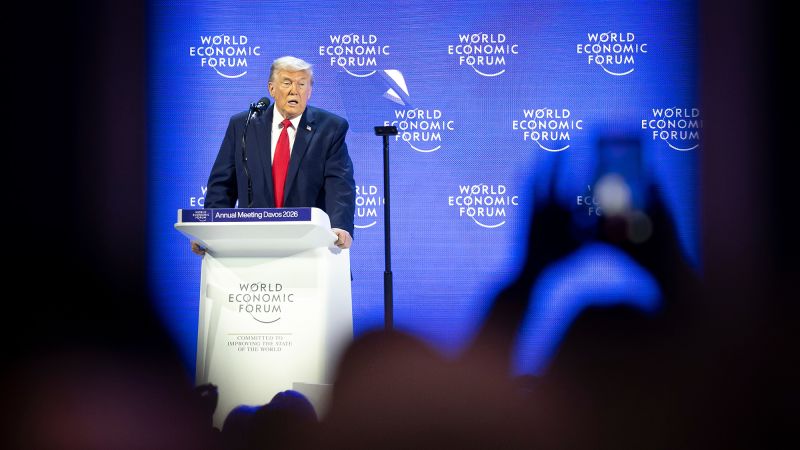
President Donald Trump made numerous inaccurate claims during his Wednesday address at the World Economic Forum in Switzerland, particularly regarding NATO and his interest in acquiring Greenland, the self-governing Danish territory.
Trump’s assertions about NATO contained several factual errors that have been repeatedly debunked over the years. When discussing the alliance, the president claimed, “What we have gotten out of NATO is nothing, except to protect Europe from the Soviet Union and now Russia. We’ve helped them for so many years. We’ve never gotten anything.”
This statement ignores a fundamental historical fact: NATO’s only invocation of Article 5, its collective defense provision, came in direct response to the September 11, 2001, terrorist attacks against the United States. Following that invocation, NATO member nations formed a coalition to support American forces in Afghanistan, with many sustaining significant casualties during years of conflict. Denmark, for example, suffered more than 40 military deaths—one of the highest per-capita loss rates among alliance members.
The president’s claims about NATO’s financial structure also contained significant inaccuracies. Trump stated that “until I came along,” the United States “was paying for virtually 100% of NATO,” and that his personal opinion was that America paid for “100% of NATO.”
Official NATO figures contradict this assertion. In 2024, U.S. defense spending constitutes approximately 63% of total NATO defense spending—a substantial portion, but significantly lower than Trump’s “100%” claim. Before Trump’s first term, in 2016, that figure stood at about 72%.
The president’s representation of NATO’s organizational budget is even more misleading. Under the established funding formula, the United States currently contributes about 16% of NATO’s direct organizational budget. When Trump first took office in 2017, that contribution was roughly 22%—nowhere near the totality he suggested.
Trump also mischaracterized NATO members’ defense spending, claiming that “most of the countries weren’t paying anything” before his presidency. In reality, every NATO member has consistently maintained defense spending—NATO figures show non-U.S. members spent $292 billion collectively in 2016, rising to an estimated $482 billion in 2024.
While many nations were indeed slow to reach NATO’s target of spending 2% of GDP on defense, significant progress has been made. In 2024, 18 of the 31 members subject to the target are meeting or exceeding it. By comparison, only four members met the threshold in 2016, increasing to eight by 2020, the final year of Trump’s first term.
The president also reiterated his misleading claim that NATO countries “weren’t paying their bills” before his presidency. This misrepresents NATO’s funding structure. The 2% spending target refers to each country’s domestic defense spending as a percentage of their GDP—not payments owed to the United States or NATO itself. No actual “bills” exist in the sense Trump suggests.
It’s worth noting that NATO recently updated its spending expectations. In 2025, the target was raised to a total of 5% of GDP—3.5% on core defense spending (previously covered by the 2% target) plus 1.5% on broader security-related expenditures.
Trump’s speech contained additional inaccurate statements on foreign affairs, economic policy, and other topics that have been repeatedly fact-checked and debunked over the years.
The president’s comments at the World Economic Forum reflect a pattern of mischaracterizing international alliances and agreements, particularly regarding NATO—an organization that has served as a cornerstone of Western security architecture for decades and came to America’s aid in its time of need following the September 11 attacks.
Fact Checker
Verify the accuracy of this article using The Disinformation Commission analysis and real-time sources.

13 Comments
The article raises valid points about the inaccuracies in President Trump’s speech at Davos. It’s important to separate fact from fiction, particularly on issues related to NATO and international relations.
The claims made by President Trump about NATO’s contributions seem to be inaccurate, as the article points out. It’s important for the public to have access to reliable information, especially on issues related to international relations and security.
Exactly. Fact-checking is essential for maintaining the integrity of public discourse and ensuring that leaders are held to high standards of truthfulness.
This fact-check highlights the need for greater scrutiny of public statements, especially from senior government officials. Maintaining the integrity of information is crucial for informed public discourse.
Absolutely. Fact-checking is an essential part of holding leaders accountable and ensuring the public has access to accurate, reliable information.
This fact-check highlights the importance of holding political leaders accountable for the accuracy of their statements. Spreading misinformation, even unintentionally, can have serious consequences for public discourse and decision-making.
While I understand the president’s interest in Greenland, making false claims about NATO’s role and contributions is concerning. Leaders should be held accountable for the accuracy of their statements, especially on the world stage.
Agreed. Fact-checking is crucial, especially for high-profile political figures. Spreading misinformation, even inadvertently, can have serious consequences.
The article raises some important points about the need to fact-check high-profile statements, even from the president. Maintaining the integrity of information should be a priority, especially on matters of international importance.
I agree. Fact-checking is crucial for ensuring the public has access to accurate information and can make informed decisions about the issues that affect them.
While I appreciate the president’s interest in Greenland, the inaccurate claims about NATO’s contributions are concerning. It’s important for leaders to be held to high standards of truthfulness, especially on the world stage.
The claims about NATO made by President Trump seem to be inaccurate. NATO members have provided significant support to the U.S. following 9/11, contrary to Trump’s assertions. It’s important to fact-check statements, especially on important geopolitical matters.
You’re right, the historical record clearly shows NATO’s support for the U.S. after 9/11. Dismissing that contribution is misleading.