


Listen to the article
President Trump’s claim that Iran possesses Tomahawk cruise missiles was swiftly contradicted by weapons experts on Monday, as he attempted to deflect responsibility for a deadly strike on an elementary school in Iran.
“Iran definitely does not, repeat does not, have Tomahawks,” stated Jeffrey Lewis, a distinguished scholar of global security at Middlebury College, responding to Trump’s assertion during a press conference. Retired U.S. Army Gen. Barry McCaffrey described the claim as “astonishing bald faced lying.”
Tomahawk missiles, manufactured by American defense contractor Raytheon, are subject to strict export controls and have only been sold to a limited number of close U.S. allies including the United Kingdom, Australia, Japan, and the Netherlands. No Middle Eastern nations, including Israel, have been authorized to purchase these sophisticated weapons.
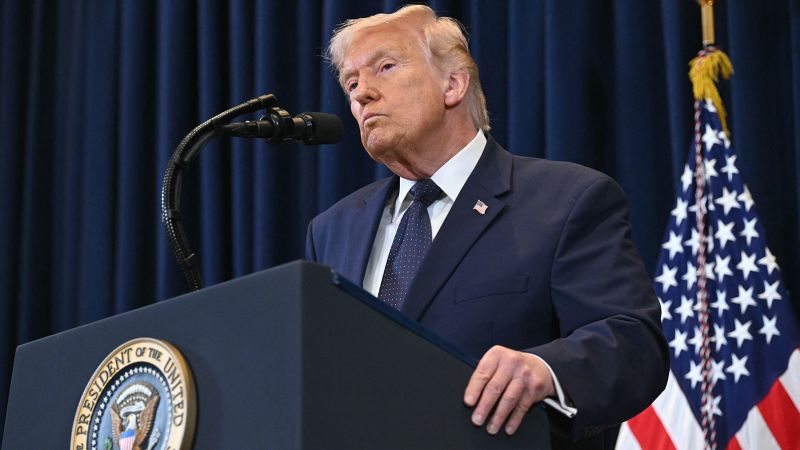
The controversial comments came after a reporter asked whether the United States would accept responsibility for footage showing what appeared to be a Tomahawk missile striking an Iranian school. Trump responded that “the Tomahawk, which is one of the most powerful weapons around, is used by, you know – is sold and used by – other countries,” adding that “whether it’s Iran, who also has some Tomahawks – they wish they had more.”
Weapons experts immediately rejected this characterization. While Iran does possess some domestically developed cruise missiles, such as the Soumar and Hoveyzeh models, they are distinctly different from American Tomahawks. Video analysis of the strike on the Islamic Revolutionary Guard Corps naval base adjacent to the school clearly shows a Tomahawk missile, not an Iranian design.
N.R. Jenzen-Jones, director of Armament Research Services, noted that even if Iran had somehow illicitly acquired Tomahawk missiles, they would lack the technical equipment and capabilities required to program flight paths and upload data to the missile’s onboard computer. Iran would also need specialized launchers capable of firing Tomahawks without damaging them.
The incident highlights growing tensions as Trump’s administration navigates the complex aftermath of strikes that have caused civilian casualties. On Saturday, Trump claimed the school strike “was done by Iran,” but Defense Secretary Pete Hegseth, standing beside him, refused to confirm this assertion, stating the matter was under investigation.
When pressed about why he was the only person in his administration publicly speculating about Iran’s potential involvement, Trump responded inconsistently, saying, “Because I just don’t know enough about it,” before adding, “whatever the report shows, I’m willing to live with that report.”
Trump also made misleading statements about the economic impact of disruptions in the Strait of Hormuz, a critical chokepoint for oil transportation from the Persian Gulf. He claimed that instability in the region “doesn’t really affect us. We have so much oil,” despite clear evidence that American consumers are feeling the effects of rising global oil prices directly at gas pumps nationwide.
Pavel Molchanov, an energy analyst at investment firm Raymond James, contradicted this assertion, explaining, “While it is true that the US imports only modest quantities of oil from the Persian Gulf region, the broader picture is that U.S. fuel prices are inextricably tied to the global oil market. When oil prices go up, they go up for everyone – American drivers are not immune from that.”
While Asian markets receive approximately 84% of crude oil and 83% of liquefied natural gas that passes through the strait, according to the U.S. Energy Information Administration, the American economy remains deeply interconnected with Asian economies, meaning disruptions there inevitably impact U.S. businesses, workers, and consumers.
Throughout the press conference, Trump made several contradictory statements about the conflict, initially claiming U.S. forces had “wiped every single force in Iran out, very completely,” before immediately stating that “most” of Iran’s naval power had been sunk, citing “over 90% decline in the Iranian missile launchers” and an “83% drop in drone launchers.”
Despite Trump’s assertion that “everything they have is gone, including their leadership,” Iran’s governing regime continues to function under newly appointed supreme leader Mojtaba Khamenei, who succeeded his father Ali Khamenei after the latter’s death at the beginning of the conflict.
Fact Checker
Verify the accuracy of this article using The Disinformation Commission analysis and real-time sources.
