


Listen to the article
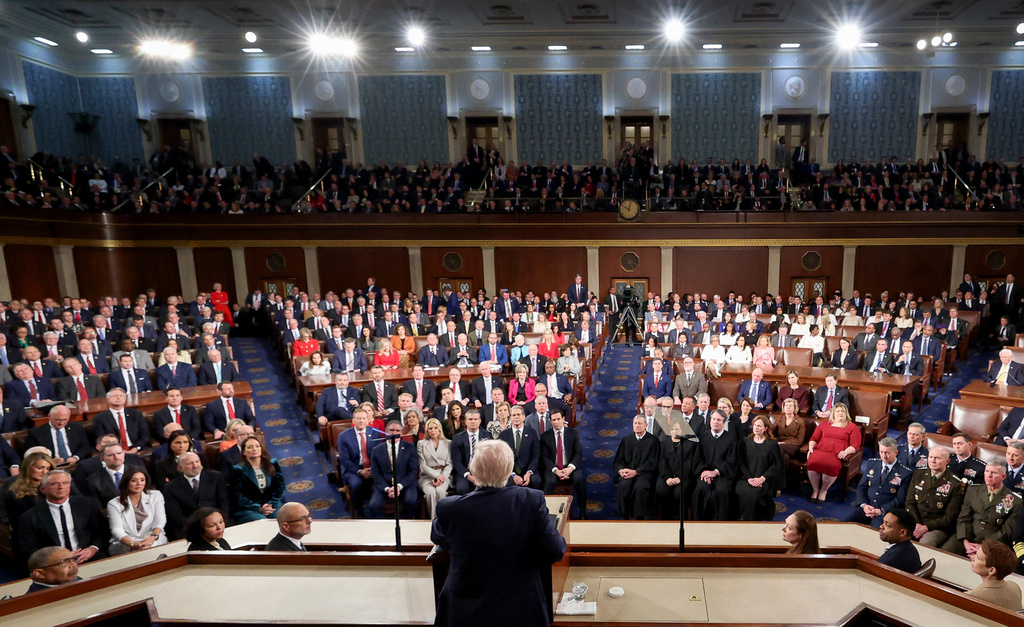
In a speech billed as a triumph of his administration, President Donald Trump presented a distorted view of America’s current state during Tuesday’s State of the Union address, making numerous claims that don’t withstand factual scrutiny.
Trump portrayed his tenure as a “turnaround for the ages,” characterizing the economy he inherited as “stagnant” despite evidence to the contrary. Economic data shows the U.S. economy grew at 2.8% in 2024 under President Biden—surpassing the 2.2% growth achieved in the first year of Trump’s second term.
The president’s assertion that “incomes are rising fast” similarly contradicts economic indicators. After-tax incomes, adjusted for inflation, rose just 0.9% in 2025, a significant decrease from the 2.2% growth recorded during Biden’s final year in office. This represents the smallest annual gain since 2022, reflecting a slowdown in hiring that has limited wage growth.
Trump’s claim of securing “$18 trillion pouring in from all over the globe” appears greatly exaggerated. The White House’s own website cites a lower figure of $9.6 trillion, which seemingly includes investment commitments made during the previous administration. A January study cast doubt on whether even the $5 trillion in commitments made last year by America’s trading partners would materialize.
While Trump correctly noted record employment numbers, this statement lacks important context. The total number of employed Americans naturally rises with population growth, while the more relevant employment-to-population ratio has actually fallen significantly over the past quarter-century. At 59.8% in January, this figure remains well below its April 2000 peak of 64.7%.
The president’s declaration that he “ended eight wars” in his first ten months demonstrates considerable creative accounting. Several conflicts he claimed to have resolved weren’t active wars, including tensions between Serbia and Kosovo, and Egypt and Ethiopia. In other cited conflicts, his influence varied significantly.
Trump’s portrayal of tariff revenues as “saving our country” overstates their fiscal impact. Before the Supreme Court struck down Trump’s emergency tariffs, the Congressional Budget Office estimated they would raise $300 billion annually—insufficient to offset his $4.7 trillion tax cuts or meaningfully reduce the $1.78 trillion annual budget deficit. Despite increasing to $195 billion this fiscal year, tariff revenues account for less than 4% of federal revenue.
His claim that prescription drug prices have been slashed by “300, 400, 500, 600% and more” defies mathematical possibility. Such reductions would mean pharmaceutical companies paying consumers to take medications—a scenario health policy experts dismiss as “total fiction.”
Trump took credit for a historic decline in murder rates, neglecting to mention that violent crime had already been trending downward since peaking during the pandemic. While a recent study by the Council on Criminal Justice did show a 21% decrease in homicide rates from 2024 to 2025 across 35 cities, significant reductions began during Biden’s presidency when crime dropped to near pre-pandemic levels around 2022.
On immigration, Trump’s assertion that “we will always allow people to come in legally” contradicts his administration’s actions. He suspended the refugee program on his first day in office, only partially resuming it in October with preference for white South Africans. He has also imposed travel and immigration restrictions affecting nearly 40 countries, many in Africa.
Despite repeatedly claiming his tax legislation means “no tax on Social Security,” this benefit doesn’t apply to all recipients. The deduction, which expires in 2029, excludes low-income seniors who already don’t pay taxes on benefits, those claiming benefits before age 65, and individuals above certain income thresholds.
Trump’s insistence on “rampant” election fraud remains unsupported by evidence. A recent Michigan review identified just 15 potential noncitizen voters out of 5.7 million ballots cast in 2024—a negligible 0.0003% of votes.
Even his historical reference to the American Revolution contained an inaccuracy, as the conflict actually began in 1775, not 1776 as he stated.
Throughout his address, Trump’s portrayal of America’s condition and his administration’s achievements frequently diverged from verifiable facts, continuing a pattern of misinformation that has characterized his political communication style.
Fact Checker
Verify the accuracy of this article using The Disinformation Commission analysis and real-time sources.

7 Comments
Interesting fact-check on Trump’s claims. It’s important to scrutinize political speeches and hold leaders accountable for misleading or false statements, regardless of party affiliation. Fact-based reporting is crucial for an informed citizenry.
It’s concerning to see such significant discrepancies between the President’s rhetoric and the actual economic data. Fact-checking is essential to cut through the partisan noise and provide citizens with the truth.
The article makes a compelling case that Trump’s speech painted an overly rosy picture of the economy. Nuanced analysis of economic indicators is crucial, as simplistic claims can obscure important trends and challenges.
Agreed. Simplistic narratives often fail to capture the full complexity of economic realities. Rigorous, data-driven reporting is key to holding leaders accountable and informing the public.
This analysis highlights the need for greater transparency and accuracy in political discourse. While economic data can be complex, leaders should strive for honesty and avoid exaggerated claims that distort the reality on the ground.
Absolutely. Misleading the public, even if unintentional, erodes trust in institutions and the democratic process. Rigorous fact-checking helps keep the political debate grounded in reality.
This report highlights the need for greater intellectual honesty in political discourse. While economic data can be open to interpretation, public figures should strive for accuracy and transparency, not exaggeration.