


Listen to the article
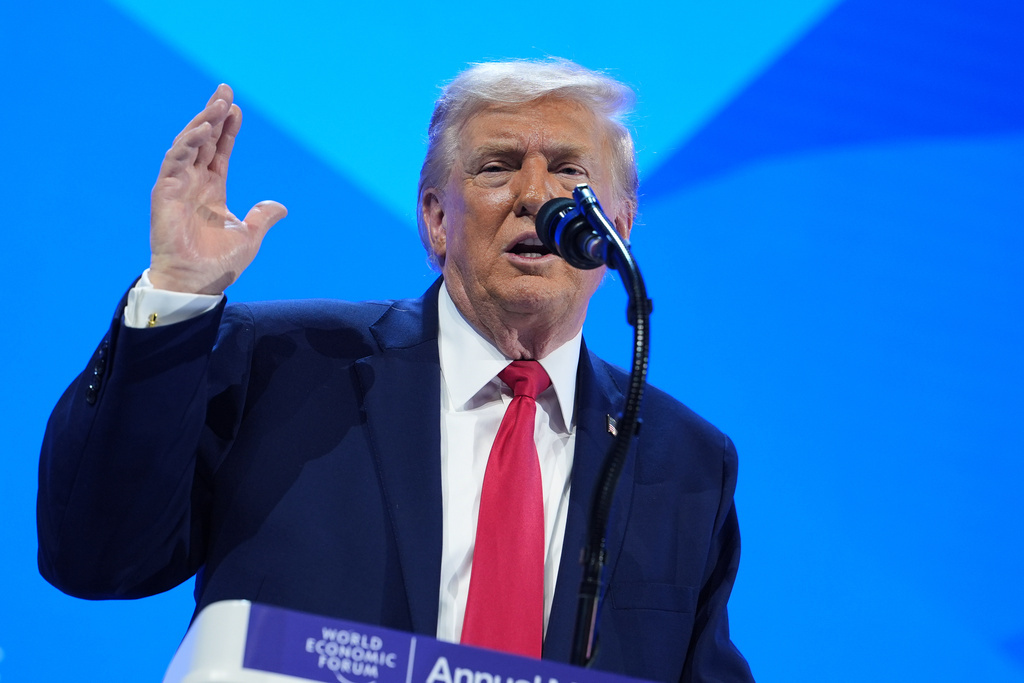
President Trump delivered a wide-ranging speech at the World Economic Forum in Davos, Switzerland on Wednesday, prompting CNN fact-checker Daniel Dale to conduct a real-time analysis that identified numerous inaccuracies and misstatements throughout the address.
The president’s appearance fulfilled his promise from last year, when he participated in the annual gathering remotely. This year’s in-person speech covered multiple topics including the Ukraine conflict, renewable energy, international relations, and renewed claims about the 2020 election.
Dale, who tracked the speech closely and posted his observations on social media platform X, noted several factual inconsistencies in Trump’s assertions about global conflicts. The president claimed to have “settled” eight wars during his administration, but Dale pointed out that several examples cited weren’t actually wars, including an Ethiopia-Egypt diplomatic dispute. He also referenced a “Serbia-Kosovo situation” that didn’t constitute a war and claimed to have resolved the conflict in the eastern Democratic Republic of Congo, which remains ongoing.
The fact-checker took particular issue with Trump’s characterization of NATO and American contributions to the alliance. When the president stated, “We’ve never gotten anything,” Dale countered by noting that NATO countries formed a coalition to support the United States in Afghanistan following the September 11 attacks.
Trump’s claim that most NATO members “weren’t paying their bills” was also challenged. Dale clarified that NATO’s spending target refers to countries’ own defense budgets rather than “bills” owed to the organization. He pointed out that as of 2024, 18 of the 31 NATO members subject to the 2% of GDP defense spending target were meeting or exceeding that threshold.
The president’s assertion that the U.S. paid “100% of NATO” was labeled “factually incorrect” by Dale, who noted that American defense spending accounts for approximately 63% of total NATO defense expenditure – significant but far from the total amount claimed.
Geographic confusion emerged as a recurring issue during the address, with Trump referring to Greenland as “Iceland” multiple times both during this speech and the previous day. He also repeatedly described Greenland, home to more than 56,000 people, as simply a “piece of ice.”
When discussing prescription drug prices, Dale observed that Trump acknowledged being told it was mathematically impossible to cut prices by “hundreds of percent” as he had previously claimed, but then insisted his approach to the calculation was superior.
The fact-checker also disputed Trump’s claim of $18 trillion in investments, noting that even the White House’s own website lists investment announcements during his term at $9.6 trillion – a figure Dale described as “a massive exaggeration” when examined closely.
Dale concluded his analysis by addressing Trump’s statement that “you can’t find any wind farms in China,” which he characterized as “an up-is-down reversal of reality.” To refute this claim, Dale shared visual evidence showing China’s extensive wind farm infrastructure.
The president’s appearance at Davos marks a continuation of his engagement with the global economic forum, which brings together political and business leaders from around the world annually to discuss pressing economic and policy issues. His speech contained many themes consistent with previous addresses, including criticism of international allies and renewed emphasis on his administration’s claimed accomplishments.
Fact Checker
Verify the accuracy of this article using The Disinformation Commission analysis and real-time sources.

8 Comments
Hmm, the discrepancies identified by the CNN fact-checker raise some concerns about the accuracy and reliability of Trump’s claims. I wonder what the broader implications are for how we evaluate leaders’ statements on the world stage.
That’s a fair point. Fact-checking is crucial to ensure leaders are held accountable and the public receives truthful information, especially on important global issues.
While I appreciate Trump highlighting global conflicts, his assertions appear to be at odds with the facts. The fact-checker’s analysis suggests he may have mischaracterized or overstated his role in resolving certain disputes. A measured, evidence-based approach is crucial for world leaders.
It’s troubling to see the president making inaccurate claims about his record on resolving international conflicts. Fact-checking is crucial to hold leaders accountable and provide the public with reliable information, even if it’s politically inconvenient.
It’s good to see the media scrutinizing political figures’ statements and holding them to account. Fact-checking is an important part of maintaining transparency and trust in public discourse, especially on complex global issues like those discussed in Davos.
While I’m glad to see Trump engaging on global issues at Davos, the fact-checker’s findings suggest he may have exaggerated or misrepresented certain details. Maintaining integrity and truthfulness should be a top priority for world leaders.
The CNN fact-checker’s analysis highlights the importance of rigorous, independent scrutiny of political figures’ statements, particularly on the global stage. Ensuring accuracy and transparency is vital for public trust and effective international cooperation.
Trump’s speech at Davos seems to be more of the same – making dubious claims and exaggerating his record. The CNN fact-checker rightly pointed out the numerous inaccuracies. It’s important to hold leaders accountable for their statements, regardless of political affiliation.