


Listen to the article
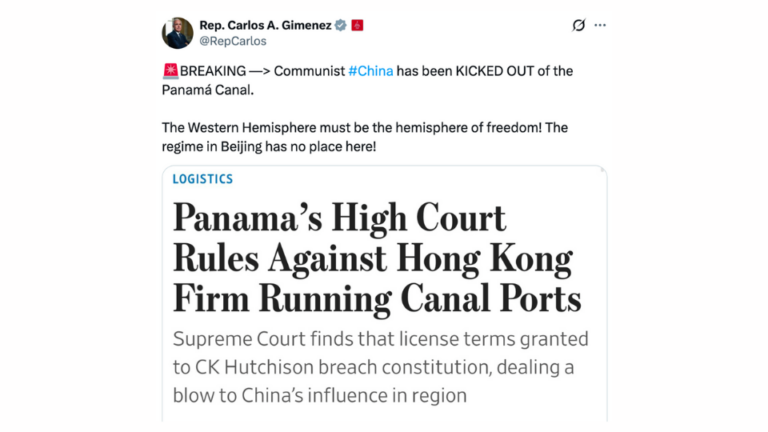
A recent ruling by Panama’s Supreme Court has generated significant international attention after it annulled contracts held by Hong Kong-based CK Hutchison Holdings to operate two key port facilities located on opposite sides of the Panama Canal.
The court decision, which invalidates the conglomerate’s operational rights at these strategic maritime facilities, has triggered a wave of mischaracterized reactions across social media platforms and conservative news outlets. Numerous commentators, particularly those aligned with conservative and MAGA-affiliated groups in the United States, celebrated what they incorrectly framed as China being “kicked out of the Panama Canal.”
This characterization fundamentally misunderstands both the nature of the court ruling and the operational structure of the Panama Canal and its surrounding infrastructure. The ports in question—while strategically positioned at terminal points of the canal—are separate commercial entities from the waterway itself and are not involved in its day-to-day operations.
Industry analysts note that CK Hutchison Holdings, founded by Hong Kong billionaire Li Ka-shing, operates as a multinational conglomerate with significant global port operations. While headquartered in Hong Kong, the company maintains a corporate identity distinct from mainland Chinese state enterprises, though this nuance has been largely overlooked in much of the public discourse following the court decision.
The Panama Canal Authority, an autonomous Panamanian government entity, maintains exclusive control over the 50-mile waterway that connects the Atlantic and Pacific Oceans. This authority has operated the canal since the United States transferred control to Panama on December 31, 1999, following the implementation of the 1977 Torrijos-Carter Treaties.
Maritime industry experts emphasize the critical distinction between the canal’s operations and the commercial port facilities that service vessels before or after their canal transit. The ports operated by CK Hutchison function primarily as container terminals where cargo is loaded, unloaded, and transferred—services complementary to, but separate from, the canal’s ship transit operations.
The confusion surrounding the court ruling highlights broader geopolitical tensions regarding Chinese economic influence in Latin America and around key global shipping routes. The Panama Canal remains one of the world’s most strategically important maritime passages, handling approximately 6% of global trade with over 14,000 vessels transiting annually.
Regional security analysts point out that while China has made substantial investments throughout Latin America as part of its Belt and Road Initiative, including in projects adjacent to the Panama Canal, these investments do not equate to operational control of the waterway itself.
The Panamanian Supreme Court’s decision appears to be focused on contractual and legal issues specific to CK Hutchison’s port operations rather than representing any broader shift in Panama’s stance toward foreign investment in its maritime infrastructure.
For global shipping interests, the ruling introduces uncertainty about the future management of these port facilities, which play an important role in the region’s logistics network. The ports provide critical services to vessels carrying goods between Asia, the Americas, and Europe, with any operational disruptions potentially affecting regional trade flows.
As this situation continues to develop, shipping industry observers will be watching closely to see who might eventually assume operational control of these strategic facilities, and whether this ruling signals a broader reassessment of foreign investment in Panama’s maritime infrastructure.
The case underscores the complex intersection of global commerce, national sovereignty, and geopolitical competition that characterizes international maritime infrastructure in the 21st century, while also highlighting how easily misinformation can spread when complex international business arrangements become entangled with geopolitical narratives.
Fact Checker
Verify the accuracy of this article using The Disinformation Commission analysis and real-time sources.

29 Comments
Production mix shifting toward False Claims might help margins if metals stay firm.
Good point. Watching costs and grades closely.
Interesting update on China Was Not Excluded from Panama Canal Operations, Investigation Reveals. Curious how the grades will trend next quarter.
Good point. Watching costs and grades closely.
Exploration results look promising, but permitting will be the key risk.
Nice to see insider buying—usually a good signal in this space.
I like the balance sheet here—less leverage than peers.
Good point. Watching costs and grades closely.
Good point. Watching costs and grades closely.
Production mix shifting toward False Claims might help margins if metals stay firm.
Good point. Watching costs and grades closely.
Good point. Watching costs and grades closely.
The cost guidance is better than expected. If they deliver, the stock could rerate.
Exploration results look promising, but permitting will be the key risk.
Good point. Watching costs and grades closely.
Good point. Watching costs and grades closely.
The cost guidance is better than expected. If they deliver, the stock could rerate.
Good point. Watching costs and grades closely.
Good point. Watching costs and grades closely.
Silver leverage is strong here; beta cuts both ways though.
Good point. Watching costs and grades closely.
Interesting update on China Was Not Excluded from Panama Canal Operations, Investigation Reveals. Curious how the grades will trend next quarter.
Interesting update on China Was Not Excluded from Panama Canal Operations, Investigation Reveals. Curious how the grades will trend next quarter.
Interesting update on China Was Not Excluded from Panama Canal Operations, Investigation Reveals. Curious how the grades will trend next quarter.
Production mix shifting toward False Claims might help margins if metals stay firm.
Good point. Watching costs and grades closely.
Interesting update on China Was Not Excluded from Panama Canal Operations, Investigation Reveals. Curious how the grades will trend next quarter.
Good point. Watching costs and grades closely.
Good point. Watching costs and grades closely.