


Listen to the article
In a move that has dramatically altered the social media landscape, platform X (formerly Twitter) has quietly implemented a new transparency feature that is exposing widespread deception across its network. The recently introduced tool adds a small but powerful “About this account” button on profile pages, revealing previously hidden information about users including their geographic location, handle change history, account creation date, and where the app was originally installed.
What began as an apparent routine anti-spam update has quickly transformed into a major revelation about the authenticity of accounts posting about the Israel-Hamas conflict. The feature has unmasked an extensive network of users falsely claiming to be posting from Gaza while actually operating from entirely different countries.
“A platform long known for allowing people to craft alternate identities and adopt personas from across the world abruptly lifted the curtain,” revealing what appears to be a sprawling ecosystem of fabricated identities, particularly around the ongoing conflict in Gaza.
Among the most striking revelations were accounts purporting to be Palestinians sharing first-hand experiences of bombardment and displacement. One account describing its owner as a witness in Rafah “living under airstrikes” was revealed to be posting from Afghanistan. A supposed nurse in Khan Younis was actually based in Pakistan, while a self-described father of six in a displacement camp was operating from Bangladesh. Even a “poet from Deir al-Balah writing by candlelight” was exposed as being located in Russia.
The scale of this deception appears substantial. Users discovered entire bot farms that had been operating for months. Accounts claiming to be “North Gaza survivors” were traced to Pakistan, while self-described “Rafah residents” were posting from Indonesia. Even profiles presenting themselves as members of Hamas’s Nukhba unit were uploading content from Malaysia.
The phenomenon wasn’t limited to one side of the conflict. Fake profiles presenting themselves as Israel Defense Forces personnel – including “officers,” “snipers,” and “reservists” supposedly operating in Gaza – were traced to London.
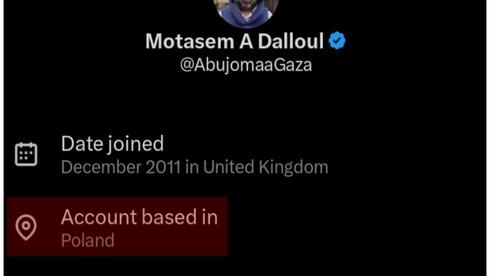
When confronted with the contradictions, some users continued to insist they were authentic. One prominent case involved a user named Moatasem Al-Daloul, who posted a video allegedly showing him walking through destroyed homes in Gaza. While the video’s authenticity couldn’t be immediately verified, X’s built-in artificial intelligence assistant, Grok, indicated that the platform’s geographic data was accurate.
The introduction of this feature represents a significant shift in how X approaches user transparency. While users can choose whether to display their country or a more general region – similar to options available on Instagram – the information is more prominently displayed on X and cannot be hidden once enabled.
According to foreign media reports, code analysts have discovered evidence that X is preparing to implement another tool that would alert users when an account attempts to disguise its true location using a VPN. If deployed, this would further complicate efforts to misrepresent location-based identity on the platform.
This development raises profound questions about the future of online discourse and the role of anonymity in social media. As the curtain is pulled back on accounts that positioned themselves as eyewitnesses to conflict, users must now reckon with the reality that many compelling first-person narratives were fabricated by individuals with no direct connection to the events they described.
The revelations come at a critical time when concerns about misinformation and digital manipulation are already heightened. Social media platforms have increasingly found themselves at the center of debates about their influence on political and social narratives that affect hundreds of millions of people worldwide.
For X, which has undergone significant changes since Elon Musk’s acquisition, this transparency push represents a potential turning point in how the platform balances user privacy with authenticity. As more accounts are exposed for misrepresenting their identities, users may need to approach content with renewed skepticism, particularly during major global events and conflicts.
Fact Checker
Verify the accuracy of this article using The Disinformation Commission analysis and real-time sources.

14 Comments
Production mix shifting toward Fake Information might help margins if metals stay firm.
Good point. Watching costs and grades closely.
Good point. Watching costs and grades closely.
If AISC keeps dropping, this becomes investable for me.
Good point. Watching costs and grades closely.
Interesting update on X Unveils Location Tool, Exposes Fake Gaza Influencer Network. Curious how the grades will trend next quarter.
Production mix shifting toward Fake Information might help margins if metals stay firm.
Good point. Watching costs and grades closely.
Uranium names keep pushing higher—supply still tight into 2026.
Good point. Watching costs and grades closely.
Uranium names keep pushing higher—supply still tight into 2026.
Good point. Watching costs and grades closely.
Exploration results look promising, but permitting will be the key risk.
Good point. Watching costs and grades closely.