


Listen to the article
Americans Trust TV News Over Social Media for Political Information, Survey Finds
Television news remains the most trusted source for political information among American voters across party lines, according to a comprehensive report released by the Video Advertising Bureau (VAB) on March 17, 2026.
The study, titled “The Lead Story: How Multiscreen TV Drives Cross-Partisan Engagement for Political Ad Campaigns,” reveals that potential voters are almost nine times more likely to trust TV news than social media when consuming political content. The findings come from a December 2025 survey of 2,319 U.S. adults conducted in partnership with research firm Dynata.
Local television news emerged as the single most trusted source for political information, with 47% of Republicans, 43% of Democrats, and 47% of Independents ranking it at the top. National TV news placed second across all political affiliations, highlighting television’s dominant position in the trust hierarchy.
In stark contrast, artificial intelligence tools like ChatGPT ranked at the bottom, with only 5% of potential voters naming AI as their most trusted news source. Social media platforms fared only slightly better, trusted by just 9% of potential voters.
“The gap between television and every other category is not marginal—it is structural,” noted industry analysts reviewing the findings.
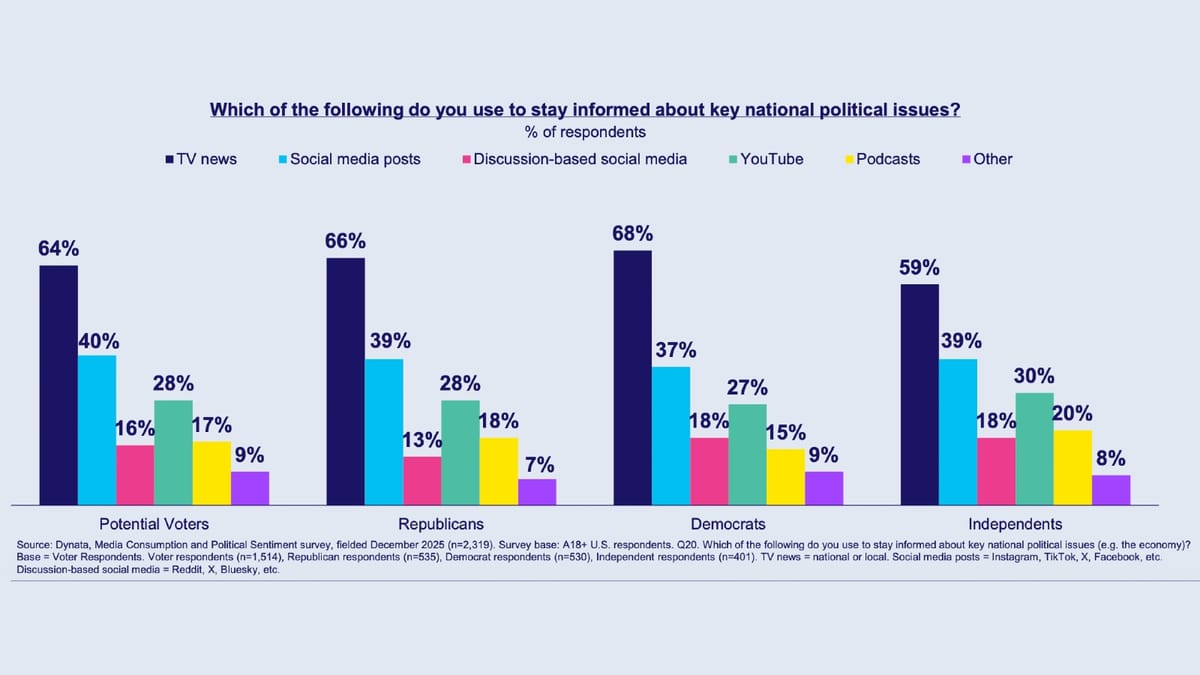
The survey also examined where voters actually go to stay informed about key national issues like the economy. Again, TV news dominated, with 64% of potential voters regularly using television, compared to 40% who rely on social media platforms like Instagram, TikTok, X, and Facebook.
“Potential voters are 60% more likely to use TV news to stay informed than social media,” the VAB analysis states. This behavior pattern has significant implications for advertisers seeking to reach engaged political audiences.
The study also revealed that television serves as the primary discovery channel for political candidates, with 43% of potential voters first learning about candidates and their positions through TV or streaming services. Social media (25%) and YouTube (11%) lagged considerably behind.
Beyond media consumption habits, the survey uncovered important insights about voter preferences. An overwhelming 65% of potential voters reported that they vote based on issues rather than party affiliation, with the figure rising to 78% among Independents. This translates directly to advertising preferences, with 75% of potential voters preferring political ads that focus on issues rather than candidates.
The satisfaction ratings for TV news remained high across multiple dimensions. Speed of breaking news coverage earned satisfaction from 81% of potential voters, while local community information from local TV news satisfied approximately 79% across all groups. Even on the more contentious question of unbiased perspective, television maintained positive ratings, with 53% of potential voters expressing satisfaction.
Perceptions of misinformation showed another clear divide between platforms. Potential voters were almost three times more likely to believe social media platforms provide fake or misleading information compared to television. Specifically, 51% of potential voters named social media as the most likely source of misinformation, while only 19% cited television.
The report defined “multiscreen TV” as the combined ecosystem of ad-supported linear and streaming television, encompassing traditional broadcast networks, cable news, and ad-supported streaming services like Tubi and Pluto TV. Subscription patterns for these services showed remarkable consistency across political divisions, with 92% of potential voters who subscribe to paid streaming having access to at least some ad-supported tiers.
For marketers, one of the most significant findings involves the “halo effect” that extends from news programming to advertisers. Potential voters are 42% more likely than not to purchase from advertisers adjacent to breaking news stories on local TV news. Similarly, placement during political programming generates positive lift, with potential voters 50% more likely than not to purchase from advertisers appearing during televised political debates or town halls.
“TV news delivers the scale, trust, credibility and authenticity that no other media can for both political and non-political advertisers,” said Jason Wiese, EVP of Strategic Insights and Measurement at VAB.
The report comes as the advertising industry grapples with concerns about misinformation, polarization, and the fragmenting media landscape. With U.S. midterm elections approaching in 2026, these findings provide critical guidance for political campaigns and brands looking to engage voters in a credible environment.
As one media buyer commented, “This data doesn’t just tell us where voters get their information—it tells us where they form their opinions before acting. For political advertisers, that distinction is crucial.”
Fact Checker
Verify the accuracy of this article using The Disinformation Commission analysis and real-time sources.

12 Comments
This survey highlights the importance of media literacy and critical thinking when it comes to consuming news and political information. Voters should be discerning and consider the reliability of different sources.
Absolutely. Just because something is on TV doesn’t automatically make it trustworthy. Voters need to scrutinize the content and source, regardless of the platform.
While I’m not surprised by the results, I do wonder if this trend will hold as younger generations become a larger share of the electorate. Their media consumption habits may differ from previous generations.
That’s a fair point. The survey results could shift as the demographic makeup of voters changes over time. Adapting to evolving media landscapes will be crucial for maintaining trust in news sources.
While the survey findings are encouraging for TV news, it’s important to recognize that trust in media can vary significantly by demographic and political affiliation. Continued efforts to improve transparency and accountability will be key.
Well said. Rebuilding trust in media across the political spectrum will require a multi-faceted approach from news organizations and the public alike.
The findings about AI-generated news being the least trusted source are intriguing. As these technologies become more advanced, it will be important for the public to understand their limitations and potential biases.
Agreed. AI-powered news should be viewed with healthy skepticism until these systems can demonstrate consistent accuracy and transparency in their processes.
This report highlights the ongoing challenge of combating misinformation and disinformation in the digital age. Trusted, traditional media outlets have an important role to play in providing factual, unbiased information to the public.
Absolutely. Maintaining the credibility of television news will be crucial for preserving an informed electorate and a healthy democracy.
Interesting to see that TV news still maintains a high level of trust among voters. While AI and social media have their place, there’s something to be said for the credibility and accountability of traditional broadcast journalism.
I agree. TV news tends to have higher editorial standards and fact-checking processes compared to the often unregulated world of social media.