


Listen to the article
Vietnam Combats Election Misinformation with Digital Innovation
As Vietnam prepares for the upcoming 16th National Assembly and People’s Council elections, authorities are facing a growing challenge from deliberate misinformation campaigns designed to undermine public confidence in the electoral process.
Recently, several ill-intentioned websites have published articles containing slanderous content about alleged “directives to rig the election.” These one-sided reports, lacking verifiable sources or evidence, deliberately create false impressions that the election preparation process lacks transparency and democratic principles.
The misinformation isn’t limited to fringe websites. On popular social media platforms like TikTok and Facebook, manipulative accounts employ sophisticated “clickbait” techniques to spread distrust. One TikTok account recently circulated misleading content about “a series of military and police generals running for the National Assembly,” presenting factual information out of context to create artificial controversy and deepen divisions between different segments of society.
More sophisticated approaches involve what experts term “pseudo-analysis” content. These seemingly objective articles and videos compare Vietnam’s electoral system with those of other countries while deliberately ignoring critical differences in political institutions, history, and legal frameworks. Such flawed comparisons can easily mislead audiences, particularly younger citizens, into believing domestic electoral processes lack transparency or voter choice.
Some social media accounts have gone further, exploiting unverified personal anecdotes for emotional effect. In one instance, a TikTok clip showed a woman expressing frustration about having “only one candidate,” generating speculative comments suggesting that “voting is just a formality” and that “results are pre-arranged.” Such content typically lacks verification and fails to reflect the consultative process and candidate introduction procedures established by law.
In response to these challenges, Vietnamese authorities and civic organizations are adopting innovative digital approaches to counter misinformation and bring election information directly to citizens.
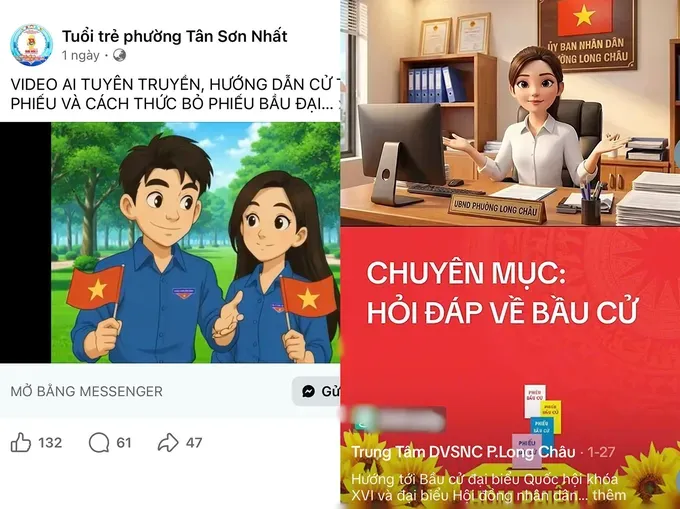
Ho Chi Minh City has emerged as a leader in this digital transformation. Youth Union pages in Tan Son Nhat and Dong Hoa wards are now utilizing AI-generated characters and virtual hosts to guide voters through the electoral process. Numerous localities have launched dedicated TikTok channels featuring engaging short videos that have successfully attracted thousands of views and positive interactions regarding the upcoming election.
Le Thi Anh Dao, Deputy Director of the Academy of Politics Region II, emphasized that the upcoming elections represent a crucial political event, making them prime targets for hostile forces spreading disinformation. She argued that functional agencies must move beyond merely reacting to fake news and instead proactively provide accurate information while operating rapid response mechanisms to promptly correct distortions.
“Maintaining transparent information on digital platforms is the direct solution to neutralize fake news,” Dao stated.
Beyond increasing the speed of official communications, authorities are focusing on innovative transmission methods. The use of infographics, short videos, and podcasts allows official information to reach citizens, especially young people, on the platforms they frequent. Additionally, government agencies are mobilizing experts, scientists, and key opinion leaders to express their views through official channels, providing scientific reasoning and practical evidence to counter false narratives.
At the national conference on election deployment, Party General Secretary To Lam emphasized that “the entire consultative process must be conducted democratically, objectively, publicly, and transparently in accordance with legal regulations.” He called for increased inspection and supervision to prevent negative phenomena such as unhealthy lobbying, vote buying, or interest groups distorting the meaning of the election.
Legal experts note that spreading false information carries significant penalties. According to Ha Hai, Vice Chairman of the HCMC Bar Association, Decree 147/2024/ND-CP defines “fake news” as information that is partially or entirely false compared to the truth, created to serve particular interests. Violators can face administrative fines ranging from VND10-20 million (US$383-766) for organizations and half that amount for individuals, along with mandatory removal of the violating content. Serious cases may result in criminal prosecution under Vietnam’s Penal Code.
As the election approaches, authorities continue to emphasize that citizen media literacy remains crucial in combating misinformation. Officials recommend that when encountering shocking election news, individuals should verify the source, author, motive, and check mainstream press coverage before engaging with or sharing the content.
Fact Checker
Verify the accuracy of this article using The Disinformation Commission analysis and real-time sources.

23 Comments
Exploration results look promising, but permitting will be the key risk.
Good point. Watching costs and grades closely.
The cost guidance is better than expected. If they deliver, the stock could rerate.
Exploration results look promising, but permitting will be the key risk.
The cost guidance is better than expected. If they deliver, the stock could rerate.
Good point. Watching costs and grades closely.
Nice to see insider buying—usually a good signal in this space.
Good point. Watching costs and grades closely.
Exploration results look promising, but permitting will be the key risk.
The cost guidance is better than expected. If they deliver, the stock could rerate.
Exploration results look promising, but permitting will be the key risk.
Production mix shifting toward Fake Information might help margins if metals stay firm.
Nice to see insider buying—usually a good signal in this space.
Nice to see insider buying—usually a good signal in this space.
Good point. Watching costs and grades closely.
Good point. Watching costs and grades closely.
If AISC keeps dropping, this becomes investable for me.
Good point. Watching costs and grades closely.
Silver leverage is strong here; beta cuts both ways though.
Good point. Watching costs and grades closely.
Good point. Watching costs and grades closely.
Silver leverage is strong here; beta cuts both ways though.
Good point. Watching costs and grades closely.