


Listen to the article
The Growing Challenge of Fake News and Deepfakes in Digital Media
In an era dominated by social media and instant information, the spread of fake news and deepfakes has emerged as one of the most significant threats to public trust and information integrity. Recent studies indicate a troubling trend: over 51% of teenagers and 33% of young adults aged 20-25 in the United States rely on social media as their primary news source, creating fertile ground for misinformation to flourish.
A December 2020 survey revealed that 38.2% of Americans admitted to accidentally sharing fake news, while another 7% were unsure if they had done so. Perhaps more concerning, 54% of respondents expressed only moderate confidence in their ability to identify fake content, with 6.6% having no confidence at all in their fake news detection skills.
Researchers define fake news as false information presented as factual news, with motives ranging from generating website traffic to deliberately manipulating public opinion. The academic community classifies fake news into three broad categories: misinformation (false information spread without malicious intent), disinformation (deliberately false information designed to cause harm), and malinformation (information based on reality but used to inflict harm).
Common manifestations include clickbait, hoaxes, propaganda, satire, and parody, though experts note that classification methods remain inconsistent across studies, complicating efforts to develop standardized frameworks for analysis.
The rise of deepfakes represents an even more sophisticated threat. These are synthetic media created by superimposing images or videos onto other media using neural networks and generative models. Deepfakes typically appear in several forms: lip sync manipulations, voice imitations, character impersonations, and face swaps—with the latter being the most prevalent form.
The psychological impact of visual content amplifies the danger of deepfakes. Research shows people are more likely to believe information when accompanied by visual “evidence,” even if fabricated. Repeated exposure to such content across multiple platforms creates a familiarity that fosters a false sense of credibility.
Real-world consequences of fake news and deepfakes are increasingly evident. The Cambridge Analytica scandal exposed how misinformation influenced the 2016 U.S. presidential election and Brexit referendum. The Pizzagate conspiracy theory led to actual violence. During the COVID-19 pandemic, health-related misinformation contributed to reduced mask-wearing and disregard for social distancing measures.
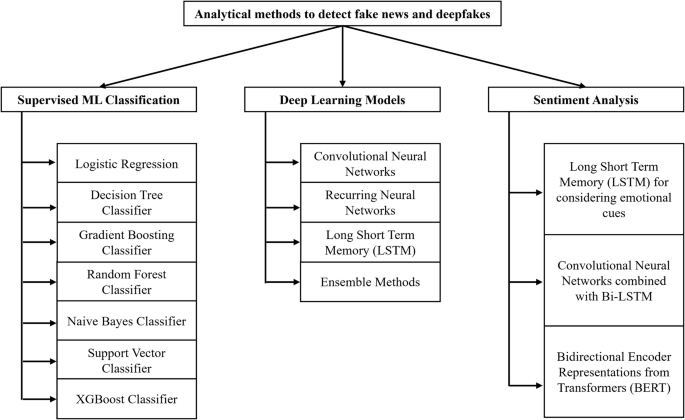
The technology for detecting fake content has advanced significantly. For text-based fake news, machine learning algorithms like logistic regression, decision trees, and support vector machines have shown promising results. A comparative study found decision tree classification achieving 99.59% accuracy, slightly outperforming support vector machines at 99.58% and random forest classifiers at 98.85%.
For deepfake detection, researchers are employing convolutional neural networks (CNNs) with architectures like ResNet50 and DenseNet121. ResNet50 uses skip connections across 50 layers and has been pre-trained on over a million ImageNet database images. DenseNet121, with its 121 layers and dense connectivity between layers, offers greater computational power but demands more resources.
The emotional impact of fake news creates unique detection opportunities. Studies indicate that fake news tends to evoke anxiety, resentment, and surprise, while genuine news typically generates anticipation, despair, optimism, and confidence. Researchers have found that news with significantly negative headlines is more likely to be fake, as legitimate news sources generally maintain a more neutral tone.
Despite technological advances, significant challenges remain. Most research focuses on detecting either text-based fake news or deepfakes in isolation, whereas modern misinformation often combines both elements. Additionally, the field lacks standardized datasets containing both text and multimedia components.
Another limitation is the difficulty of obtaining properly labeled fake news data for supervised machine learning techniques. Some researchers have turned to unsupervised methods, using natural language processing to cluster news articles by topic, then analyzing these clusters for veracity rather than individually evaluating each article.
As AI-powered content generation tools become increasingly accessible, the distinction between authentic and fabricated information continues to blur. The ultimate concern is that persistent exposure to fake news and deepfakes may lead to a complete erosion of public trust in media, social platforms, and democratic institutions.
Fact Checker
Verify the accuracy of this article using The Disinformation Commission analysis and real-time sources.

16 Comments
Interesting to see the breakdown of the different categories of fake news. Distinguishing between misinformation and disinformation is an important nuance to understand.
The growing reliance on social media as a news source, especially among younger demographics, is a concerning trend that makes the fake news problem even more urgent to address.
The data analytics approach to detecting and assessing fake news and deepfakes sounds promising. I’m curious to learn more about the specific techniques and how effective they’ve proven to be.
Yes, the technological solutions to this challenge are intriguing. Keeping pace with the evolving tactics of misinformation is crucial.
I’m curious to learn more about the data analytics techniques that can be used to tackle this problem. Leveraging technology to combat the spread of false information seems like a valuable approach.
Absolutely, any insights into how to improve detection of fake content would be welcome. Building public awareness and media literacy is also key.
Addressing the fake news and deepfake problem is such an important issue, especially given social media’s growing role as a primary news source. I’m glad to see efforts being made to tackle this challenge.
The statistics on people’s ability to identify fake news are concerning. Developing stronger skills in this area is important for everyone, not just media professionals.
Agreed, we all have a responsibility to be critical consumers of information, especially in the digital age.
I appreciate the breakdown of the different types of fake news – misinformation, disinformation, etc. Understanding the nuances is helpful in formulating effective strategies to combat this challenge.
Detecting and assessing fake news and deepfakes is a growing challenge in the digital age. The ability to quickly identify misinformation and disinformation is crucial to maintaining public trust and information integrity.
Agreed, social media’s role as a primary news source for younger generations makes this issue even more pressing.
Improving public awareness and media literacy around fake news and deepfakes seems like a key part of the solution. Equipping people with the skills to critically evaluate online content is essential.
Definitely, building that critical thinking capacity in the general public is crucial to stemming the tide of misinformation.
Utilizing data analytics to detect and assess fake news and deepfakes is an intriguing approach. I’m curious to learn more about the specific techniques and how effective they’ve proven to be.
Yes, the details on the data-driven methods would be very informative. Staying ahead of evolving misinformation tactics is crucial.