


Listen to the article
Algeria’s Digital Battlefield: “Electronic Flies” Buzz Amid Protest Movement
Amid ongoing anti-government demonstrations in Algeria, a sophisticated online information war has emerged, with protesters struggling to combat coordinated troll accounts they’ve dubbed “electronic flies.”
The digital conflict intensified following protests that began on February 22, when thousands of Algerians took to the streets opposing then-President Abdelaziz Bouteflika’s bid for a fifth term in office. The unprecedented scale of demonstrations caught the regime off guard, representing the largest public uprising since the 1990s.
“We hadn’t seen these kind of protests since the 1990s,” said Dalia Ghanem, a resident scholar at the Carnegie Middle East Centre in Beirut.
As demonstrations spread, authorities reportedly disrupted internet access in several regions, according to NetBlocks, an organization that monitors internet freedom. Under mounting pressure, Bouteflika eventually resigned in April, but this failed to satisfy protesters demanding deeper changes to what they call “le pouvoir” – the powerful network of generals, businessmen, and ruling party politicians that has long controlled Algeria’s political landscape.
“Then, a second phase of the cyber warfare started,” explains Raouf Farrah, one of the founders of the Collective of Activist Youth, a key protest movement. He claims that opponents fought back “by engaging [internet] trolls, fake news, fake information, fake accounts.”
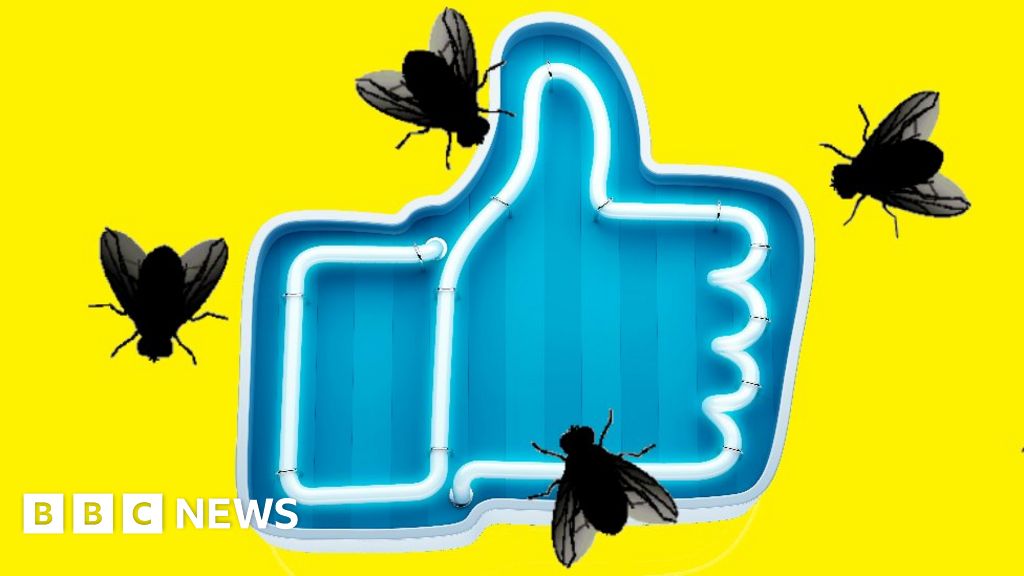
The protesters use the term “electronic flies” to describe troll-like accounts disseminating pro-government or pro-establishment messages. The Collective of Activist Youth’s Facebook page has been among their primary targets.
“You’ll see trolls commenting negatively on our page and [calling] the movement… every possible name,” says Farrah.
These accounts typically share common characteristics suggesting coordinated activity: most were created after protests began, have fewer than 100 friends, and repeatedly post identical comments across multiple platforms.
“They just create this annoying noise and they try to swerve the debate,” explains Carolyn Lamboley, an analyst from BBC Monitoring who has been tracking the phenomenon. “It’s just to create some sort of ‘pollution’.”
The content pushed by these “electronic flies” revolves around several recurring themes, predominantly aimed at undermining the protest movement. Many messages promote conspiracy theories suggesting foreign powers are orchestrating the demonstrations.
“This idea that there’s a foreign sponsorship behind the protests, that they might somehow be pushed or sponsored by outside powers,” Lamboley says. “France, as Algeria’s former colonial power, is often an easy scapegoat.”
Other common narratives suggest continued popular support for former President Bouteflika and the military. “Sometimes it’s really weird stuff like ‘Long live the army’,” Lamboley notes. “And that phrase gets copied and pasted twelve times in one message, so it doesn’t look like [normal] human behavior.”
Some messages also attempt to exploit tensions between Algeria’s various ethnic groups.
Alongside the emergence of these coordinated troll accounts, Algeria has experienced a flood of fake news stories spreading rapidly across social media platforms, particularly Facebook, which serves as a primary information source for many Algerians.
“It became a site of struggle between the protesters and the authorities because a lot of Algerians basically get their information from Facebook,” says Omar Al-Ghazzi, assistant professor in media and communication at the London School of Economics.
In response to this disinformation crisis, a fact-checking initiative called Fake News DZ was created on Facebook. Nassim, one of the page’s founders and an Algerian IT specialist based in Paris, says the team launched the effort after noticing “an increase in published fake news” when protests began.
Since April, Fake News DZ has debunked over 300 false stories, many with anti-protest messages claiming demonstrations were no longer necessary or that Algeria was thriving after Bouteflika’s departure. However, Nassim notes that disinformation has come from both sides, with some protest supporters sharing outdated images of demonstrations to exaggerate current participation.
“During the summer, where the protests were less massive… we saw some people sharing pictures of the protests saying ‘This is what happened today.’ But they were old pictures, of old protests,” Nassim told the BBC.
Several opposition politicians have condemned the use of fake news and “electronic flies” against the protest movement, implying potential establishment involvement in such tactics. However, there is no conclusive evidence directly connecting the government or military to any coordinated disinformation campaign. Neither the Algerian Embassy in the UK nor the country’s Ministry of Communications responded to requests for comment.
Algeria currently ranks 141st in the World Press Freedom Index compiled by Reporters Without Borders, reflecting significant constraints on media freedom in the country.
Facebook has stated it is working “aggressively to combat the spread of disinformation” and regularly removes pages and profiles engaged in coordinated inauthentic behavior. The platform reported removing 2.2 billion fake profiles during one three-month period earlier this year.
As Algeria’s political future remains uncertain, the digital battlefield continues to evolve alongside street demonstrations, highlighting how modern protest movements must fight not only in physical spaces but also in the information realm.
Fact Checker
Verify the accuracy of this article using The Disinformation Commission analysis and real-time sources.

8 Comments
The concept of ‘electronic flies’ is a vivid and concerning one. It’s alarming to see how coordinated troll networks can be used to overwhelm and distort legitimate protest movements. This is a challenge that goes beyond Algeria and needs to be addressed globally.
You’re absolutely right. The proliferation of coordinated disinformation campaigns is a worldwide issue that threatens the integrity of public discourse. Developing effective strategies to counter these tactics must be a priority for policymakers, tech companies, and civil society.
This article highlights the importance of digital literacy and critical thinking when it comes to navigating the online information landscape, especially during times of political unrest. Equipping citizens with the skills to identify and counter disinformation campaigns is key to preserving democratic discourse.
This article underscores the complexity of the digital battleground, where protesters and governments alike vie for narrative control. It’s a sobering example of how social media can be exploited to undermine democratic movements. Rigorous research and multi-stakeholder collaboration will be key to addressing this challenge.
The internet disruptions during the Algerian protests are a stark reminder of how authoritarian regimes can leverage technology to maintain control. It’s crucial that we continue to shine a light on these tactics and advocate for internet access as a fundamental human right.
It’s concerning to see how internet disruptions were used to limit access to information and free expression during the Algerian protests. Controlling the narrative online seems to be a common tactic for repressive governments trying to maintain power. I hope researchers can continue to shed light on these issues.
You’re right, the use of internet shutdowns is a worrying trend. It’s crucial that we understand how authoritarian regimes leverage digital tools to suppress dissent and distort facts. Ongoing monitoring and analysis of these tactics is essential.
This is an interesting look at the spread of disinformation during political protests. It highlights how social media can be weaponized to sway public opinion, even in authoritarian regimes. I’m curious to learn more about the tactics used by the ‘electronic flies’ and how protesters tried to combat them.