


Listen to the article
In a watershed moment for digital regulation, India’s proposed 2026 amendments to the Information Technology Rules are targeting the growing epidemic of fake news and digital extortion that has flourished across social media platforms.
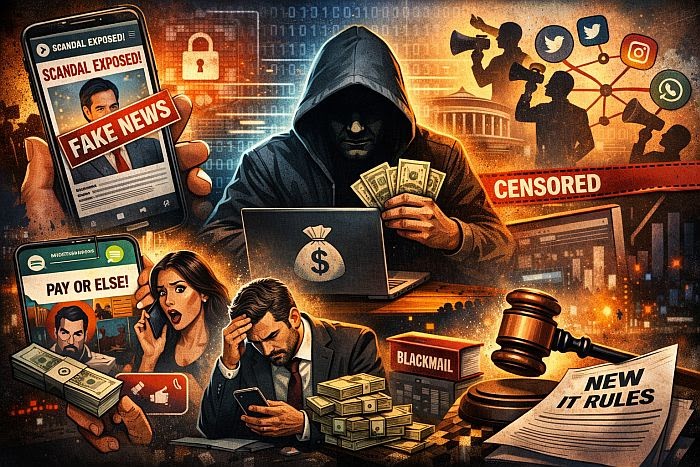
The amendments represent a direct response to what experts describe as a parallel information economy, where individuals masquerading as journalists and news outlets systematically manufacture false narratives and monetize them through coercion and blackmail schemes.
Across platforms like Facebook, X, Instagram, and WhatsApp, a disturbing pattern has emerged. Sophisticated posts mimicking legitimate journalism circulate widely, naming individuals and alleging misconduct without substantiation. Once these fabricated stories gain traction, the perpetrators approach their victims with a proposition: pay for silence or face continued harassment.
Police investigations in Maharashtra have uncovered networks of individuals posing as journalists on Facebook, publishing defamatory content about local businessmen and subsequently demanding money to retract the stories. These operations maintain meticulous facades of legitimacy with professional-looking layouts, logos, and fabricated bylines.
“The damage is immediate and severe,” notes a law enforcement official familiar with several cases. “Victims find their business relationships and social standing compromised within hours of publication.”
On Instagram, anonymous accounts styled as news updates circulate morphed images and manipulated video clips, particularly targeting women. The ephemeral nature of stories and reels accelerates dissemination before any corrective action can be taken.
WhatsApp presents its own challenges. The platform’s encrypted, closed-group communication structure enables the rapid spread of fabricated narratives within trusted communities. In one documented case, a school teacher was falsely accused of misconduct through a series of messages formatted as breaking news alerts, leading to social ostracism and professional consequences.
On X (formerly Twitter), coordinated campaigns driven by anonymous accounts can propel false narratives into trending territory within hours. The platform’s architecture, which rewards engagement regardless of veracity, ensures that sensational content travels faster than subsequent corrections.
India consistently ranks among countries most affected by misinformation. Law enforcement data shows a steady rise in cases involving cyber extortion, online defamation, and journalist impersonation, with financial losses from cybercrime collectively reaching thousands of crores annually.
The proposed amendments aim to disrupt this ecosystem by extending regulatory reach to anyone engaging with news and current affairs content, not just formally recognized publishers. This change effectively eliminates the distinction between institutional journalism and individual content creation, ensuring those who systematically disseminate news-like material can no longer evade scrutiny.
“The amendments recognize that in today’s digital landscape, anyone can function as a publisher with significant reach and impact,” explains a digital policy expert associated with the drafting process.
Among the most significant changes is the introduction of a three-hour takedown window for content deemed misleading or synthetic—an acknowledgment of the velocity at which misinformation travels. Additionally, Rule 3(4) transforms what was once a largely voluntary compliance framework into a binding obligation, linking adherence to government advisories with the preservation of safe harbor protections under Section 79.
The amendment to Rule 14 further empowers the Inter-Departmental Committee to take cognizance of content on its own motion, without waiting for formal complaints. This marks a shift from reactive governance to proactive oversight, potentially allowing authorities to intervene before significant damage occurs.
Industry observers note that these measures could substantially disrupt the mechanics of the fake news economy. Rapid takedowns can blunt virality, expanded definitions can pierce anonymity, and mandatory compliance can compel platforms to act with greater urgency.
However, critics argue that effective implementation will require clear and enforceable penal provisions that extend beyond content removal into criminal liability. Without consequences targeting not only the dissemination but also the intent to extort or defame, the deterrent effect may be limited.
The challenge ahead lies in striking a balance between confronting digital abuse and preserving free expression. As one legal expert puts it: “The task is to craft a regime that possesses both the strength to confront abuse and the wisdom to preserve liberty.”
With these amendments, India is attempting to reclaim regulatory ground in a digital landscape that has long operated beyond conventional oversight, aiming to restore accountability to spaces where truth has become a commodity too often manipulated for profit.
Fact Checker
Verify the accuracy of this article using The Disinformation Commission analysis and real-time sources.

12 Comments
The proposed amendments seem like a reasonable approach to addressing the concerning trend of fake news and extortion by fraudulent media outlets. I’m curious to see how the legislation is implemented and its long-term impact.
This is a serious issue that needs to be addressed. Fake news and extortion schemes by fraudulent media outlets are harmful to society and undermine the credibility of legitimate journalism. Strengthening regulations to target these unethical practices is a step in the right direction.
I agree, it’s important to protect individuals and businesses from these types of malicious attacks. Proper oversight and accountability measures are crucial to curbing the spread of disinformation.
This is a positive development in the effort to combat the spread of disinformation and protect the integrity of journalism. Holding fraudulent media outlets accountable for their unethical tactics is an important step.
I agree. Maintaining public trust in the media is crucial, and measures like these can help restore that trust by weeding out bad actors.
The proposed amendments sound like a reasonable approach to combat the growing problem of fake news and digital extortion. Holding these bad actors accountable and disrupting their business models is key to addressing this challenge.
Absolutely. Measures like these can help restore trust in media and protect vulnerable individuals and businesses from these predatory tactics.
This is an important issue that deserves attention. Fake news and extortion tactics by fraudulent media outlets can have real-world consequences and undermine public discourse. I’m curious to see how the proposed regulations will be implemented and enforced.
Good point. The effectiveness of these measures will depend on robust enforcement and close monitoring to ensure they achieve the desired outcomes.
It’s concerning to see the scale of this problem, with perpetrators systematically manufacturing false narratives and then extorting their victims. Strengthening regulations to disrupt these predatory practices is a necessary step.
This is a complex issue that requires a multifaceted solution. While strengthening regulations is a positive step, it will also be important to focus on media literacy and empowering individuals to critically evaluate the information they encounter online.
That’s a good point. Educating the public on how to identify and avoid falling victim to these types of schemes is just as crucial as legal measures to hold the perpetrators accountable.