


Listen to the article
In the wake of a tragic stabbing incident in Merseyside, a case study in misinformation has unfolded, revealing how unverified claims can rapidly spread through social media channels during breaking news events.
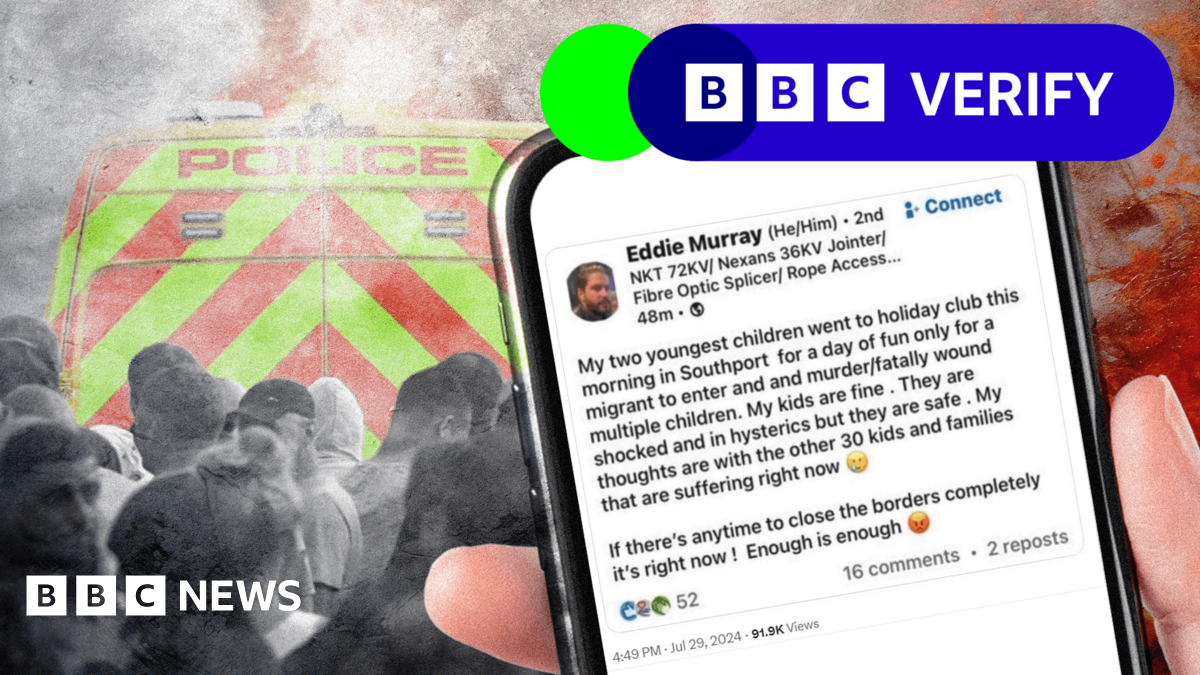
Early reports of the attack included a social media post by Mr. Eddie Murray, which incorrectly characterized the suspect as a “migrant.” The BBC has since learned that while Murray’s family was in the vicinity of the incident, they had actually been turned away from the dance class where the stabbings occurred because it was already at capacity.
Murray’s post represents one of the earliest examples of local testimony that incorrectly applied the term “migrant” to the suspect. When contacted about the post, Murray explained he was simply sharing information that had been relayed to him. His experience illustrates how quickly unverified information can spread during crisis situations, regardless of its accuracy.
In the immediate aftermath of the stabbings, Merseyside Police followed standard protocol by releasing limited information. At approximately 1:00 PM, authorities issued a brief statement confirming that “armed police have detained a male and seized a knife.” This cautious approach is typical when suspects are minors, as was the case here. Even in incidents where suspects are deceased, official identification often takes many hours.
The information vacuum that followed the sparse police statement created fertile ground for speculation, particularly across social media platforms. Though Murray’s original LinkedIn post reached only a few hundred viewers before being removed, screenshots had already begun circulating elsewhere online.
LinkedIn later confirmed to the BBC that the post violated its policies regarding “harmful or false content,” prompting its removal. However, by then, the damage was done. BBC Verify analysis shows that within hours, the content had been viewed more than two million times across various social media platforms.
The amplification process happened with remarkable speed. Within an hour of Murray’s original post, a screenshot appeared on X (formerly Twitter) from an account advocating mass deportations. This repost alone garnered more than 130,000 views. By 4:23 PM, an India-based online news outlet called Upuknews had shared a retweet of Murray’s post, describing the information as “confirmed” despite the lack of official verification. This post received over half a million views.
This cascade of misinformation demonstrates the challenges faced by authorities and legitimate news organizations during critical incidents. The rapid sharing capabilities of social media platforms can transform isolated, unverified claims into widely circulated “facts” before official information becomes available.
Media literacy experts point to this case as exemplifying why verification is crucial before sharing sensitive information during breaking news events. The incident also highlights how initial mischaracterizations can shape public perception and potentially inflame tensions around sensitive issues like immigration.
The situation underscores growing concerns about the role social media platforms play in information dissemination during crisis events, when emotional responses may override critical thinking. Despite efforts by platforms to combat misinformation through content policies, the speed at which false information can spread often outpaces moderation efforts.
For communities affected by tragic events like the Merseyside stabbings, these misinformation cycles can compound trauma and complicate the healing process, particularly when they introduce divisive narratives that weren’t present in the actual incident.
Fact Checker
Verify the accuracy of this article using The Disinformation Commission analysis and real-time sources.

26 Comments
Production mix shifting toward Fake Information might help margins if metals stay firm.
The cost guidance is better than expected. If they deliver, the stock could rerate.
Uranium names keep pushing higher—supply still tight into 2026.
Good point. Watching costs and grades closely.
Good point. Watching costs and grades closely.
Exploration results look promising, but permitting will be the key risk.
Good point. Watching costs and grades closely.
Good point. Watching costs and grades closely.
Exploration results look promising, but permitting will be the key risk.
Good point. Watching costs and grades closely.
Good point. Watching costs and grades closely.
I like the balance sheet here—less leverage than peers.
Exploration results look promising, but permitting will be the key risk.
Good point. Watching costs and grades closely.
Good point. Watching costs and grades closely.
Nice to see insider buying—usually a good signal in this space.
Good point. Watching costs and grades closely.
Good point. Watching costs and grades closely.
If AISC keeps dropping, this becomes investable for me.
Good point. Watching costs and grades closely.
Good point. Watching costs and grades closely.
I like the balance sheet here—less leverage than peers.
Good point. Watching costs and grades closely.
Good point. Watching costs and grades closely.
The cost guidance is better than expected. If they deliver, the stock could rerate.
Good point. Watching costs and grades closely.