


Listen to the article
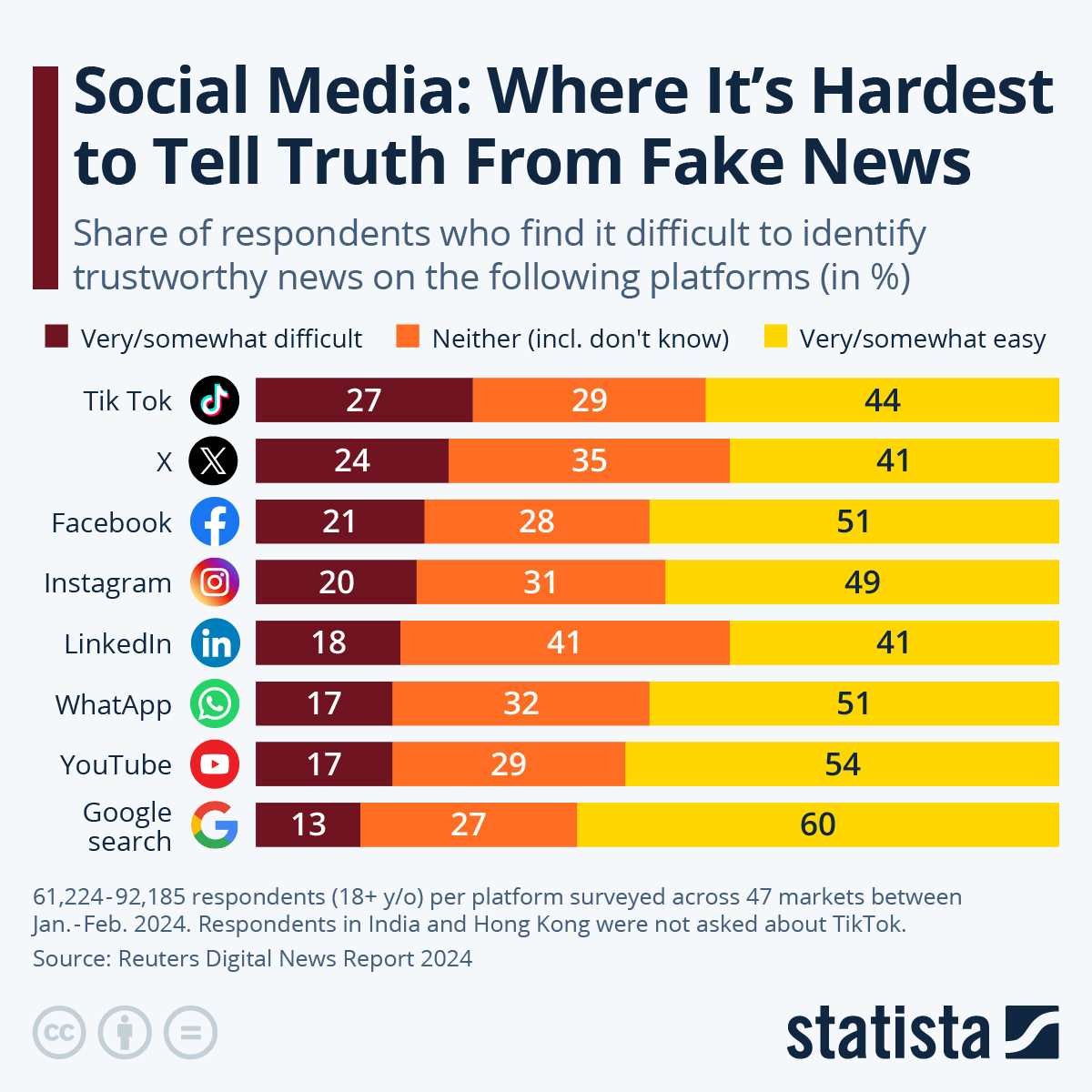
Social media has emerged as the most challenging arena for distinguishing fact from fiction in news content, according to a new survey by the Reuters Institute for the Study of Journalism. The findings highlight growing concerns about misinformation in digital spaces as the information landscape continues to fragment.
The study, which polled news consumers across various markets, found that nearly half of all respondents view social media platforms as environments where truth and falsehood are particularly difficult to separate. This represents a significant trust deficit compared to traditional news sources like print media, television, and radio broadcasts.
Trust levels vary dramatically across different information channels. Traditional news outlets maintain relatively stronger credibility, with only about 29 percent of respondents reporting difficulty determining fact from fiction in television and radio news. Print newspapers fared slightly better, with just 26 percent of participants expressing challenges in verifying their content’s accuracy.
The trust gap appears to stem from fundamental differences in how content is created, vetted, and distributed. Traditional news organizations typically employ professional journalists and editorial standards that include fact-checking and source verification. Social media platforms, by contrast, allow virtually anyone to publish content with minimal oversight, creating an environment where misinformation can spread rapidly.
“What we’re seeing is the consequence of platforms prioritizing engagement over accuracy,” says media analyst Rebecca Thornton, who was not involved in the study. “When algorithms reward emotional reactions and share counts rather than factual integrity, misleading content naturally thrives.”
The implications of this trust deficit extend beyond media consumption habits. As social media platforms have become primary news sources for many users, particularly younger demographics, the challenges in distinguishing reliable information can have far-reaching consequences for public discourse and democratic processes.
Several high-profile incidents have demonstrated the real-world impact of social media misinformation. During recent election cycles across multiple countries, coordinated disinformation campaigns spread through platforms like Facebook, Twitter (now X), and TikTok have threatened to influence voting behavior and undermine confidence in electoral systems.
The problem is compounded by the personalized nature of social media feeds. As users receive algorithmically curated content tailored to their preferences and previous engagement patterns, they may encounter increasingly narrow perspectives that reinforce existing beliefs – a phenomenon researchers call “filter bubbles.”
Platform companies have responded with varying levels of commitment to addressing the issue. Meta, which owns Facebook and Instagram, has expanded fact-checking partnerships and implemented warning labels on questionable content. Twitter under Elon Musk’s ownership has rolled back some content moderation efforts while introducing a community notes feature that allows users to add context to misleading posts.
However, critics argue these measures remain insufficient given the scale of the problem. “Platform companies are fundamentally caught between their business models, which benefit from engagement regardless of content quality, and their responsibilities as de facto public information utilities,” notes digital policy researcher Dr. James Morton.
Media literacy experts emphasize that the responsibility for navigating this complex information environment doesn’t rest solely with platforms or publishers. Increasingly, consumers must develop critical evaluation skills to assess the credibility of sources and claims.
“The distinction between reputable news organizations and unverified social media content has never been more important,” says media literacy advocate Sarah Chen. “Checking multiple sources, looking for original reporting rather than commentary, and considering who benefits from a particular narrative are essential habits in today’s information ecosystem.”
As the digital information landscape continues to evolve, the challenge of separating truth from fiction is likely to remain at the forefront of concerns about media consumption. The significant trust gap between traditional and social media sources serves as a reminder that technological innovation in content distribution has outpaced our collective ability to ensure information quality and integrity.
Fact Checker
Verify the accuracy of this article using The Disinformation Commission analysis and real-time sources.
