


Listen to the article
As tensions flared between nuclear-armed rivals India and Pakistan this month, a digital war of disinformation unfolded alongside military hostilities, threatening to push the countries closer to full-scale conflict.
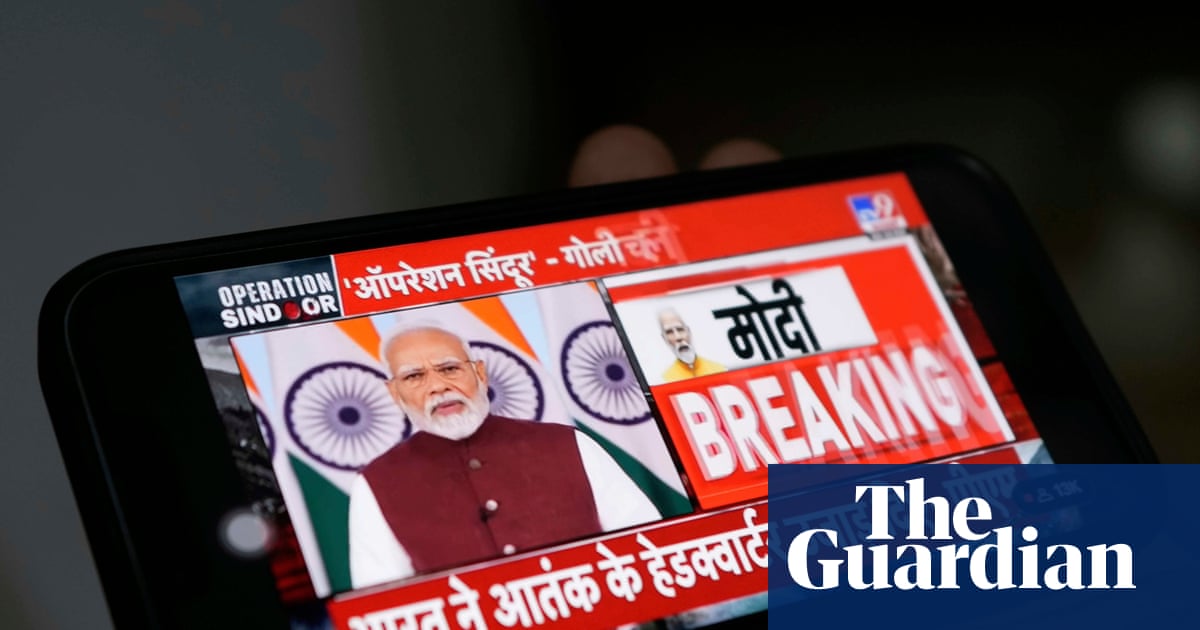
In the wake of India’s announcement of Operation Sindoor—a military offensive against Pakistan following a militant attack in Kashmir that killed 26 people, mainly Indian tourists—a flood of false claims began circulating online. What started as scattered posts on social media platforms quickly escalated into widespread misinformation broadcast as “breaking news” by mainstream media outlets in both countries.
Indian social media accounts and news channels claimed the country had shot down multiple Pakistani jets, captured a Pakistani pilot, taken control of Karachi port, and occupied the city of Lahore. Other fabricated stories alleged that Pakistan’s military chief had been arrested and a coup was underway. “We’ll be having breakfast in Rawalpindi tomorrow,” read one widely shared post, referring to Pakistan’s military headquarters.
These claims were typically accompanied by misleading visuals: a 2023 Israeli airstrike on Gaza presented as an Indian attack on Pakistan; images from naval drills falsely described as India taking over Karachi port; and video game footage passed off as authentic battle scenes. Even AI-generated content was deployed to support false narratives of military victories.
Pakistan’s disinformation machine also operated at full capacity. After the government lifted its ban on X (formerly Twitter) shortly before the conflict, the platform became a hub for misinformation. Pakistani social media accounts, journalists, and government ministers amplified fake claims of capturing an Indian pilot, a coup in the Indian army, and alleged Pakistani strikes crippling India’s defenses. One widely circulated false report claimed a Pakistani cyber-attack had disabled most of India’s power grid.
“This had the power to push two nuclear-armed countries closer to war,” said Joyojeet Pal, associate professor at the University of Michigan’s School of Information, who noted that while both sides spread disinformation, “the scale [in India] went beyond what we have seen before.”
A ceasefire declared on May 10 prevented further military escalation, but the digital information war has raised serious concerns among analysts and human rights advocates. The Washington DC-based Centre for the Study of Organized Hate (CSOH), which tracked misinformation from both sides, warned that this weaponization of false information represents “part of a broader global trend in hybrid warfare.”
The pattern mirrors tactics seen in other conflicts, particularly the Russia-Ukraine war, where recycled footage and fabricated claims of military victories have become common tools for shaping public perception and inflaming tensions.
Social media platforms have faced criticism for their inadequate response. Of 427 concerning posts examined by CSOH on X, some with nearly 10 million views, only 73 received warning labels. “There has been a pretty catastrophic failure on the part of social media platforms to moderate and control the scale of disinformation,” said Raqib Hameed Naik, CSOH’s executive director.
Meta, which owns Facebook, defended its efforts, stating in a written response that it had taken “significant steps to fight the spread of misinformation” by removing content and labeling false stories. X did not respond to requests for comment.
The London Story, a civil society organization, released a report detailing how social media platforms became “fertile ground for the spread of war narratives, hate speech, and emotionally manipulative disinformation” and “drivers of nationalist incitement” in both countries.
In India, scrutiny has fallen particularly on mainstream news outlets. Citizens for Justice and Peace (CJP), an Indian human rights organization, has filed formal complaints against six prominent television channels for “serious ethical breaches” in their reporting of Operation Sindoor.
“Instead of being neutral news broadcasters, they became propaganda collaborators,” said Teesta Setalvad, CJP’s secretary.
Kanchan Gupta, a senior adviser to India’s Ministry of Information and Broadcasting, denied government involvement in the misinformation campaigns and claimed authorities had been “very alert” to the issue. He said the government established a 24-hour monitoring center to track disinformation and worked with social media platforms to remove problematic accounts.
While acknowledging that “strong” notices had been issued to several news channels for violating broadcasting rules, Gupta maintained that the “fog of war is universally accepted as a reality” and that reporting naturally becomes “high-pitch” in conflict situations.
As both countries step back from military confrontation, the digital battlefield has exposed dangerous vulnerabilities in the information ecosystem that could easily inflame future conflicts between these nuclear neighbors.
Fact Checker
Verify the accuracy of this article using The Disinformation Commission analysis and real-time sources.

10 Comments
The weaponization of social media to inflame conflicts is deeply troubling. Policymakers and tech companies must work together to find solutions that uphold free speech while limiting the spread of dangerous falsehoods.
This is a prime example of the dangers of misinformation spreading like wildfire on social media. Fact-checking and responsible journalism are essential to prevent conflicts from spiraling out of control.
Agreed. Verifying information and avoiding the spread of false claims should be the top priority for media outlets covering sensitive international incidents.
This underscores the critical importance of media literacy and the ability to discern truth from falsehood, especially when tensions are high. Responsible reporting has never been more crucial.
Absolutely. Developing robust media literacy skills among the public should be a priority to combat the spread of misinformation and its destabilizing effects.
Deeply concerning how social media can escalate tensions between nuclear-armed rivals. Disinformation has no place in sensitive geopolitical conflicts. Accurate, impartial reporting is critical to avoid further escalation.
This is a sobering reminder that misinformation can have real-world consequences, especially in volatile geopolitical situations. Fact-checking and restraint in reporting are essential to prevent further escalation.
Agreed. The stakes are far too high for irresponsible reporting or the unchecked spread of fabricated claims. Maintaining a clear separation between truth and fiction is crucial.
The dissemination of false information during this India-Pakistan conflict highlights the urgent need for greater digital literacy and media accountability. Responsible journalism is paramount in defusing such tense situations.
It’s alarming to see how quickly fabricated stories and misleading visuals can be amplified online, blurring the line between fact and fiction. Stricter content moderation is needed to curb this.