


Listen to the article
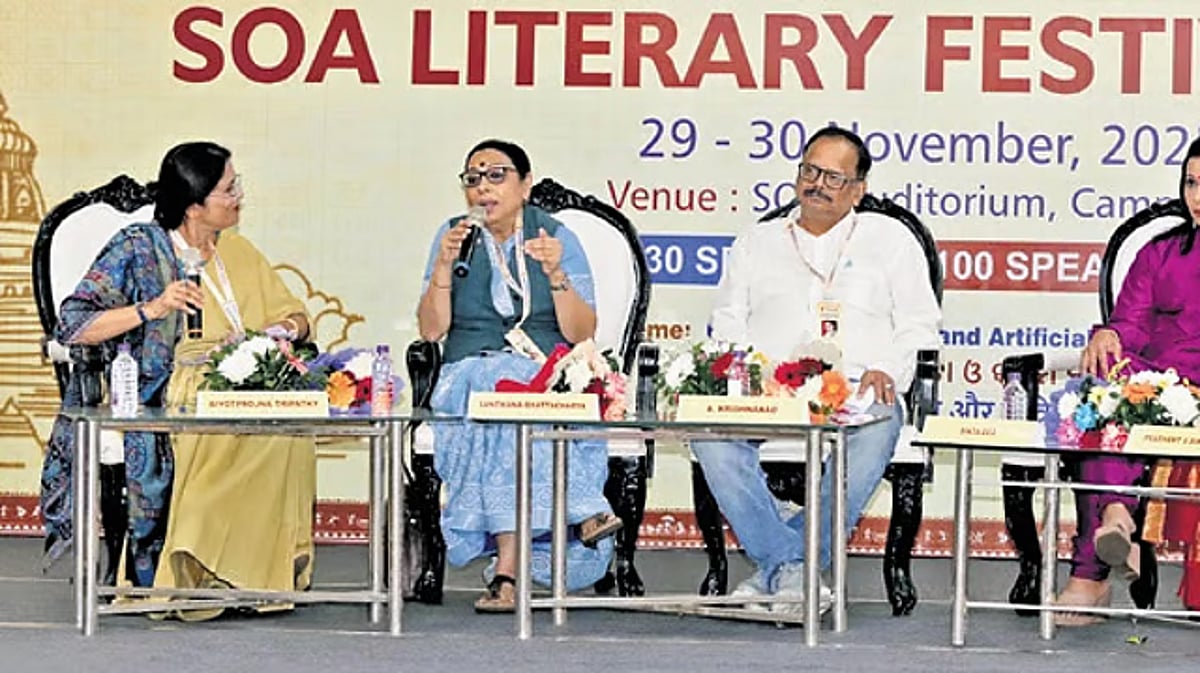
In an era dominated by digital information, the line between journalism and social media continues to blur, creating challenges for readers seeking reliable information. This growing concern took center stage at the SOA Literary Festival-2023 in Bhubaneswar on Sunday, where leading journalists gathered to discuss the session “Noise, News, Narrative: Whose Truth Do We Trust.”
Santwana Bhattacharya, editor of The New Indian Express Group, emphasized that a journalist’s fundamental responsibility is to present truth based on verifiable evidence. “There is noise, which is most often deliberate, engineered and calibrated, but the responsibility of a journalist is to pick up truth and facts and present them before the people,” she said, drawing a clear distinction between evidence-based reporting and manufactured narratives.
Illustrating her point with recent coverage of the Bihar elections, Bhattacharya described how a narrative emerged from Delhi about Chief Minister Nitish Kumar’s failing health and voter list irregularities. However, when she visited Bihar personally, she discovered ground realities that contradicted this narrative, including unexpected public sympathy for Kumar. This disconnect highlighted the danger of reporting that fails to incorporate direct observation.
The panel acknowledged that journalism faces a crisis today, though Bhattacharya contended this stems more from internal problems than external pressures from social media. “Journalists are not in competition with social media influencers,” she noted, while cautioning that reporters must avoid allowing personal ideologies to influence their work.
She pointed to impactful environmental reporting from The New Indian Express’s Bhubaneswar edition that led to government reconsideration of a project involving road construction in protected forest areas. “That is the power of journalism,” she emphasized, demonstrating how factual reporting can drive tangible change.
A. Krishna Rao, who brings perspectives as a journalist, poet, and literary critic, reinforced that news should represent unembellished truth. He warned that ideological influences compromise journalistic integrity and ultimately undermine the profession’s core purpose.
Fellow panelists Sikta Deo and Prashant V. Singh focused on social media’s role in narrative-setting. They noted the aggressive spread of misinformation through digital platforms and stressed the importance of rigorous fact-checking to separate authentic news from fabricated content. Their comments reflect growing concerns across the media landscape about how rapidly false information can spread through digital channels before traditional verification processes can respond.
The session was moderated by writer and filmmaker Biyot Projna Tripathy, who guided the discussion through these complex media landscape challenges.
The festival also featured the presentation of the SOA Yuva Sahitya Puraskar to young writer Suryasnata Tripathy for his short story collection “Thia Puchi Naranga.” The award, presented by SOA Vice-president Saswati Das, included a silver plaque, citation, shawl, and cash prize of Rs 1 lakh, highlighting the festival’s commitment to recognizing emerging literary talent.
The event was presided over by Pro Vice-Chancellor of SOA Prasanta Kumar Patra, with additional addresses from Gayatribala Panda, head of PPRACHIN and festival director, and Jyoti Ranjan Das, dean of students’ welfare and chief coordinator.
As traditional and social media continue to evolve in tandem, this discussion underscores the ongoing challenge for both journalists and consumers to maintain critical thinking skills in navigating today’s complex information environment. The consensus among these experienced journalists points to a continued need for professional standards that prioritize verification, direct observation, and ethical reporting practices as essential safeguards against misinformation.
Fact Checker
Verify the accuracy of this article using The Disinformation Commission analysis and real-time sources.

11 Comments
It’s concerning to hear how social media can distort news coverage and create false narratives. This underscores the need for robust fact-checking and verification processes in journalism.
This is an important discussion on the challenges journalists face in the digital age. Fact-checking and on-the-ground reporting are vital to cut through the online noise and provide reliable information to the public.
Absolutely. Journalists need to remain vigilant and maintain their journalistic integrity, even as the lines between news and social media continue to blur.
Social media has definitely amplified the spread of misinformation and distorted narratives. It’s crucial that journalists uphold their duty to present facts and evidence-based reporting, rather than contributing to the noise and confusion.
The distinction between journalism and social media is an important one that needs to be emphasized. Fact-based reporting should always take priority over engineered narratives or manufactured noise.
This panel discussion raises critical questions about the role of media in an era of widespread misinformation. Journalists have a responsibility to cut through the noise and provide citizens with truthful, evidence-based reporting.
Agreed. Maintaining journalistic standards and public trust should be the top priorities, even as the media landscape becomes increasingly complex and challenging.
This panel discussion highlights the critical role journalists play in cutting through the clutter of online information and providing citizens with reliable, evidence-based news. Maintaining public trust should be a top priority.
This is a timely discussion on the dangers of social media-driven news. Journalists must remain vigilant and committed to their core mission of providing truthful, unbiased information to the public.
Absolutely. Upholding journalistic integrity and standards is crucial in an era where misinformation can spread so rapidly online.
The example of the Bihar election coverage highlights how easily narratives can be engineered online, even when they don’t reflect the actual ground realities. Journalists must be proactive in verifying information and countering false narratives.