


Listen to the article
Americans Grow Less Supportive of Online Content Restrictions, Survey Finds
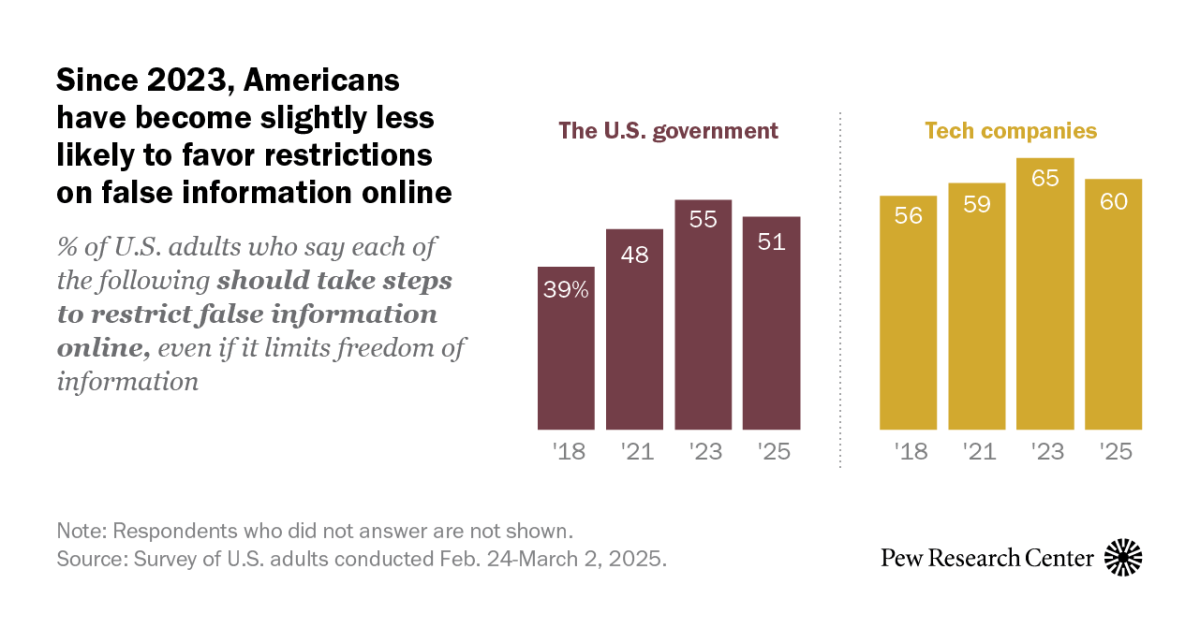
Public support for restricting false information and violent content online has declined over the past two years, according to new data from Pew Research Center. The shift marks a reversal of previous trends that had shown increasing acceptance of content moderation.
Currently, 51% of Americans believe the U.S. government should take steps to restrict false information online, even if it limits freedom of information. This represents a four-percentage-point drop from 55% in 2023. Similarly, 60% of Americans support tech companies implementing such restrictions, down from 65% two years ago.
The decline in support for content restrictions is even more pronounced regarding extremely violent content. Only 52% of Americans now favor government action to limit violent content online, compared to 60% in 2023. Support for tech company intervention in this area has plummeted 13 percentage points, from 71% to 58%.
These findings come at a pivotal moment in the ongoing debate about online speech and content moderation. The survey, conducted between February 24 and March 2, 2025, followed significant policy shifts, including Meta’s announcement ending its fact-checking program and President Donald Trump’s January executive order titled “Restoring Freedom of Speech and Ending Federal Censorship.”
The political landscape surrounding content moderation continues to evolve rapidly. Some lawmakers are now pushing to repeal Section 230, the law that shields social media companies from liability for user-posted content on their platforms.
Partisan divisions on these issues remain significant but are narrowing in unexpected ways. Democrats continue to show stronger support for content restrictions than Republicans, but the gap has diminished substantially as Democratic support has fallen sharply. In 2023, 70% of Democrats supported government restrictions on false information; today, only 58% do—a 12-point decrease. Republican support has remained relatively stable, moving from 39% to 43% during the same period.
The partisan shift is even more dramatic regarding violent content. Democratic support for tech companies restricting violent content plummeted from 83% in 2023 to 65% today. Republicans also showed decreased support, dropping from 61% to 51%.
These changes appear to correlate with presidential administrations. Democratic support for government restrictions on false information has been highest during President Biden’s administration (2021-2023) and lowest during Trump’s terms (2018 and 2025). Republican views have been more consistent across administrations, though they dipped after Biden took office in 2021.
The survey reveals a notable increase in Americans prioritizing freedom of information over content restrictions. Currently, 42% of Democrats say freedom of information should be protected, even if it means extremely violent content can be published—a significant shift from previous positions.
Republicans remain nearly evenly split on whether the government should restrict extremely violent content (48% support restrictions versus 50% opposing them). They show similar division on tech company restrictions (51% in favor, 47% opposed).
These findings suggest a broader shift in American attitudes toward online speech and content moderation. After years of increasing acceptance of restrictions to combat misinformation and harmful content, the pendulum appears to be swinging back toward prioritizing freedom of information—a change that crosses partisan lines but is most pronounced among Democrats.
The Pew survey included 5,123 U.S. adults and was conducted through the organization’s American Trends Panel, which uses random sampling of residential addresses to create a nationally representative sample weighted for factors including gender, race, ethnicity, partisan affiliation, and education.
Fact Checker
Verify the accuracy of this article using The Disinformation Commission analysis and real-time sources.

12 Comments
This survey data suggests a growing wariness about government and tech company oversight of online speech. While the risks of harmful content are real, overly aggressive moderation can also infringe on civil liberties. Striking the right balance will be crucial.
This is a tricky balance to strike – protecting free expression while also limiting the spread of misinformation and extreme content. I imagine there are valid arguments on both sides of this issue.
Agreed, it’s a complex topic without easy answers. Reasonable people can disagree on where to draw the line.
It’s an interesting shift in public opinion on online content moderation. I can understand the desire for free speech, but false and violent content can also be very harmful. Curious to see how this debate evolves over time.
Interesting to see the decline in public support for content moderation, even as the harms of misinformation and violent content online remain significant. Policymakers will need to carefully weigh these competing interests moving forward.
I’m curious to understand the underlying drivers behind this decline in support for content restrictions. Is it a reaction to perceived overreach, or a broader shift in attitudes around online speech? This is a complex issue without easy answers.
The survey results reflect an interesting shift in public sentiment. It will be important for policymakers to carefully consider how to address online harms while preserving fundamental freedoms. Thoughtful dialogue on this issue is critical.
The public’s shifting attitudes on online content moderation reflect the complexities of this debate. Reasonable people can disagree on where to draw the line between free speech and harmful content. Continued dialogue and compromise will be essential.
Declining public support for content restrictions could undermine efforts to curb the spread of harmful online material. However, overly aggressive moderation can also infringe on civil liberties. This is a nuanced debate with valid concerns on multiple sides.
This is a challenging issue without clear solutions. Protecting free expression is vital, but the proliferation of false and violent content online also poses serious risks. Balancing these interests will require a delicate touch from policymakers.
It’s an interesting development to see public support for content restrictions declining, even as the harms of misinformation and extremism online remain pressing concerns. Policymakers will need to carefully navigate this nuanced issue going forward.
The survey findings suggest a growing skepticism about government and tech company intervention in online speech. While the risks of harmful content are real, overzealous moderation can also be problematic. Thoughtful, nuanced approaches will be crucial.