


Listen to the article
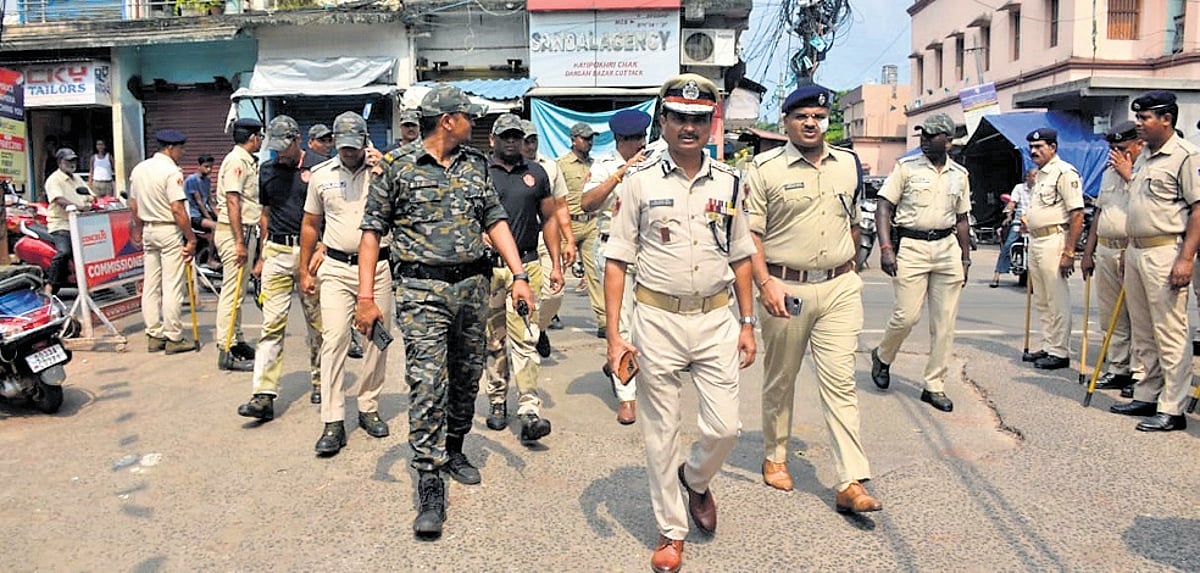
Police in Cuttack conducted a flag march through sensitive areas of the city on Friday, demonstrating heightened vigilance following recent violence. The operation focused on the Dargah Bazaar and Qadam-e-Rasool neighborhoods, areas known for their religious significance.
Police Commissioner S Dev Datta Singh, accompanied by Cuttack Deputy Commissioner of Police Khilari Rishikesh Dnyandeo, personally visited these locations to assess security arrangements and review police deployment. The high-level inspection underscores authorities’ concerns about maintaining peace in the wake of community tensions.
“The situation is normal in Cuttack,” Commissioner Singh told reporters during his visit. He explained that specific arrangements had been made to accommodate prayer gatherings for one community, which he personally reviewed to ensure adequacy and appropriateness.
In a stern warning, Singh emphasized that authorities would take decisive action against those spreading inflammatory content online. “We will continue our crackdown against false information,” he stated, addressing growing concerns about the role of social media in amplifying tensions in the region.
The commissioner specifically targeted individuals claiming ignorance after posting problematic material. “It will not be tolerated if people, after posting objectionable content on social media, say that they have forgotten,” Singh declared. “Those who disturb peace and harmony will be identified and punished as per the law.”
Law enforcement has already begun enforcement actions, with two individuals arrested for sharing objectionable content. Additionally, police have removed over 300 offensive posts from various social media platforms as part of their efforts to prevent digital provocations from sparking real-world violence.
The flag march represents a visible show of force, designed both to reassure law-abiding residents and deter potential troublemakers. Such demonstrations are standard practice in Indian cities during periods of communal sensitivity, particularly in regions with diverse religious populations like Odisha’s Cuttack district.
Singh emphasized that the current police deployment is precautionary rather than reactive. “I urge the residents of Cuttack to enjoy the festivities,” he said, suggesting that authorities do not want security concerns to overshadow scheduled celebrations in the city.
The commissioner’s message carried a clear threat of serious consequences for those attempting to disrupt the peace. “Any deliberate attempt to mislead the public or destabilize law and order will be met with uncompromising action,” he warned, adding that charges could include sedition, one of the most serious offenses in the Indian legal system.
This incident highlights the growing challenge Indian authorities face in managing the intersection between online speech and public order. Social media platforms have become battlegrounds where misinformation and provocative content can rapidly intensify existing social tensions.
Cuttack, one of Odisha’s largest cities with a population exceeding half a million, has historically maintained relatively harmonious community relations despite its diverse religious makeup. The Dargah Bazaar area, named for its proximity to a Muslim shrine, and Qadam-e-Rasool, which houses a sacred Islamic relic, are particularly sensitive zones that authorities monitor closely.
The Commissionerate Police, which has jurisdiction over both Cuttack and the state capital Bhubaneswar, has increasingly focused on monitoring digital communications alongside traditional policing. This dual approach reflects the evolving nature of maintaining public order in an increasingly connected society.
As the situation develops, local residents remain hopeful that the preventive measures will succeed in maintaining stability and allowing the city’s planned festivities to proceed without incident.
Fact Checker
Verify the accuracy of this article using The Disinformation Commission analysis and real-time sources.
