


Listen to the article
A Pakistani high court judge signaled Monday that recent amendments to the country’s cybercrime law will remain in effect during legal challenges, despite concerns from journalists’ organizations about potential threats to press freedom.
During a hearing at the Islamabad High Court, Justice Inam Ameen Minhas stated that the amended Prevention of Electronic Crimes Act (PECA) represents enacted legislation that “cannot be suspended through an injunction.” The court will make its final determination after full proceedings, with the next hearing scheduled for March 6.
The case involves petitions filed jointly by prominent media organizations, including the Pakistan Federal Union of Journalists (PFUJ) and the Islamabad High Court Journalists Association (IHCJA), challenging what they describe as controversial changes to Pakistan’s digital content regulations.
Attorney Mian Samiuddin, representing the IHCJA, argued that the amendments inappropriately transfer powers from the judiciary to executive authorities. He advocated for the establishment of a judicial tribunal appointed in consultation with Pakistan’s chief justice to provide proper oversight.
Justice Minhas raised pointed questions about Section 2C of the amended law, which prohibits “fake and false” social media posts. He specifically asked who would determine whether information qualifies as fake or false, and how such content would be identified before legal proceedings begin.
Samiuddin highlighted particularly troubling aspects of the new regulations, including provisions allowing third parties—not just affected individuals—to file complaints against alleged violations. This expansion, he warned, could enable the use of proxies to target journalists and lead to systematic misuse of the law. He emphasized the importance of establishing harm criteria, noting that minor factual errors causing no actual damage should not trigger severe penalties.
The National Assembly passed these PECA amendments last year under a supplementary agenda, significantly expanding government authority over digital content. The PECA (Amendment) Act 2025 establishes a Digital Rights Protection Authority with broad powers to remove online content, block access to prohibited materials, and penalize those who share such content.
The revised legislation also expands the definition of “social media platforms” to encompass tools and software used to access these platforms, effectively extending the law’s reach to websites, applications, and various communication channels across the digital landscape.
Under the amended framework, Pakistan’s Federal Investigation Agency (FIA) Cybercrime Wing will be disbanded and replaced with what government officials describe as a more robust enforcement mechanism. The penalties are substantial—individuals sharing expunged material from parliamentary or provincial assembly proceedings on social media could face up to three years imprisonment and fines of up to 2 million Pakistani rupees (approximately $7,200).
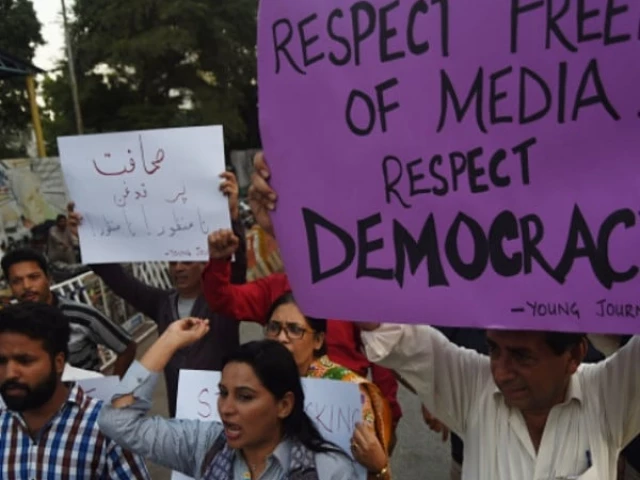
Media rights advocates have expressed growing alarm about the amendments, viewing them as part of a broader pattern of constraints on journalistic freedom in Pakistan. Press organizations have documented increasing incidents of harassment, intimidation, and legal pressure against journalists in recent years.
Pakistan’s ranking in global press freedom indices has declined steadily over the past decade, with international watchdog organizations citing regulatory restrictions, physical threats to journalists, and economic pressures on independent media outlets as significant concerns.
The case represents a critical test for digital rights and press freedoms in Pakistan, as courts balance national security interests with constitutional protections for expression and information access in the rapidly evolving digital media landscape.
Fact Checker
Verify the accuracy of this article using The Disinformation Commission analysis and real-time sources.

7 Comments
This is a complex issue with valid arguments on both sides. On one hand, the court believes the amended PECA law is legitimate legislation that shouldn’t be blocked. But the journalists raise legitimate concerns about potential threats to press freedom. The final ruling will set an important precedent.
This is a nuanced situation where security and civil liberties need to be carefully balanced. While the court seems inclined to let the PECA amendments stand during the legal challenge, the journalists’ worries about threats to press freedom are legitimate and warrant serious consideration. The final ruling will set an important precedent.
The PECA amendments seem to shift more content oversight powers to the executive branch, which could open the door to abuse. I’m curious to see how the court ultimately rules on the journalists’ concerns about threats to press freedom. A balanced approach is needed.
I agree, the transfer of powers from the judiciary to the executive is worrying. Careful judicial oversight will be critical to ensuring the new cybercrime law is applied fairly and doesn’t infringe on legitimate speech.
The court’s stance that the PECA amendments cannot be suspended by injunction suggests it sees the changes as valid, despite the journalists’ objections. It will be interesting to see how the full proceedings play out and whether the court ultimately upholds the amended law or finds a way to address the press freedom concerns.
This is an interesting development in Pakistan’s cybercrime legislation. While concerns over press freedom are valid, the court’s stance that the amended law cannot be suspended suggests it sees the changes as legitimate. It will be worth monitoring the final outcome and how it balances security and civil liberties.
You raise a good point. The court seems inclined to let the new law stand during the legal challenge process. This will test how the amendments are implemented and their real-world impacts on media and citizens.