


Listen to the article
Islamabad High Court Questions “Fake News” Determination in Amended Cybercrime Law
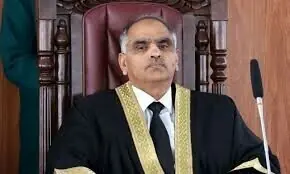
A judge of the Islamabad High Court (IHC) raised critical questions Monday about the mechanism for determining what constitutes “fake news” under Pakistan’s amended Prevention of Electronic Crimes Act (Peca), highlighting concerns about potential government overreach in restricting free expression.
Justice Raja Inaam Ameen Minhas posed the questions during a hearing on petitions filed by prominent journalists and media organizations challenging the controversial amendments to the cybercrime law. The petitioners, including senior journalist Hamid Mir, the Pakistan Federal Union of Journalists (PFUJ), and the Islamabad High Court Journalists Association, argue that the amendments severely restrict freedom of expression and transfer judicial powers to executive authorities.
“Who will decide whether the information is fake or false?” Justice Minhas asked during the proceedings. “Explain how fake news will be determined. How will proceedings regarding fake news begin?”
The counsel for the petitioners explained that the amended law introduces a troubling mechanism allowing not only aggrieved parties but also third parties to file complaints about alleged fake news. This provision, they argued, creates opportunities for proxy complaints and potential misuse of the law against journalists and media outlets.
“This provision opens the door for proxies to file complaints, which will inevitably lead to misuse of the law,” the counsel stated, adding that it was essential to assess actual harm caused by alleged misinformation since not every incorrect statement amounts to deliberate disinformation. “Fake information can also be the result of an error that does not cause harm to anyone.”
The petitioners’ counsel emphasized that matters concerning the determination of false information should be adjudicated by an independent judicial tribunal established in consultation with Pakistan’s chief justice, rather than by executive authorities with potential political motivations.
During the proceedings, Rawalpindi-Islamabad Union of Journalists President Asif Bashir Chaudhry informed the court that the PFUJ had initially approached the court regarding Peca on February 6 last year, but the case had remained pending without any stay order. Chaudhry claimed that during this period, more than two dozen journalists had been sentenced to life imprisonment under the law’s provisions.
He cited a case where a journalist was prosecuted merely for reporting on the use of substandard materials in road construction—reporting that was later vindicated when the road required early demolition due to poor quality.
Justice Minhas noted that since the matter involved legislation enacted by parliament, such a law could not be suspended through an interim restraining order. “This is legislation. It cannot be suspended through an interim order,” the judge remarked, adding that the court would decide after hearing detailed arguments from all sides. The hearing was subsequently adjourned until March 6.
Peca has faced intense criticism since its introduction in 2016, with critics labeling it a “black law” designed primarily to punish political dissent. Last year’s amendments further intensified concerns by introducing harsher penalties for alleged “fake news,” expanding state oversight of digital platforms, and creating new regulatory bodies with broad powers to monitor social media content.
International human rights organizations have expressed serious concerns about the law. Amnesty International warned that the changes could “further tighten the government’s grip over Pakistan’s heavily controlled digital landscape,” while the Human Rights Commission of Pakistan (HRCP) stated that the amendments “would curb fundamental rights.”
The controversy reflects broader tensions in Pakistan between the government’s stated concerns about misinformation and the media community’s fears of censorship. In August 2025, the Senate Standing Committee on Information and Broadcasting expressed concern over the registration of cases against journalists under Peca and called for urgent action to address the media’s growing concerns regarding arrests and legal actions against journalists.
The case highlights the delicate balance between combating harmful misinformation and protecting the essential role of a free press in a democratic society, a challenge that many countries are currently grappling with in the digital age.
Fact Checker
Verify the accuracy of this article using The Disinformation Commission analysis and real-time sources.

8 Comments
The judge’s skepticism about the ‘fake news’ provisions is justified. Vague, subjective definitions of misinformation are a dangerous path that can undermine the free flow of information and public discourse.
Absolutely. Any laws regulating online content must have robust safeguards to protect legitimate criticism and dissent, not just unverified claims. The stakes for free expression are high.
The amended cybercrime law seems to give the government broad discretion to determine what constitutes ‘fake news’. Establishing clear, objective criteria will be crucial to prevent this from being misused for political purposes.
This is an important debate over the limits of government power in regulating online content. The judge’s probing questions highlight the need for robust checks and balances to prevent the abuse of cybercrime laws.
Journalists and media groups are right to be concerned about the implications of this amended law. Preserving press freedom and preventing government overreach should be top priorities in this debate.
Defining ‘fake news’ is a challenging and complex issue. The judge’s skepticism about the mechanisms in the amended law is understandable – the criteria must be well-defined to avoid abuse and ensure fairness.
Agreed. Vague or overly broad definitions of ‘fake news’ open the door to censorship. Careful consideration is needed to strike the right balance between addressing misinformation and safeguarding free speech.
The judge’s questions highlight important concerns about how ‘fake news’ will be defined and determined under the amended cybercrime law. Clear, transparent processes are crucial to avoid potential government overreach and protect free expression.