


Listen to the article
In an age of digital misinformation, false content spreads six times faster than factual news across social platforms, according to recent studies. This alarming trend has given rise to what experts call “internet frenzy” – a chaotic form of rapid engagement driven by AI-generated content, spam, and an overall decline in quality information.
The mechanics behind this phenomenon are straightforward but troubling. Shocking or emotionally charged content, regardless of its accuracy, travels rapidly as users engage and share posts. Higher engagement translates to broader reach, allowing false information to cascade across digital spaces with remarkable efficiency.
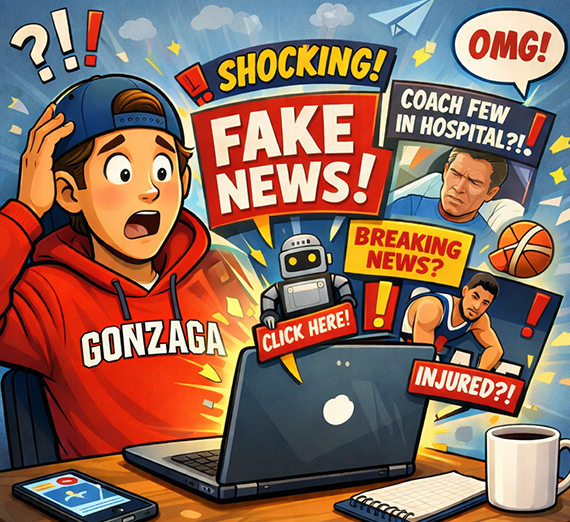
Gonzaga University, celebrated for its school spirit, athletic prowess, academic excellence, and Jesuit values, has become a prime target for this type of misinformation. The university’s passionate fan base, particularly during basketball season, creates fertile ground for clickbait and fabricated stories.
“With Gonzaga’s national profile and dedicated following, distinguishing between legitimate news and fabricated content has become increasingly challenging for fans and community members,” says media literacy expert James Harrison. “The emotional connection people have with the institution makes them particularly vulnerable to sensationalist headlines.”
Recent examples highlight the severity of the problem. One fabricated story claimed Gonzaga was building a new $3.2-billion upgraded arena – completely false information generated by AI for clicks. Another falsely claimed that head coach Mark Few had been hospitalized, using the alarming headline to drive traffic to unverified websites.
These posts follow a predictable pattern: they appear on unverified websites, employ emotionally charged headlines, mix legitimate names with fabricated claims, and target passionate audiences like sports enthusiasts. Their primary goal is generating engagement rather than reporting facts.
The tactics have become increasingly sophisticated. Clickbait accounts targeting high-profile programs like Gonzaga basketball carefully weave factual elements – such as coach and player names or authentic images – with AI-generated content and false information. This blending of truth and fiction makes the deception particularly effective.
Digital media analyst Sophia Chen explains, “These operations understand fan psychology extremely well. By incorporating enough familiar and accurate details, they create a veneer of credibility that can fool even relatively savvy consumers.”
Media literacy experts recommend several strategies to identify and avoid fake news about Gonzaga or any institution:
First, get information directly from verified sources. Official university accounts, reputable news organizations, and journalists with established credentials remain the most reliable information channels.
Second, carefully examine URLs before clicking. Fraudulent sites often mimic legitimate ones with subtle alterations, such as “gonzagaa.edu” instead of “gonzaga.edu.”
Third, be skeptical of extreme language. Excessive punctuation, all-capital-letter text, and emotionally manipulative wording often signal questionable content.
Fourth, approach images and videos with caution, as visual content can be manipulated or presented out of context. In several cases, AI-generated imagery has been used to create entirely fictional scenarios featuring Gonzaga athletes or facilities.
Finally, look for named authors with verifiable credentials. Anonymous sources or claims from unidentified “insiders” warrant additional scrutiny.
The university has responded by strengthening its official digital presence and encouraging community members to verify information through legitimate channels before sharing.
“Misinformation doesn’t just mislead people temporarily – it can damage institutional reputations and create unnecessary alarm among stakeholders,” notes university communications specialist Maria Delgado. “Fighting fake news requires both institutional vigilance and consumer education.”
As digital literacy becomes increasingly essential, the Gonzaga community’s experience offers a case study in how passionate fan bases can be targeted – and how awareness serves as the first line of defense against the spread of misinformation in an increasingly complex information landscape.
Fact Checker
Verify the accuracy of this article using The Disinformation Commission analysis and real-time sources.

10 Comments
As a long-time Gonzaga fan, I’m glad to see the university taking a strong stance against misinformation. In today’s digital landscape, it’s crucial that we all stay vigilant and rely on reputable sources.
Absolutely. Misinformation can spread like wildfire, especially around topics like college sports that people are so passionate about.
This is a timely and crucial issue. I’m glad to see Gonzaga taking it seriously and working to combat the spread of false information, especially around topics that generate a lot of passion and engagement.
Agreed. Misinformation can be particularly problematic in the context of college sports, where emotions and team loyalties run high. Gonzaga’s approach is commendable.
This is an important issue facing universities and their communities. Kudos to Gonzaga for proactively addressing the problem of false claims and ‘internet frenzy.’ Maintaining credibility and public trust is vital.
Agreed. Misinformation undermines the integrity of important institutions like universities. I hope more schools follow Gonzaga’s lead.
Kudos to Gonzaga for recognizing the threat of misinformation and taking proactive steps to address it. Maintaining integrity and public trust is critical for universities.
The statistics on the rapid spread of misinformation are alarming. It’s encouraging to see Gonzaga taking steps to combat this challenge. Digital literacy is crucial for students and fans alike.
Misinformation can be particularly problematic around topics like college sports, where emotions and team loyalties run high. Gonzaga’s approach to this issue sets a good example.
You’re right. Sports fans can be especially susceptible to falling for false claims. Fact-checking and media literacy are so important.