


Listen to the article
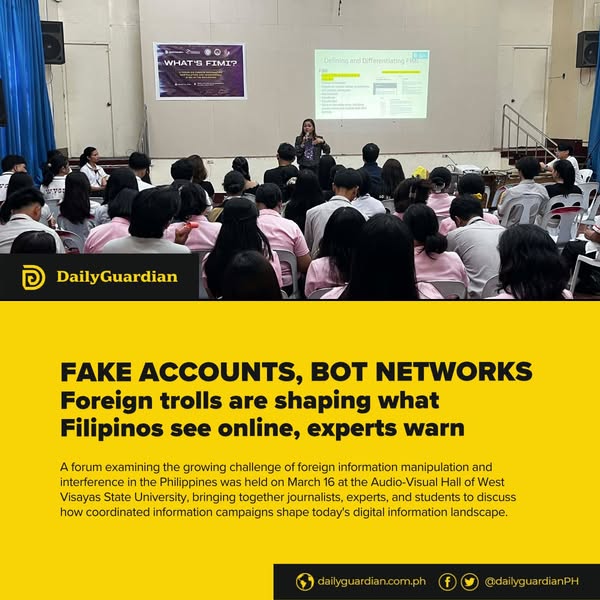
In a timely response to emerging digital threats, West Visayas State University hosted a crucial forum addressing the mounting challenge of foreign information manipulation and interference in the Philippines. The event, held on March 16 at the university’s Audio-Visual Hall, brought together an influential group of journalists, media experts, and students to examine the increasingly complex landscape of misinformation in the country.
The forum comes amid growing concern about foreign actors attempting to influence Philippine public opinion and democratic processes through coordinated disinformation campaigns on social media platforms. Participants explored how these sophisticated operations exploit existing social divisions and technological vulnerabilities to shape political narratives.
Media professionals attending the event highlighted the evolving tactics used by both domestic and foreign entities to spread false information. These include the use of artificial intelligence to create deepfake videos, coordinated bot networks to amplify misleading content, and the strategic targeting of emotional issues to maximize engagement and division.
“What we’re seeing is unprecedented in scale and sophistication,” said one participating journalist who specializes in digital security. “Foreign interference operations no longer rely on crude propaganda but instead blend into existing conversations, making them much harder to detect and counter.”
The Philippines, with its high social media usage rates and upcoming electoral cycles, has become particularly vulnerable to such manipulation. According to recent studies, Filipinos spend an average of four hours daily on social media – among the highest rates globally – creating an ideal environment for information operations to flourish.
University officials emphasized the importance of hosting such discussions in academic settings, where critical thinking skills can be developed among future media professionals and citizens. “Universities must serve as bastions of truth and critical inquiry in an era where facts themselves are under assault,” noted a faculty member from the university’s communication department.
Students participating in the forum expressed concern about their ability to distinguish genuine information from manipulation. Many acknowledged regularly encountering suspicious content on their social media feeds but feeling ill-equipped to verify its authenticity.
The forum also addressed the economic and geopolitical motivations behind foreign interference campaigns. Experts pointed to the strategic location of the Philippines in the South China Sea and its traditional alliance with the United States as factors making it a prime target for competing influence operations from various international actors.
Media literacy emerged as a central focus during discussions, with participants agreeing that building resilience against manipulation requires a multi-faceted approach. This includes strengthening journalistic standards, promoting digital literacy programs, and developing more robust legal frameworks to counter foreign interference while protecting free speech.
“The challenge we face isn’t just technological – it’s deeply social and political,” explained a media studies researcher present at the event. “Solutions must address both the supply side of disinformation and the demand side – why people are susceptible to it.”
The gathering concluded with participants establishing informal networks to continue monitoring and responding to information manipulation threats. Several journalists committed to developing specialized reporting techniques to expose foreign interference operations more effectively.
As the Philippines approaches future election cycles, forums like this highlight the growing recognition that protecting information ecosystems has become a fundamental national security concern. The consensus among participants was that addressing these challenges requires collaboration between government agencies, media organizations, educational institutions, and civil society groups.
West Visayas State University officials indicated plans to develop this initial forum into a regular series, potentially expanding to include international partners facing similar challenges to information integrity.
Fact Checker
Verify the accuracy of this article using The Disinformation Commission analysis and real-time sources.

7 Comments
I’m curious to learn more about the specific tactics and narratives being used by foreign actors in the Philippines. Understanding their methods and goals is crucial to developing effective countermeasures. This forum seems like a valuable step in that direction.
This is a critical issue that deserves serious attention. Foreign interference in domestic politics through disinformation is a growing threat to democracies worldwide. I’m glad to see this university taking proactive steps to educate and empower the public against such manipulation.
While the threat of foreign interference is concerning, I’m encouraged to see the Philippines taking proactive steps to address it. Strengthening democratic institutions and empowering citizens to be discerning consumers of information is the best defense against these manipulation attempts.
The use of AI-generated deepfakes and coordinated bot networks to amplify false narratives is particularly concerning. It’s crucial that media professionals and the public remain vigilant and develop the skills to identify and counter these increasingly sophisticated tactics.
Absolutely. Building media literacy and critical thinking are key to combating the spread of disinformation. Kudos to the organizers for bringing experts together to explore these challenges and equip attendees with the knowledge to discern truth from fiction.
Disinformation campaigns that exploit emotional issues and social divisions are particularly insidious. Addressing the root causes of these divisions and promoting social cohesion should be part of the broader strategy to counter foreign interference.
This forum highlights the importance of international cooperation in tackling the global challenge of information manipulation. Sharing best practices and coordinating responses across borders will be crucial to protecting the integrity of democratic processes worldwide.