


Listen to the article
Finland’s schools are teaching children to fight fake news with critical thinking skills, positioning the nation at the forefront of information literacy education in an age of widespread disinformation.
“You can start when children are very young,” explains Kari Kivinen, a Helsinki school head teacher. “Fairytales work well. Take the wily fox who always cheats the other animals with his sly words. That’s not a bad metaphor for a certain kind of politician, is it?”
Finland, recently rated Europe’s most resistant nation to fake news, has incorporated media literacy as a core component across subjects in its national curriculum since 2016. The comprehensive approach is part of a government strategy developed after 2014, when Finland first became a target of Russian disinformation campaigns.
In Kivinen’s secondary school, students learn how statistics can be manipulated in mathematics classes. Art lessons examine how images can be altered to change meaning. History classes analyze propaganda campaigns, while language teachers focus on how words can deceive and mislead.
“The goal is active, responsible citizens and voters,” Kivinen explains. “Thinking critically, factchecking, interpreting and evaluating all the information you receive, wherever it appears, is crucial. We’ve made it a core part of what we teach, across all subjects.”
Finland’s approach treats information literacy almost as a matter of national security. Jussi Toivanen, chief communications officer for the prime minister’s office, frames the issue broadly: “This affects all of us. It targets the whole of Finnish society. It aims to erode our values and norms, the trust in our institutions that hold society together.”
The country, which declared independence from Russia in 1917, now finds itself on the frontline of an information war that has intensified since Moscow’s annexation of Crimea. Most disinformation campaigns targeting Finland focus on undermining the European Union, amplifying immigration concerns, and influencing debate over Finland’s potential NATO membership.
The Finnish program is coordinated by a high-level committee representing 20 different government ministries, welfare organizations, police, and intelligence services. Over the past three years, it has trained thousands of civil servants, journalists, teachers, and librarians.
“It’s a broad-based, coordinated effort to raise awareness,” says Saara Jantunen, a senior defense ministry researcher seconded to the prime minister’s office. “Like virus protection on your computer: the government’s responsible for a certain amount, of course, but ultimately it’s up to the individual to install the software.”
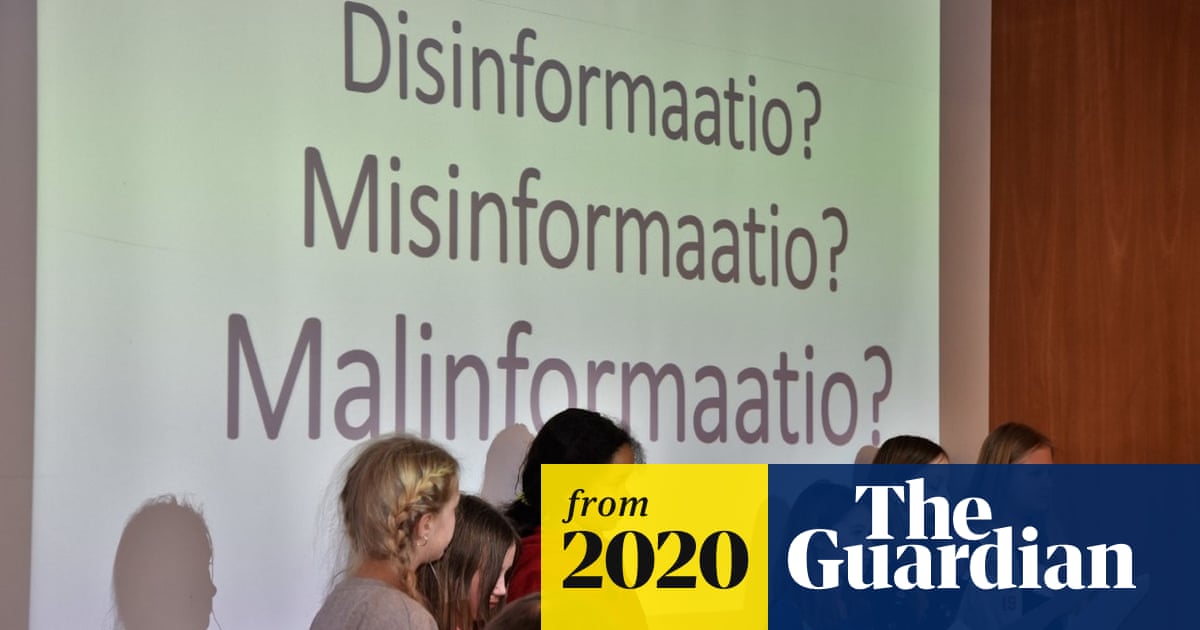
For young students, Kivinen avoids using the term “fake news,” instead teaching three distinct categories: misinformation (“mistakes”), disinformation (“lies” and “hoaxes” deliberately spread to deceive), and malinformation (“gossip” that may be correct but is intended to harm).
“Even quite young children can grasp this,” Kivinen says. “They love being detectives. If you also get them questioning real-life journalists and politicians about what matters to them, run mock debates and real school elections, ask them to write accurate and fake reports on them… democracy, and the threats to it, start to mean something.”
Students are taught to ask critical questions: Who produced this information and why? Where was it published? What does it really say? Who is it aimed at? What is it based on? Is there evidence, or is this just someone’s opinion? Can it be verified elsewhere?
The approach appears effective. Eighteen-year-old Mathilda explains, “You must always factcheck. The number one rule: no Wikipedia, and always three or four different and reliable sources. We learn that basically in every subject.”
Another student, Priya, age 16, believes education is “the best way to fight it. The problem is, anyone can publish anything. There’s not much a government can do when they’re faced with big multinationals like Google or Facebook, and if it does too much it’s censorship. So yes, education is what’s most effective.”
Non-governmental organizations also contribute to Finland’s information literacy landscape. Faktabaari (Fact Bar), launched for the 2014 European elections, provides factchecking services and produces voter literacy kits for schools. Its founder, Mikko Salo, says: “Essentially, we aim to give people their own tools. It’s about trying to vaccinate against problems, rather than telling people what’s right and wrong.”
Finland’s success in building resilience against disinformation builds on several advantages: the country consistently ranks at or near the top of international indices for press freedom, transparency, education, and social justice. Its students have the EU’s highest PISA score for reading.
“The level of trust in national institutions, in the media, in society as a whole, does tend to be higher in the Nordic countries than in many others,” notes Salo. “But that means we really need even greater vigilance now, to prepare ourselves for the next phase. Because we have more to lose.”
As democracies worldwide struggle with the consequences of unchecked disinformation, Finland’s proactive, education-centered approach offers valuable lessons in building societal resilience against an increasingly sophisticated threat.
Fact Checker
Verify the accuracy of this article using The Disinformation Commission analysis and real-time sources.

7 Comments
The example of using fairytales to teach about misleading rhetoric is clever. Relating abstract concepts to relatable stories is an effective way to help young students grasp these important ideas.
Finland’s proactive stance on combating fake news is admirable. Developing active, responsible citizens who can think critically and fact-check information is crucial for the health of any democracy.
Agreed. This type of media literacy education should be implemented more widely. Other countries could learn from Finland’s model to safeguard their own information ecosystems.
It’s encouraging to see a government taking such a strategic, multi-pronged approach to tackling disinformation. Embedding these skills across the curriculum is a smart way to make them second nature for students.
I’m impressed by Finland’s comprehensive curriculum to equip students with the tools to identify and resist fake news. Integrating media literacy across different subjects is a smart way to reinforce these essential skills.
Absolutely. Analyzing propaganda techniques in history class and learning how data can be misrepresented in math are valuable lessons for navigating today’s information landscape.
This is a great initiative. Teaching critical thinking and media literacy skills from a young age is key to combating the spread of misinformation. Kudos to Finland for taking a proactive approach to address this growing challenge.