


Listen to the article
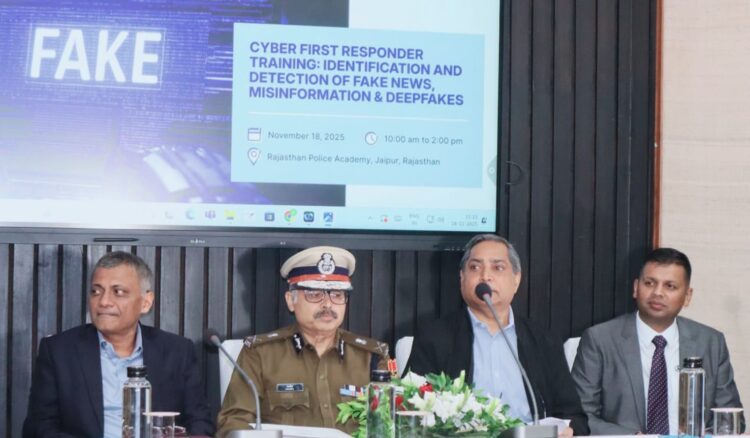
In a concerted effort to combat the rising threat of misinformation in the digital age, the Rajasthan Police hosted a specialized workshop for media professionals on Tuesday at the Nalanda Auditorium of the Rajasthan Police Academy. The initiative focused on equipping both journalists and law enforcement with advanced techniques to identify and counter AI-generated misleading content.
Rajasthan Director General of Police (DGP) Rajeev Sharma delivered a powerful opening address, characterizing fake news as a dangerous weapon in contemporary information warfare. “The velocity at which false information propagates in today’s digital landscape poses serious threats to public safety and social harmony,” Sharma remarked, highlighting the cascading consequences of misinformation.
The top police official expressed particular concern about how rapidly fabricated content can trigger law and order disruptions, cause psychological distress, and facilitate sophisticated financial fraud schemes. According to statistics shared during the workshop, India currently has approximately 9 million internet users, with over a third actively engaged on social media platforms where unverified information frequently circulates.
DGP Sharma emphasized the particular vulnerability of younger demographics, noting that citizens between 18 and 24 years of age are especially susceptible to misleading content. He stressed the urgent need for comprehensive public awareness campaigns targeting these at-risk populations.
Addressing the media representatives directly, Sharma urged news organizations to implement rigorous fact-checking protocols before broadcasting breaking news. “The rush to be first with a story should never supersede the responsibility to be accurate,” he cautioned, adding that unverified reporting can inflict significant societal damage.
The police chief advocated for greater technological adoption within newsrooms and encouraged stronger collaborative relationships between media outlets and law enforcement agencies, particularly when dealing with potentially sensitive or misleading information. He envisioned a partnership where both institutions work in tandem to ensure only verified information reaches the public domain.
The workshop featured an impressive assembly of expertise, with a delegation of ten specialists from the Indian School of Business (ISB) leading technical training sessions. Professor Manish Gangwar and Major Vineet Kumar provided hands-on instruction in utilizing artificial intelligence tools to detect sophisticated deep fake content—a growing concern in India’s media landscape.
Several high-ranking police officials attended the event, including Sanjay Agarwal, Director General of Cyber Crime and Law & Order; Sanjib Narzari, Director of the Rajasthan Police Academy and Additional Director General of Police; V.K. Singh, Additional Director General of Police (Cyber Crime); Ajay Pal Lamba, Inspector General of Police; and Kunwar Rashtradeep, Deputy Inspector General. Superintendents of Police Rashi Dogra and Shantanu Singh were also present, along with numerous other police officers.
The workshop attracted significant participation from local and regional media personnel, alongside influential social media personalities whose platforms often serve as primary news sources for many citizens.
This initiative comes amid growing national concern about the proliferation of misinformation on digital platforms, with law enforcement agencies across India increasingly recognizing the need for specialized training in detecting and countering sophisticated fake news operations.
The collaboration between the Rajasthan Police and academic institutions like ISB represents an emerging trend in India’s approach to information security, where interdisciplinary expertise is leveraged to address complex challenges at the intersection of technology, media, and public safety.
Fact Checker
Verify the accuracy of this article using The Disinformation Commission analysis and real-time sources.

24 Comments
Exploration results look promising, but permitting will be the key risk.
Good point. Watching costs and grades closely.
Good point. Watching costs and grades closely.
Interesting update on Fake News Used as Tool of Information Warfare, Says Rajasthan DGP. Curious how the grades will trend next quarter.
Good point. Watching costs and grades closely.
Interesting update on Fake News Used as Tool of Information Warfare, Says Rajasthan DGP. Curious how the grades will trend next quarter.
Good point. Watching costs and grades closely.
Uranium names keep pushing higher—supply still tight into 2026.
Good point. Watching costs and grades closely.
Silver leverage is strong here; beta cuts both ways though.
Good point. Watching costs and grades closely.
Good point. Watching costs and grades closely.
Nice to see insider buying—usually a good signal in this space.
Silver leverage is strong here; beta cuts both ways though.
Good point. Watching costs and grades closely.
The cost guidance is better than expected. If they deliver, the stock could rerate.
Good point. Watching costs and grades closely.
Good point. Watching costs and grades closely.
Uranium names keep pushing higher—supply still tight into 2026.
Good point. Watching costs and grades closely.
Good point. Watching costs and grades closely.
Production mix shifting toward Fake Information might help margins if metals stay firm.
Good point. Watching costs and grades closely.
Interesting update on Fake News Used as Tool of Information Warfare, Says Rajasthan DGP. Curious how the grades will trend next quarter.