


Listen to the article
Study Reveals How Fake News Impacts Online Donation Behaviors to NGOs
Recent research examining the factors influencing people’s intentions to make online donations has uncovered complex relationships between social media usage, fake news, and charitable giving behaviors.
The study draws on extensive literature that explores the dynamics between social media platforms, non-governmental organizations (NGOs), and potential donors. According to researchers Reddick and Ponomariov, a person’s pre-existing involvement with an organization significantly increases their likelihood of donating online—even more so than the mere availability of technology.
This relationship between donors and organizations has been explored through the Theory of Planned Behaviour (TPB), which suggests that predictions about an individual’s actions can best be made by establishing their behavioral intention. According to TPB, intention is determined by three key factors: a person’s attitude toward the behavior, subjective norms (social pressure and expectations), and perceived behavioral control (the ease or difficulty of performing the behavior).
“Individual attitudes toward NGOs significantly influence donation intention,” explains the research, noting that both internal factors (like a donor’s personal values) and external factors (such as the charity’s reputation) play crucial roles in the decision-making process.
In today’s digital landscape, social media platforms have become vital channels for NGOs to increase visibility, showcase their causes, and interact with stakeholders. The concept of “e-philanthropy”—altruism that takes place in cyberspace—has emerged as charities leverage digital tools to support welfare causes and build better societies.
However, the research identifies a troubling trend: the proliferation of fake news on social media that targets NGOs. The study notes that compared to factual content, “fake news spreads faster, has a longer lifespan, and has a greater impact on the much wider audience it is likely to reach.”
This misinformation phenomenon poses particular challenges for charitable organizations. Fake campaigns conducted on social media not only mislead potential donors but can cause significant reputational damage to the targeted NGOs, altering their relationships with key stakeholders and negatively impacting donation intentions.
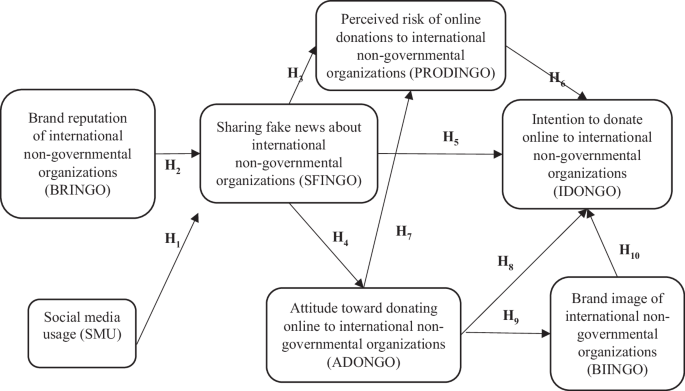
The research hypothesizes several important relationships, including that social media usage positively influences users’ intention to share fake news about international NGOs, and that the sharing of such fake news affects users’ attitudes toward donating online.
Brand reputation and image emerge as critical factors for NGOs in distinguishing themselves in donors’ minds. As competition for donations increases, organizations must develop recognizable brands that resonate with potential funders. The research suggests that marketing strategies are vital for non-profit organizations in the fundraising process and in attracting new donors.
“If the goals advocated by an NGO overlap with a donor’s own values, then they are more likely to consider donating,” notes the study, highlighting how NGOs must strengthen their links with donors by making it easier for them to identify with the organization’s social mission.
The study’s conceptual model examines how external factors—specifically the sharing of fake news on social media—affect the intention to donate online to NGOs. By understanding these dynamics, organizations can better position themselves to counter misinformation and develop more effective donor engagement strategies.
As social media platforms continue to evolve as fundraising channels, NGOs must navigate the complex information environment while maintaining trust with their donor base. Those that successfully manage their online reputation and effectively counter misinformation are likely to see stronger donor engagement and support in an increasingly competitive charitable landscape.
Fact Checker
Verify the accuracy of this article using The Disinformation Commission analysis and real-time sources.

14 Comments
The relationship between social media usage, fake news, and charitable giving intentions is complex. This study offers a helpful framework for NGOs to navigate those dynamics.
I’m curious to see if these findings hold true across different types of NGOs and geographic regions. The impact of fake news may vary based on organizational and cultural factors.
Good point. Further research comparing diverse NGOs and contexts would provide valuable insights to help organizations develop effective anti-misinformation strategies.
The study’s emphasis on the Theory of Planned Behavior is interesting. Attitudes, social norms, and perceived control do seem to be crucial factors in online donation decisions.
Absolutely. NGOs need to carefully consider all these psychological drivers to encourage more people to donate, especially in the face of fake news.
The findings about pre-existing donor-NGO relationships driving online giving are insightful. Building strong connections with supporters seems key to weathering fake news challenges.
Agreed. NGOs need to focus on cultivating long-term, meaningful relationships with donors rather than just optimizing for short-term online donations.
Interesting study on how fake news impacts online donations to NGOs. It’s concerning how misinformation can undermine trust and reduce charitable giving, especially for important causes.
You’re right, it’s crucial that NGOs find ways to combat fake news and maintain donor confidence. Transparency and fact-checking will be key.
It’s concerning how fake news can undermine the important work of NGOs. I hope this research inspires NGOs to invest more in combating misinformation and building trust with donors.
This is a timely and important study. Safeguarding online donation platforms from fake news influence should be a top priority for NGOs moving forward.
Fake news is a growing concern for all types of organizations. It’s encouraging to see academic research exploring its specific impacts on the non-profit sector.
Agreed. Understanding these dynamics is crucial for NGOs to maintain public trust and continue their important work in the digital age.
This is an important issue that deserves more attention. Fake news poses a real threat to NGO fundraising and the causes they support. Better digital literacy efforts could help.