


Listen to the article
Social Media Platforms Remove Billions of Fake Accounts Annually to Combat Scams
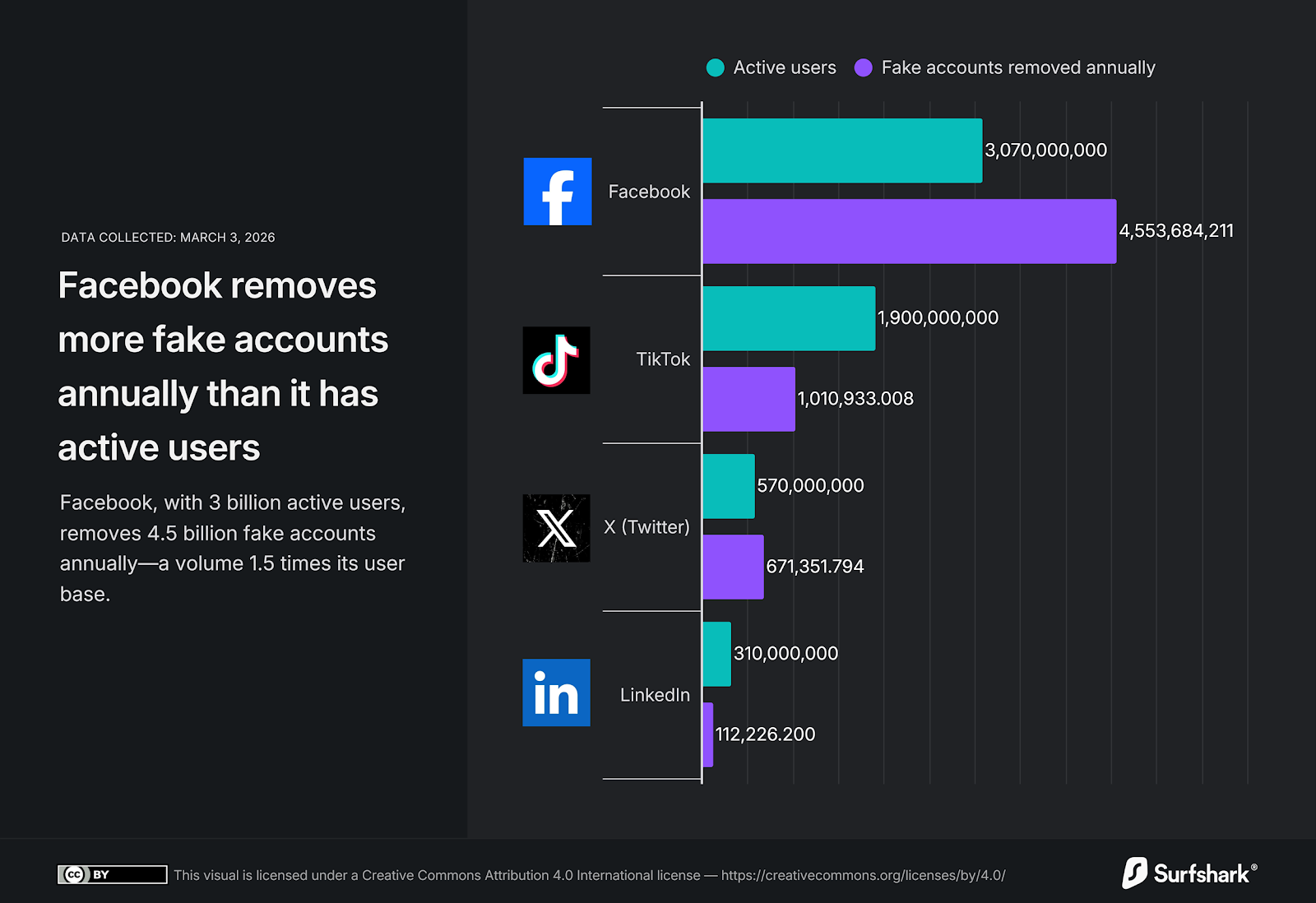
Social media users navigate an increasingly deceptive digital landscape as major platforms struggle to combat a rising tide of fake accounts and spam content. New research from Surfshark reveals the staggering scale of this problem: Facebook alone removes 4.5 billion fake accounts annually—a figure that exceeds its entire active user base of 3 billion by 1.5 times.
The prevalence of fake accounts has created a significant challenge for platform integrity teams. TikTok removes approximately 1 billion fake accounts each year, while X (formerly Twitter) eliminates 671 million accounts annually for platform manipulation and spam—surpassing its 570 million active user count. LinkedIn also faces substantial challenges, removing 112 million fake accounts yearly, representing more than a third of its 310 million active user base.
“The scenario of communicating with fake users and interacting with scam content on social media has become a daily reality,” noted researchers at Surfshark, who compiled the data from official transparency reports published by the platforms.
YouTube’s content moderation efforts are equally substantial. The video platform terminates an average of 25 million spam channels annually, which results in the removal of 311 million spam-related videos. This represents approximately 40% of YouTube’s estimated active channel base each year.
The battle extends beyond fake accounts to the content they generate. Facebook leads in content removals, purging an average of 4.7 billion pieces of spam annually. YouTube removes 3.6 billion spam-related comments from videos each year, while TikTok deletes an average of 1.4 billion comments and 671 million videos attributed to fake accounts. Instagram and LinkedIn remove 271 million and 200 million instances of spam content annually, respectively.
The underground economy supporting these fake accounts presents another troubling dimension. In dark web marketplaces, fake social media accounts can be purchased for as little as $0.08, with prices varying based on the account’s age, follower count, country of origin, and platform.
“The business model typically works in two steps,” explained Surfshark researchers. “First, hackers acquire as many fake accounts as they can, either by creating them or purchasing them in bulk. Once enough accounts are gathered, they begin using them for their own ends or selling services to promote questionable products, increase engagement, or push political agendas.”
These operations directly violate platform terms of service and represent a significant threat to legitimate users. The sheer volume of fake accounts makes it increasingly difficult for average users to distinguish between authentic and fraudulent interactions, raising the risk of scams and misinformation exposure.
The research methodology collected data from transparency reports published by Meta, Google, TikTok, X, and LinkedIn, with data collection beginning in 2021—the earliest year for which comparable data was available across platforms. For platforms reporting quarterly versus semi-annually, researchers calculated average annual figures to enable meaningful comparisons.
As social media companies continue investing heavily in detection and removal systems, the scale of the problem highlights the ongoing cat-and-mouse game between platforms and those creating fake accounts. For users, the research underscores the importance of maintaining skepticism about online interactions and verifying information sources before taking action based on social media content.
Fact Checker
Verify the accuracy of this article using The Disinformation Commission analysis and real-time sources.

12 Comments
This speaks to the scale of the challenge social media platforms face in maintaining platform integrity. Removing billions of fake accounts every year just to keep up with the onslaught is no easy task. I wonder what other innovations they can bring to bear.
Definitely a complex issue. Transparency around their efforts is crucial so users can understand the challenge. Hopefully, they can stay ahead of the scammers through a combination of technology, policy, and industry collaboration.
It’s alarming to see how fake accounts can distort the user base and undermine the authenticity of social media. The platforms are clearly working hard to combat this, but it’s an uphill battle. I hope they can develop even more sophisticated tools to stay ahead of the bad actors.
Absolutely. This is an ongoing arms race, and the platforms need to remain vigilant. Improved AI, user verification, and industry cooperation could all help turn the tide. It’s a complex challenge, but the integrity of these platforms is so important.
The sheer volume of fake accounts is mind-boggling. It’s good to see the major platforms taking action, but this problem is clearly far from solved. Curious to see what new tactics they develop to stay ahead of the scammers.
Agreed, it’s an endless game of cat and mouse. Improved user authentication, AI-powered detection, and industry collaboration could all help, but the bad actors will keep evolving their tactics.
Wow, the scale of fake accounts across social media is staggering. It’s good to see the platforms taking action, but this is clearly an ongoing battle. I wonder what other measures they can implement to stay ahead of the scammers.
Agreed, it’s a never-ending game of cat and mouse. Improved AI-powered detection and better user authentication could help, but the bad actors are always adapting too.
It’s concerning to see how fake accounts can distort the user base and undermine platform integrity. I hope the platforms continue investing in sophisticated tools to weed out this kind of manipulation.
Yes, the platforms need to stay vigilant. Transparency around their efforts is also important so users can understand the scale of the challenge.
This is a real challenge for the social media giants. Removing billions of fake accounts annually just to maintain a semblance of authenticity is no easy feat. It speaks to the constant arms race with bad actors.
Absolutely. The platforms have to devote significant resources to this ongoing fight. I wonder if there are any regulatory or industry-wide solutions that could help.