


Listen to the article
Musk’s Digital Influence Empire: How X’s Owner Weaponizes Disinformation
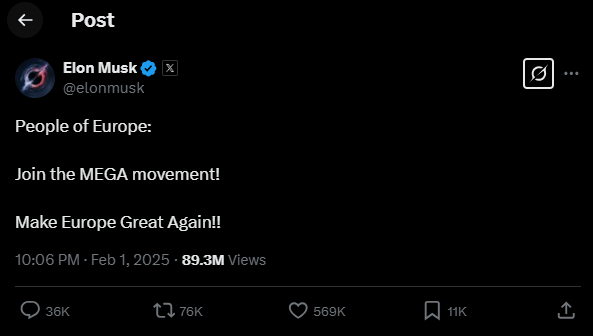
In early February, Elon Musk issued a rallying cry to European citizens on his social platform X: “Join the Mega movement! Make Europe Great Again!!” The slogan, echoing Donald Trump’s “Make America Great Again,” was first popularized by Hungarian Prime Minister Viktor Orbán during Hungary’s presidency of the EU Council last year.
Days after Musk’s post, leaders of right-wing and far-right eurosceptic parties from the “Patriots for Europe” group gathered in Madrid under the same slogan, agreeing that Trump represented the model to follow in Europe.
This intervention marks just one episode in Musk’s increasingly aggressive interference in European politics. His activities have included insulting European left-wing heads of government, calling for their arrest, attacking judiciary systems, and openly supporting far-right parties and politicians across the continent.
The billionaire’s political activism extends far beyond Europe. According to an NBC News investigation, Musk has encouraged right-wing political movements, policies, and administrations in at least 18 countries over the past two years, promoting policies aligned with his ideological views globally.
Among these favored policies is reducing immigration based on “nativism,” a far-right theory suggesting that native populations have greater rights than newcomers, as explained by Mattia Zulianello, a comparative politics professor at the University of Trieste who studies right-wing populism.
Musk has also waged campaigns against business regulations. In Europe, he targeted the Digital Services Act (DSA), a regulation approved by the European Parliament in 2022 and implemented in February 2024. The European Commission is currently investigating X for potential DSA violations.
Manuela Caiani, political science associate professor at the Scuola Normale Superiore in Pisa and an expert on international far-right movements, told NBC News that Musk is helping these movements grow by fostering idea exchanges, creating personal connections, and building a shared ideological framework. “It is very dangerous that a nonpolitical actor now speaks with a sort of political legitimacy. He’s changing the paradigm of politics,” Caiani emphasized.
X serves as Musk’s primary tool for this global political campaign. With over 220 million followers—the platform’s largest audience—he wields enormous influence. According to Jasmine Enberg, an analyst at market research company Emarketer, the entrepreneur is fully aware of “the power of social media in shaping a political narrative.”
Since acquiring Twitter (now X) in 2022 for $44 billion, Musk has increasingly used the platform to amplify both his own political views and those of right-wing figures he supports, explains Barbara Ortutay, a social media expert journalist at the Associated Press.
Simultaneously, Musk reportedly altered the platform’s algorithm to favor his content and that of far-right users, as documented by numerous journalistic investigations. These allegations prompted the European Commission in January to request internal documents about X’s algorithms to verify potential manipulations favoring far-right content. In February, the Paris cybercrime unit launched an investigation following complaints about distortion in the platform’s recommendation algorithms.
Disinformation as a Political Weapon
Musk’s relationship with factual reality has long been complicated. During the COVID-19 pandemic, he spread false information about the SARS-CoV-2 infection, downplayed COVID-19 risks, and promoted unproven treatments like hydroxychloroquine.
A Rolling Stone investigation revealed that Musk has strategically deployed political disinformation to delegitimize liberal parties, progressive causes, and opposing governments. His celebrity and influence allow him to shape public discourse both online and offline.
In 2022, Musk amplified a conspiracy theory about Nancy Pelosi’s family following an assault on her husband, Paul Pelosi. In 2023, he endorsed far-right conspiracy theories denying that a mass shooter with Nazi tattoos who killed eight people in Allen, Texas, was a white supremacist.
Musk has repeatedly attacked Jewish billionaire philanthropist George Soros, who has long been the target of right-wing conspiracy theories. Musk accused Soros of “eroding the very fabric of civilization” and “hating humanity,” fueling various conspiracy narratives, including anti-Semitic ones, as noted by the Anti-Defamation League.
Following the October 7, 2023, Hamas attack on Israel, Musk endorsed an anti-Semitic conspiracy theory claiming that Jews had incited hatred against white people. He has also promoted entirely unfounded theories about transgender individuals being responsible for mass shootings in the United States.
During violent anti-immigrant protests in the United Kingdom last summer, Musk participated in spreading false news, sharing a fake Telegraph article claiming that Prime Minister Keir Starmer was considering sending far-right rioters to “emergency detention camps” in the Falkland Islands.
In early 2025, Musk launched a social media attack against Starmer’s Labour government with over 100 posts that garnered more than 100 million views. He falsely accused the Prime Minister of allowing grooming gangs to avoid prosecution in exchange for community votes during Starmer’s tenure as head of the Crown Prosecution Service.
During Trump’s 2024 presidential campaign, Musk not only contributed approximately $130 million to the Republican effort but also spread disinformation against the Democratic Party through X. According to a report by the Center for Countering Digital Hate, Musk’s false or misleading claims about the U.S. elections reached 2 billion views on X, with Reuters later describing the platform and its owner as “the epicenter of disinformation” in the election cycle.
After Trump’s victory, the new president appointed Musk to lead the “Department of Government Efficiency” (DOGE), tasked with reducing bureaucracy and cutting government spending. Under Musk’s direction, the administration dismissed thousands of federal employees, particularly those in diversity, equity, and inclusion programs, and foreign humanitarian workers.
Musk specifically targeted USAID, the US agency for international humanitarian aid, spreading disinformation claiming that its funding had been misused and sharing fabricated Russian propaganda alleging that USAID paid Hollywood celebrities to visit Ukraine as a publicity stunt.
A Participatory Disinformation Ecosystem
Musk’s approach to political disinformation is strategic. Rather than creating false content himself, he primarily shares false and misleading content from far-right and conspiracy accounts active on X. This accomplishes multiple goals: his massive follower count mainstreams previously fringe narratives while boosting the reach and perceived credibility of these profiles.
According to a Science Feedback analysis, since Musk’s acquisition of X, the popularity of 490 “super-spreader” disinformation accounts has grown by an average of 42% in interactions per tweet. The study found that “four out of the five accounts that have gained the most influence have received replies from Elon Musk’s personal account.”
NBC News reported that most of Musk’s posts about USAID were responses to “small but influential verified accounts,” many using pseudonyms. These accounts have histories of spreading false claims on various topics, including US elections, COVID-19 vaccines, and male supremacy theories.
The same pattern emerged during the UK’s racist protests and in attacks against the Labour government. According to Le Monde, Musk regularly amplifies content from a handful of far-right X accounts that cover European news in English with anti-immigration and anti-Islam positions.
The New York Times reported that some right-wing activist accounts with which Musk frequently interacts appear to have direct connections to his DOGE team and the ability to influence government policies. For example, after right-wing influencer Kyle Becker posted misleading allegations about government agencies funding news outlets, Musk shared the post, and hours later, the official DOGE account announced cancellation of the spending Becker had criticized.
This dynamic exhibits all the characteristics of “participatory disinformation,” a concept developed by computer scientist Kate Starbird and colleagues that explains how both ordinary people and influential actors become active participants in spreading false narratives.
While in 2016 fake news campaigns were primarily driven by anonymous accounts and bots, today’s disinformation landscape has evolved. As sociologist and disinformation expert Joan Donovan notes, “lies travel further and faster across social media, which is now a battleground for narrative dominance. And now, the owners of the platforms circulating the most incendiary lies have direct access to the Oval Office.”
Fact Checker
Verify the accuracy of this article using The Disinformation Commission analysis and real-time sources.

28 Comments
I like the balance sheet here—less leverage than peers.
Good point. Watching costs and grades closely.
The cost guidance is better than expected. If they deliver, the stock could rerate.
Production mix shifting toward Fake Information might help margins if metals stay firm.
If AISC keeps dropping, this becomes investable for me.
Nice to see insider buying—usually a good signal in this space.
Good point. Watching costs and grades closely.
If AISC keeps dropping, this becomes investable for me.
Good point. Watching costs and grades closely.
Good point. Watching costs and grades closely.
The cost guidance is better than expected. If they deliver, the stock could rerate.
Good point. Watching costs and grades closely.
Good point. Watching costs and grades closely.
Production mix shifting toward Fake Information might help margins if metals stay firm.
Good point. Watching costs and grades closely.
Good point. Watching costs and grades closely.
Silver leverage is strong here; beta cuts both ways though.
The cost guidance is better than expected. If they deliver, the stock could rerate.
Good point. Watching costs and grades closely.
Good point. Watching costs and grades closely.
Interesting update on Elon Musk’s Disinformation Network: An Analysis of Its Operation and Influence. Curious how the grades will trend next quarter.
Good point. Watching costs and grades closely.
Exploration results look promising, but permitting will be the key risk.
Good point. Watching costs and grades closely.
Good point. Watching costs and grades closely.
Nice to see insider buying—usually a good signal in this space.
Good point. Watching costs and grades closely.
Good point. Watching costs and grades closely.