


Listen to the article
The rapidly growing menace of fake news poses a significant challenge to societies worldwide, according to researchers exploring the phenomenon in Germany and the United Kingdom. A comprehensive study published in Scientific Reports reveals distinct patterns in how citizens detect and share misinformation across these two major European nations.
Unlike most previous research that focused primarily on the United States, this study examines fake news dynamics in less politically polarized European countries where public broadcasting institutions like the BBC, ARD, and ZDF remain influential information sources.
The researchers distinguish between misinformation (false or misleading content) and disinformation (deliberately deceptive content), noting that both contribute to public misconceptions. Their study involved surveying over 2,300 participants – 1,223 Germans and 1,156 Britons – to analyze both fake news detection abilities and sharing behaviors.
“Fake news spreads significantly farther, faster, deeper, and more broadly than the truth,” the researchers note, citing earlier findings that demonstrate how misinformation outpaces factual reporting across social media platforms.
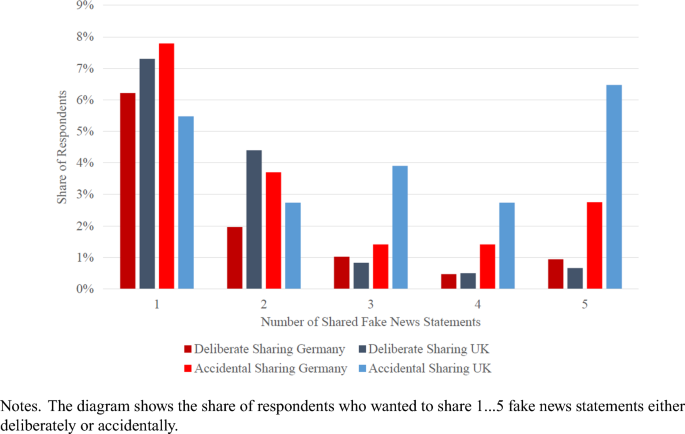
The study’s innovation lies in distinguishing between accidental sharing (when someone unknowingly shares false information they believe to be true) and deliberate sharing (when someone shares content they recognize as likely false). This distinction carries important policy implications, as different interventions would be needed depending on whether fake news spreads primarily through ignorance or intention.
The comparison between Germany and the UK is particularly revealing. Germany has implemented stronger legislative measures against online misinformation, with three bills passed in recent years targeting hate speech and false information on social networks. This robust public debate may have heightened German citizens’ awareness and skepticism toward potential fake news. The UK, meanwhile, has experienced more populist discourse following Brexit, potentially creating greater receptivity to fact-ignoring arguments.
Age, gender, education, and political ideology all appear to influence fake news susceptibility. Previous studies suggest older adults, particularly conservatives, are more likely to share misinformation, though findings about demographic factors remain inconsistent across different research.
To test participants’ abilities, researchers presented ten viral news headlines – five true and five false – and asked respondents to evaluate their accuracy and likelihood of sharing them. By comparing identification abilities with sharing intentions, the team could differentiate between deliberate and accidental dissemination patterns.
The researchers hypothesized that most fake news sharing stems from failure to detect it rather than intentional spreading. This aligns with research showing most people overestimate their ability to identify fake news, with overconfidence potentially contributing to its propagation. Men generally show higher overconfidence, especially in tasks with minimal performance feedback like news sharing, suggesting they may accidentally spread more misinformation.
Understanding these patterns across different populations and countries is crucial as societies grapple with the corrosive effects of misinformation on public discourse, democratic processes, and critical policy issues like vaccination and immigration. The findings could help shape more effective interventions tailored to specific demographic vulnerabilities and national contexts.
As the digital information environment grows increasingly complex, this research provides valuable insights into who spreads fake news, why they do it, and what approaches might best address this pressing challenge to informed public debate.
Fact Checker
Verify the accuracy of this article using The Disinformation Commission analysis and real-time sources.

17 Comments
Glad to see research expanding beyond the US to look at fake news dynamics in Europe. The comparison between Germany, the UK, and previous US-focused studies could yield important cross-cultural learnings. I’m particularly interested in how public broadcasting institutions factor into the equation.
This study sounds like an important step in understanding the global scale and nuances of the fake news challenge. Analyzing detection and sharing behaviors across different political and media landscapes is crucial. I hope the findings can inform more effective strategies to combat the spread of both misinformation and disinformation.
Yes, a multi-faceted, cross-cultural approach is essential for developing comprehensive solutions to this complex problem.
Fascinating study on the pervasive challenge of fake news. I’m curious to learn more about the distinct patterns of detection and sharing behaviors between Germany and the UK. Comparing the influence of public broadcasting in these countries versus the US could provide valuable insights.
Yes, it will be interesting to see how the political and media landscapes impact the dynamics of fake news in these less polarized European contexts.
The finding that misinformation outpaces factual reporting on social media is deeply concerning, but not altogether surprising. I’m curious to learn more about the specific behavioral patterns and psychological drivers behind this phenomenon, as uncovering those insights could inform more effective interventions.
Very interesting to see this research exploring fake news dynamics outside of the US context. The influence of public broadcasting institutions like the BBC, ARD, and ZDF is an intriguing factor to examine. I wonder if there are any insights on how their presence shapes the information landscape compared to more polarized media environments.
Yes, that’s a great point. Understanding how the role of public media influences the spread of misinformation and disinformation could provide valuable lessons for other countries.
The researchers’ distinction between misinformation and disinformation is a helpful framework. I’m curious to learn more about how citizens in Germany and the UK fare in detecting each type, and whether there are any notable differences. Identifying the most vulnerable areas could inform targeted interventions.
This study sounds like an important step in understanding the global scale of the fake news challenge. Analyzing detection and sharing behaviors across different political and media landscapes is crucial. I hope the findings can inform more effective strategies to combat the spread of misinformation and disinformation.
Agreed. Developing a more nuanced, cross-cultural understanding of this problem is key to developing impactful solutions.
This is an important issue that deserves close attention. I appreciate the researchers’ nuanced distinction between misinformation and disinformation – both contribute to public confusion, but the latter is particularly problematic. Curious to see how the findings might inform strategies to combat the spread of fake news.
The fact that misinformation outpaces factual reporting on social media is deeply concerning. I wonder if there are any insights from this study on why false content seems to gain traction so quickly compared to the truth. Understanding the underlying psychological and behavioral drivers could help develop more effective interventions.
Yes, that’s a great point. Exploring the reasons behind the rapid spread of fake news, even in less polarized contexts, could shed light on some universal human tendencies that contribute to this problem.
Fascinating to see this research examining fake news dynamics in less politically polarized European countries. The influence of public broadcasting institutions like the BBC, ARD, and ZDF is an intriguing factor that could provide valuable insights. I’m curious to learn more about how citizens in these contexts fare in detecting and sharing misinformation versus disinformation.
This study sounds like an important contribution to the growing body of research on the fake news challenge. Expanding the scope beyond the US context is crucial, as the dynamics can vary significantly across different political and media landscapes. I look forward to seeing how the findings from Germany and the UK compare to previous work.
Agreed. Cross-cultural comparisons are key to developing a more comprehensive understanding of this global issue and crafting tailored solutions.