


Listen to the article
In the wake of violent riots that erupted in Southport following the tragic knife attack that claimed the lives of three young girls, social media has become a battleground of misinformation that fueled further unrest across the United Kingdom.
Authorities have identified two distinct groups responsible for orchestrating the online disinformation campaign that preceded the violence. The first consists of far-right agitators within Britain, while the second involves foreign actors, particularly those linked to Russia, who exploited the tragedy to sow discord.
Security officials report that Russian-linked accounts began amplifying false claims almost immediately after the attack occurred. These accounts spread unfounded allegations about the attacker’s identity and background, falsely claiming he was an asylum seeker who had recently arrived in the UK by boat. In reality, police confirmed the suspect was born in the UK to parents from Rwanda.
“This pattern of foreign interference is consistent with previous attempts to exacerbate tensions during moments of national distress,” said one senior security source who spoke on condition of anonymity. “The speed and coordination of these campaigns suggest they were prepared to exploit any suitable tragedy.”
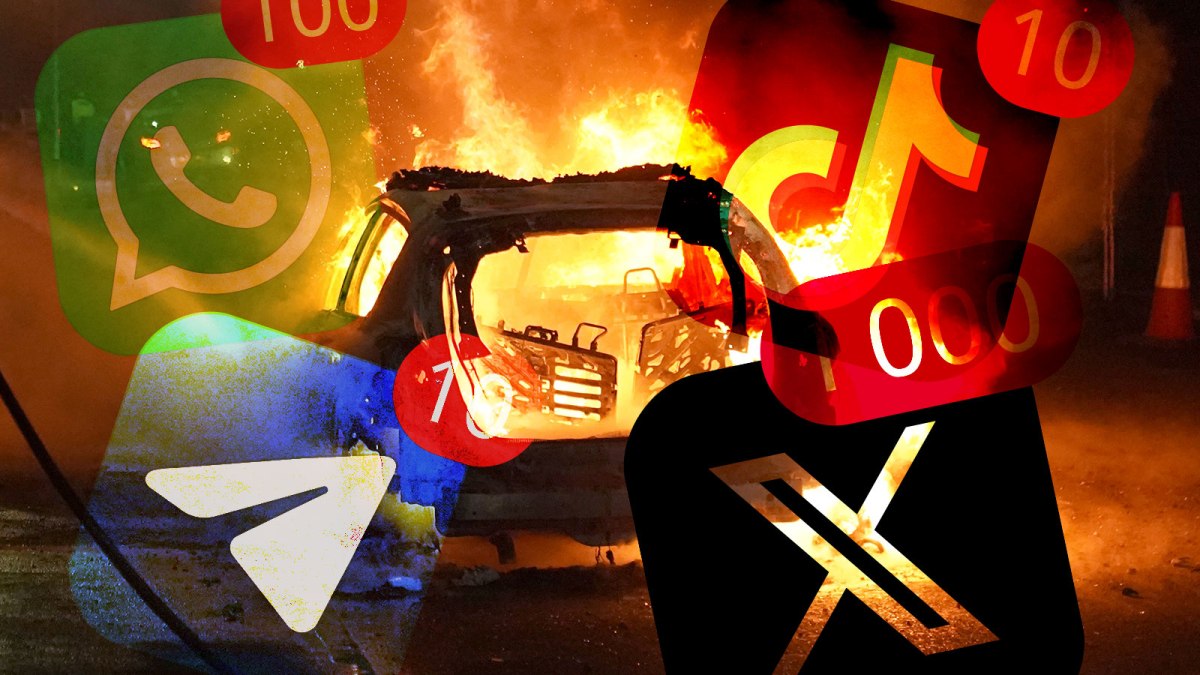
Domestic far-right groups quickly joined the fray, creating and sharing doctored images, manipulated videos, and fabricated quotes from public officials. These materials spread rapidly across multiple platforms including X (formerly Twitter), Facebook, and TikTok.
The online campaign had real-world consequences. Within hours, mobs gathered in Southport, targeting a mosque and attacking police officers. The violence soon spread to other cities including Liverpool, Manchester, and parts of London, resulting in hundreds of arrests and millions of pounds in property damage.
Social media companies have faced harsh criticism for their slow response to the crisis. Despite repeated warnings from government officials and police, many platforms failed to remove content that clearly violated their own policies against inciting violence and spreading harmful misinformation.
“The platforms have the tools and resources to identify and remove this content much more quickly,” said Dr. Emma Wilson, a researcher specializing in online extremism at King’s College London. “Their hesitation appears to be commercially motivated rather than technical in nature.”
Home Secretary Yvette Cooper announced plans for emergency legislation that would hold social media executives personally accountable for failing to remove content that incites violence. The proposed measures would include substantial fines and potential criminal penalties for companies that do not act swiftly during periods of civil unrest.
“These platforms have become weaponized by those seeking to tear at the fabric of our society,” Cooper stated. “We cannot allow tech companies to prioritize engagement metrics over public safety.”
The challenge of combating organized disinformation campaigns remains daunting. Security experts point to the increasingly sophisticated methods employed by both domestic extremists and foreign actors, including the use of artificial intelligence to create convincing false content and coordinated networks of accounts that can quickly amplify messages.
Former counter-terrorism official Richard Morgan explained that the Southport case demonstrates how vulnerable communities can be to manipulation during emotional moments. “These actors look for wedge issues and tragedies they can exploit. They don’t create the underlying tensions, but they’re expert at inflaming them to dangerous levels.”
Law enforcement agencies have established specialized units to identify and track the sources of online disinformation, but they acknowledge the difficulty of staying ahead of rapidly evolving tactics.
As investigations continue, police have made several arrests of individuals suspected of creating or sharing the most inflammatory content. However, officials admit that addressing the root causes of both online extremism and susceptibility to disinformation requires long-term strategies beyond simple enforcement actions.
The events in Southport have prompted renewed calls for digital literacy education and greater transparency from tech companies about their content moderation practices during crises. Meanwhile, communities across Britain are working to heal divisions exacerbated by the online storm that turned a tragedy into chaos.
Fact Checker
Verify the accuracy of this article using The Disinformation Commission analysis and real-time sources.

8 Comments
Interesting article on the spread of disinformation around the tragic Southport incident. Concerning to see foreign actors exploiting such events to sow discord. Authorities will need to stay vigilant in identifying and containing these malicious campaigns.
Absolutely. The speed and coordination of these online disinfo campaigns is alarming. Strengthening digital literacy and resilience will be crucial to combating this threat.
The article highlights the serious threat posed by foreign interference and coordinated disinformation campaigns on social media. Effective strategies to identify, limit, and counter these malicious activities will be critical going forward.
The use of social media to amplify false narratives and incite unrest is a disturbing tactic. I hope the authorities can effectively identify and shut down these coordinated disinformation efforts, especially those linked to foreign interference.
Agreed. Transparency and accountability from social media platforms will be key in limiting the spread of harmful misinformation during sensitive situations.
Tragic that a terrible crime could be exploited in this way. Glad to see the authorities calling out the foreign influence and working to contain the online disinformation campaign. Vigilance is key to protecting the public from these manipulation tactics.
Absolutely. The speed and coordination of these disinfo efforts is alarming. Strengthening digital defenses and public awareness will be crucial to stay ahead of bad actors.
This is a concerning example of how social media can be weaponized to sow division and chaos, especially by foreign adversaries. Fact-checking and media literacy initiatives will be vital to combat these malicious information operations.