


Listen to the article
In the wake of the Southport tragedy, a disturbing pattern of disinformation has emerged across social media platforms, creating a digital wildfire that has further inflamed tensions in communities already grieving after the fatal stabbings of three young girls at a Taylor Swift-themed dance class.
Security officials and disinformation experts have identified several key drivers behind the wave of false information that culminated in violent riots across multiple UK cities. The spread of this content, they say, has been accelerated by a potent mix of domestic extremists, foreign influence operations, and algorithmic amplification.
Home Secretary Yvette Cooper confirmed that Russian state actors have been actively involved in promoting divisive content related to the Southport incident. “We are seeing evidence of significant Russian state-linked hostile information operations, deliberately manipulating distressing events here to stir up division,” Cooper told Parliament this week.
The government’s assessment aligns with findings from the Institute for Strategic Dialogue, which documented how false claims about the attacker’s identity and immigration status gained remarkable traction online. Within hours of the stabbings, unverified claims labeled the suspect as an asylum seeker who had recently arrived in the UK by boat – assertions that were demonstrably false yet spread rapidly across platforms.
Security analysts point to a well-established pattern of Russian disinformation campaigns designed to exploit social fractures in Western democracies. These operations typically don’t create new tensions but instead amplify existing societal divisions through coordinated networks of accounts and targeted messaging.
However, experts caution against attributing the entire problem to foreign interference. Far-right groups within the UK have shown growing sophistication in leveraging tragic events to advance anti-immigration narratives. One monitoring group documented how several UK-based accounts with histories of promoting extremist content were among the first to spread false narratives about the Southport attack.
“What we’re seeing is a perfect storm,” said Dr. Eleanor Matthews, a digital disinformation researcher at King’s College London. “Foreign actors may light matches, but they’re dropping them onto domestic kindling that’s been accumulating for years.”
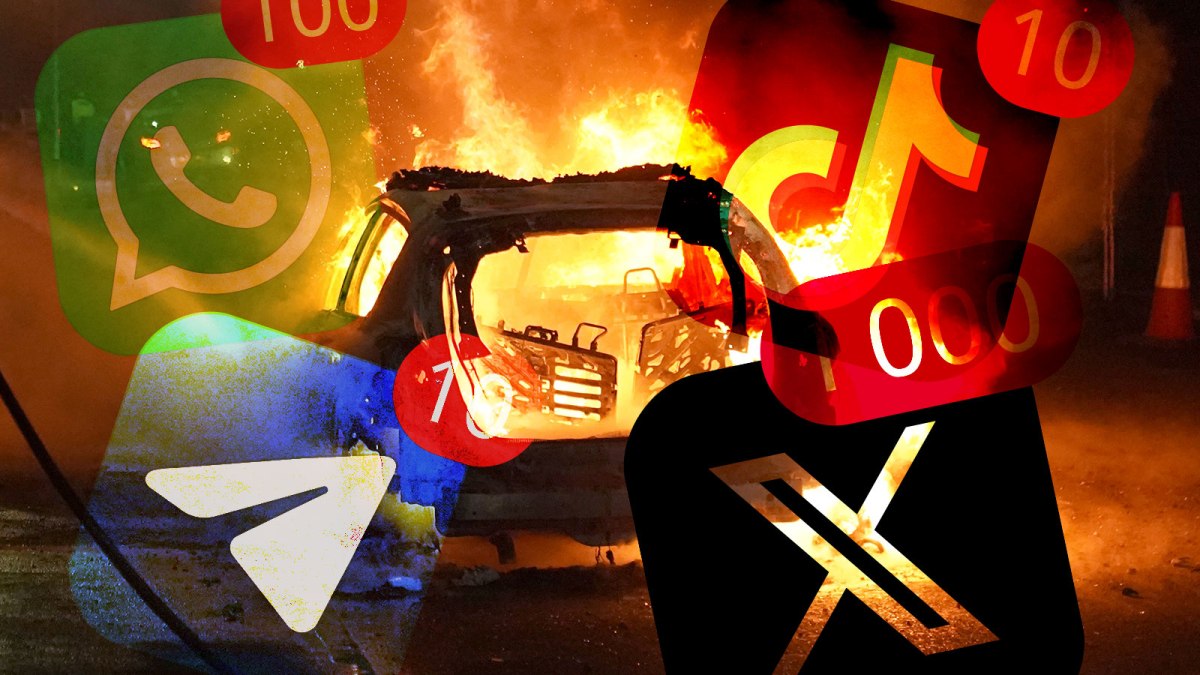
Social media platforms have faced renewed criticism for their handling of the situation. Despite public commitments to combat misinformation, harmful content continued to spread widely across major platforms including X (formerly Twitter), Facebook, and TikTok.
“The algorithmic architecture of these platforms rewards engagement, and unfortunately, emotionally charged false information generates significant engagement,” explained Matthews. “When platforms optimize for user attention rather than information accuracy, they inadvertently become vectors for harmful content.”
Legal experts note that the UK’s Online Safety Act, which came into full effect earlier this year, theoretically provides regulators with new tools to hold platforms accountable. The legislation requires companies to limit the spread of harmful content, with potential fines of up to 10% of global annual turnover for non-compliance.
“The regulatory framework exists, but implementation remains challenging,” said Jonathan Spencer, a technology law specialist. “Platforms are still largely marking their own homework when it comes to content moderation.”
The government has announced a series of measures in response, including the creation of a specialized Counter-Disinformation Unit within the Home Office and increased pressure on social media companies to improve their response to crisis situations.
Meanwhile, community leaders in affected areas are working to rebuild trust through grassroots initiatives. In Southport itself, interfaith groups have organized vigils and community dialogues aimed at countering divisive narratives.
“The real antidote to disinformation is stronger community bonds,” said Reverend Sarah Wilson, who has been coordinating local response efforts. “When people know their neighbors and have relationships across different groups, they’re less susceptible to narratives designed to divide them.”
As investigations continue into both the original attack and subsequent violence, security officials warn that the pattern of disinformation seen following Southport represents a persistent challenge for democratic societies in the digital age – one that requires coordinated responses from government, technology companies, and civil society.
Fact Checker
Verify the accuracy of this article using The Disinformation Commission analysis and real-time sources.

13 Comments
The algorithmic amplification of divisive content is a serious issue that requires more transparency and oversight of social media platforms. Proactive steps are needed to address this challenge.
This serves as a sobering reminder of the real-world impact that online disinformation can have. Improving digital media literacy and platform transparency should be top priorities.
Disturbing to see how false narratives can gain traction and incite real-world violence. Rigorous fact-checking and rapid response mechanisms are needed to limit the spread of disinformation.
The involvement of Russian state actors is deeply concerning. Strengthening international cooperation and information-sharing will be key to disrupting cross-border disinformation campaigns.
Disturbing to see how false narratives can gain traction and incite violence. Rigorous fact-checking and rapid response mechanisms are crucial to limit the spread of disinformation.
This highlights the challenges of combating coordinated online influence operations. Strengthening digital literacy and transparency around platform algorithms will be key to building resilience.
This underscores how social media can be weaponized to sow division. Strengthening digital media literacy and platform accountability will be crucial to counter future manipulation attempts.
Tragic that these events have been exploited for political gain. Authorities must remain vigilant and work to quickly identify and debunk false claims before they can spread further.
The algorithmic amplification of divisive content is a serious issue that requires more transparency and oversight of social media platforms. Proactive steps are needed to address this challenge.
This highlights the need for a multi-pronged approach to combat online disinformation. Collaboration between government, tech companies, and civil society will be essential.
Tragic that these events have been exploited for political aims. It’s critical that authorities work to separate fact from fiction and provide clear, unbiased information to the public.
The revelation of Russian state involvement is concerning. Proactive measures to identify and disrupt foreign influence operations should be a top priority for policymakers.
Interesting to see how foreign actors can amplify divisive narratives around tragic events. Careful analysis of social media patterns is crucial to identify and counter disinformation campaigns.