


Listen to the article
In the wake of the Southport tragedy that claimed the lives of three young girls, a toxic wave of disinformation has engulfed social media platforms, stoking tensions and fueling unrest across England.
What began as peaceful vigils quickly descended into violent riots after false rumors spread claiming the suspect was a Muslim asylum seeker who had recently arrived in the UK. These claims were categorically false – police confirmed the suspect was born in Cardiff to parents from Rwanda – but the damage was already done.
The social media storm that followed reveals the alarming speed with which misinformation can spread in today’s digital landscape. Analysis by The Times has identified several key accounts responsible for amplifying the falsehoods, some with enormous reach. One particular account, with over 1.5 million followers, played a significant role in spreading the unfounded claims.
Social media experts note that these accounts often operate with algorithmic precision, knowing exactly which buttons to push to maximize engagement. “They understand that content which provokes outrage spreads faster than factual information,” explains Dr. Hannah Marshall, a digital media researcher at Oxford University. “The more inflammatory the post, the further it travels.”
The role of X (formerly Twitter) has come under particular scrutiny. Since Elon Musk’s acquisition of the platform in 2022, content moderation has been significantly reduced, creating what critics call a perfect environment for misinformation to flourish. Several far-right figures previously banned from the platform have been reinstated, giving them renewed access to large audiences.
Home Secretary Yvette Cooper pointed to “far-right extremists and English Defence League supporters” as being behind the organized violence, emphasizing how digital platforms became critical tools in coordinating the unrest. Meanwhile, Prime Minister Keir Starmer has promised those responsible will face “the full force of the law.”
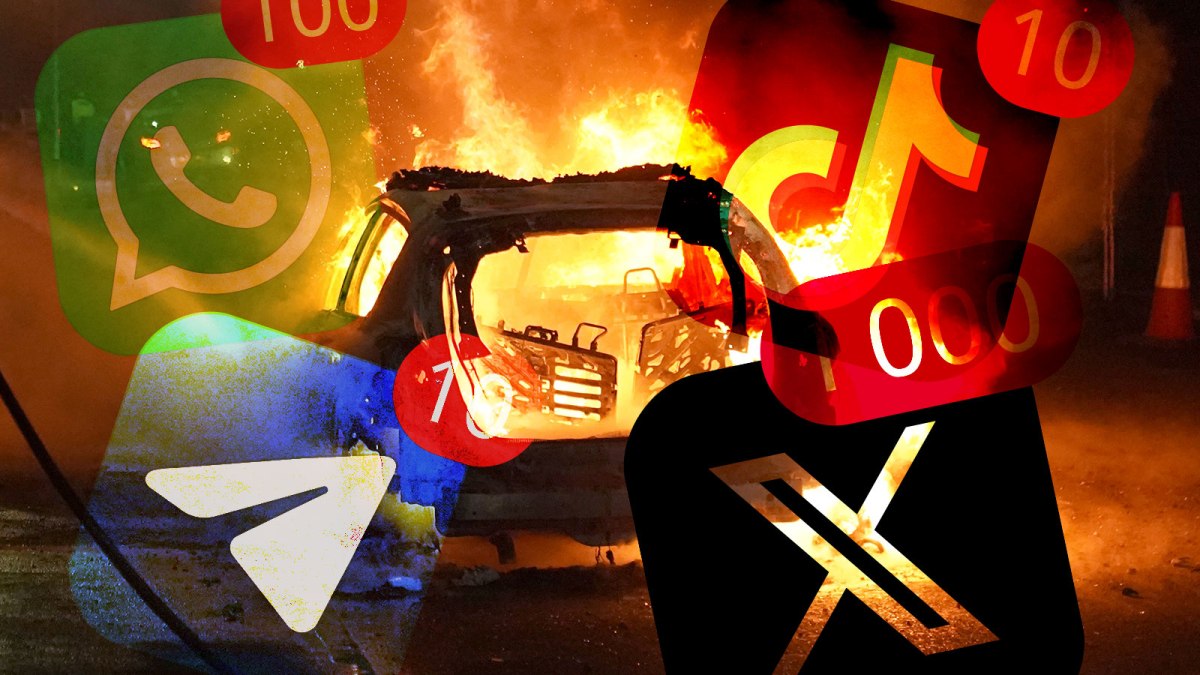
The riots have inflicted serious damage across multiple cities. In Liverpool, police vehicles were set ablaze, while in Manchester, businesses faced extensive property damage. Law enforcement agencies have made dozens of arrests, with more expected as they review surveillance footage and social media evidence.
Tech companies have responded with varying degrees of action. Meta, which owns Facebook and Instagram, has removed numerous posts inciting violence, while TikTok claims to have blocked certain hashtags associated with the unrest. X has faced criticism for its slower and more limited response.
“The challenge for platforms is enormous,” says tech policy expert James Townsend. “They must balance free speech considerations with public safety concerns, all while processing millions of posts per hour. But the Southport case demonstrates that failure to act quickly can have real-world consequences.”
The events highlight broader tensions in British society around immigration and integration. Far-right groups have attempted to exploit these tensions, with some explicitly calling for supporters to join the protests through encrypted messaging apps.
Legal experts note that while prosecution of those physically participating in riots is straightforward, pursuing those who spread misinformation presents more complex challenges. The UK’s Online Safety Act, designed to address harmful content, is still in the implementation phase and wasn’t fully operational during these events.
Government officials have scheduled emergency meetings with social media executives to discuss improved protocols for crisis situations. Meanwhile, community leaders across affected cities are organizing peace rallies to counter the division.
“What we’re witnessing is the real-world impact of digital disinformation,” says Dr. Marshall. “It’s no longer just a theoretical concern about online echo chambers – it’s now directly translating into violence on our streets.”
As authorities work to restore calm, the Southport case serves as a stark reminder of social media’s power to shape public perception and trigger real-world consequences, often outpacing traditional fact-checking mechanisms and challenging society’s ability to distinguish truth from fiction in moments of crisis.
Fact Checker
Verify the accuracy of this article using The Disinformation Commission analysis and real-time sources.

14 Comments
Disturbing to see how quickly false claims can gain traction online. This underscores the fragility of the information ecosystem and the need for systemic solutions to combat the spread of disinformation.
Completely agree. Improving digital literacy, strengthening fact-checking, and making platforms more accountable are all important steps to address this challenge.
This highlights the urgent need to address the rapid spread of misinformation online. Social media platforms must do more to curb the amplification of false narratives that inflame tensions.
Absolutely. Improving digital literacy and fact-checking capabilities among users could also help counter the viral nature of misinformation.
Tragic that social media is being weaponized to sow division rather than bring people together in times of crisis. Responsible reporting and moderation are crucial to prevent further escalation.
Agreed. We must find ways to build more resilient, trusted online communities that prioritize facts and constructive dialogue over sensationalism and outrage.
The Southport tragedy is heartbreaking, and the social media storm that followed has only compounded the pain. We must find ways to address the underlying issues that allow misinformation to spread so rapidly and sow division.
Agreed. This is a complex challenge that requires multifaceted solutions, from platform reforms to strengthening digital literacy. Restoring trust and promoting constructive dialogue should be the top priority.
This is a sobering reminder of the real-world consequences of unchecked online misinformation. Authorities and platforms must work together to develop comprehensive strategies to curb the viral nature of false narratives.
Absolutely. Improving transparency, accountability, and user education will be key to building a more resilient information ecosystem that serves the public interest.
Tragic situation in Southport. Important to await official facts before jumping to conclusions or spreading unverified claims on social media. Misinformation can spur harmful reactions that make things worse.
Agree, knee-jerk reactions on social media rarely help in such sensitive cases. Authorities should focus on thorough investigation and supporting the community.
The Southport tragedy is heartbreaking, and the social media storm that followed is deeply troubling. We must find ways to build more resilient, trusted online communities that prioritize facts and constructive dialogue.
Well said. Responsible reporting, improved moderation, and greater digital literacy are all crucial in combating the spread of harmful misinformation during sensitive situations.