


Listen to the article
Flood of Fake News, AI Videos Spread After Northern Japan Earthquake
Fake news and AI-generated videos proliferated across social media platforms following the major earthquake that struck northern Japan on December 8, creating confusion and spreading misinformation during a critical time when accurate information was most needed.
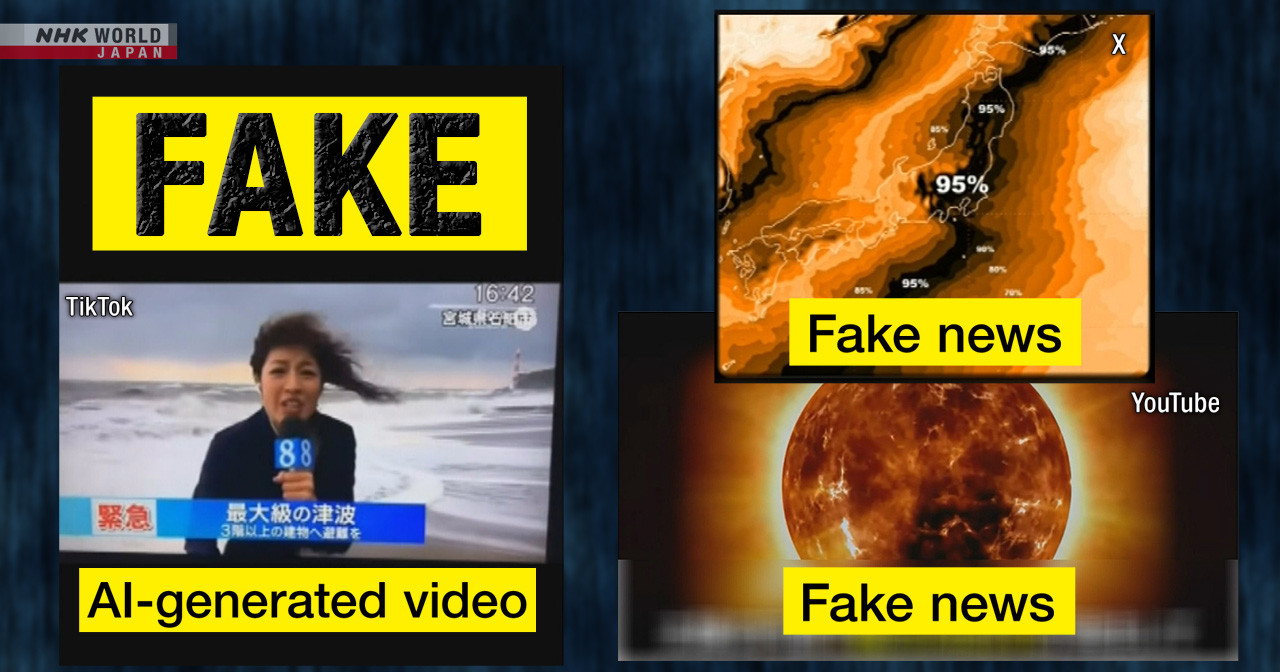
One particularly concerning example was an AI-generated video showing a fictional female news reporter covering a tsunami hitting a beach. The fabricated clip garnered more than 20,000 views on TikTok before eventually being removed from the platform.
Similarly misleading content appeared on YouTube, where one video making pseudoscientific claims about solar flares triggering massive earthquakes attracted over 720,000 views, despite having no basis in scientific fact.
Text-based misinformation also circulated widely. On X (formerly Twitter), a post that claimed to have predicted the December 8 earthquake received significant attention and shares. However, investigation revealed the account regularly posts baseless earthquake “predictions” almost daily, with any apparent accuracy being merely coincidental.
The Japan Meteorological Agency has warned that information specifying exact times and locations of potential earthquakes should be treated with extreme skepticism, as earthquake prediction remains beyond current scientific capabilities.
Japanese government officials responded quickly to the surge in misinformation. The day after the earthquake, Chief Cabinet Secretary Kihara Minoru urged the public to exercise caution regarding unverified information. Two days later, Kihara escalated his warning, stating that the government had identified false data circulating online.
“The dissemination of false information must never be tolerated, as it could affect socio-economic activity and disaster response,” Kihara said. “We strongly urge people to exercise the utmost caution.” He emphasized the importance of relying on government sources and established media outlets for accurate information during disasters.
NHK World’s Yabuuchi Junya, who specializes in countering misinformation, identified two primary motivations behind disaster-related fake news. First, some individuals seek attention in the aftermath of disasters when public hunger for information creates opportunities to gain followers. Second, there are financial incentives, as social media platforms like X offer revenue based on view counts, making sensationalist fake news financially rewarding for creators.
Even more concerning is the trend of direct scams where individuals falsely claim to be disaster victims soliciting donations.
The quality of AI-generated content represents a growing challenge. While earlier fake videos, such as those that circulated after the Myanmar earthquake, were often obviously artificial, technological advancements have made detection increasingly difficult. The September release of OpenAI’s Sora 2 has significantly improved the quality of AI-generated videos, making them nearly indistinguishable from authentic footage.
Yabuuchi offers practical advice for identifying and combating fake news. First, he recommends being aware of how these posts often exploit emotional responses, particularly during times of heightened anxiety following disasters. If content triggers strong emotions, that’s a sign to pause and evaluate more critically.
Next, consider the source—examine the account’s history and reliability. Even careful media consumers can be fooled by sophisticated AI videos, so when in doubt, refrain from sharing content from unknown origins. Instead, verify information through established public institutions and trusted media organizations.
This surge in misinformation following the Japan earthquake highlights the evolving challenges of maintaining information integrity during crises in the age of artificial intelligence, underscoring the growing importance of digital literacy and critical information consumption.
Fact Checker
Verify the accuracy of this article using The Disinformation Commission analysis and real-time sources.

10 Comments
Earthquake predictions are notoriously unreliable, and anyone claiming to have accurately forecast this event should be viewed with skepticism. It’s important to rely on official sources and scientific consensus rather than unsubstantiated claims.
It’s troubling to see how quickly misinformation can spread, especially during times of crisis. Relying on credible news sources and official agencies is the best way to stay informed and avoid contributing to the problem.
Agreed. Fact-checking and source verification are essential skills in the digital age. We all have a responsibility to be discerning consumers of information, especially when it comes to emergencies and natural disasters.
Terrible to see the spread of misinformation during such a critical time. Fact-checking and reliance on official sources is crucial to avoid confusion and panic. Spreading unverified claims, even inadvertently, can do more harm than good.
Agreed, we must be vigilant about verifying information, especially in emergencies. Relying on credible news outlets and government agencies is the best way to stay informed.
The proliferation of AI-generated content is a complex issue. While it has many beneficial applications, the potential for misuse to spread misinformation is alarming. Robust regulation and user education will be crucial to address this challenge.
AI-generated content can be a double-edged sword – it can be incredibly useful, but also poses serious risks if used to spread misinformation. Rigorous fact-checking and source verification is essential to combat this growing threat.
Absolutely. The speed and scale at which AI-generated content can spread is alarming. Robust safeguards and media literacy are crucial to prevent the public from being misled during critical events.
Spreading misinformation, whether intentionally or not, can have devastating consequences during disasters and emergencies. We all have a responsibility to verify information before sharing it, especially on social media.
Well said. Fact-checking and critical thinking are essential skills, especially in the digital age where information can spread rapidly. Relying on official sources is the best way to stay informed and avoid contributing to the problem.