


Listen to the article
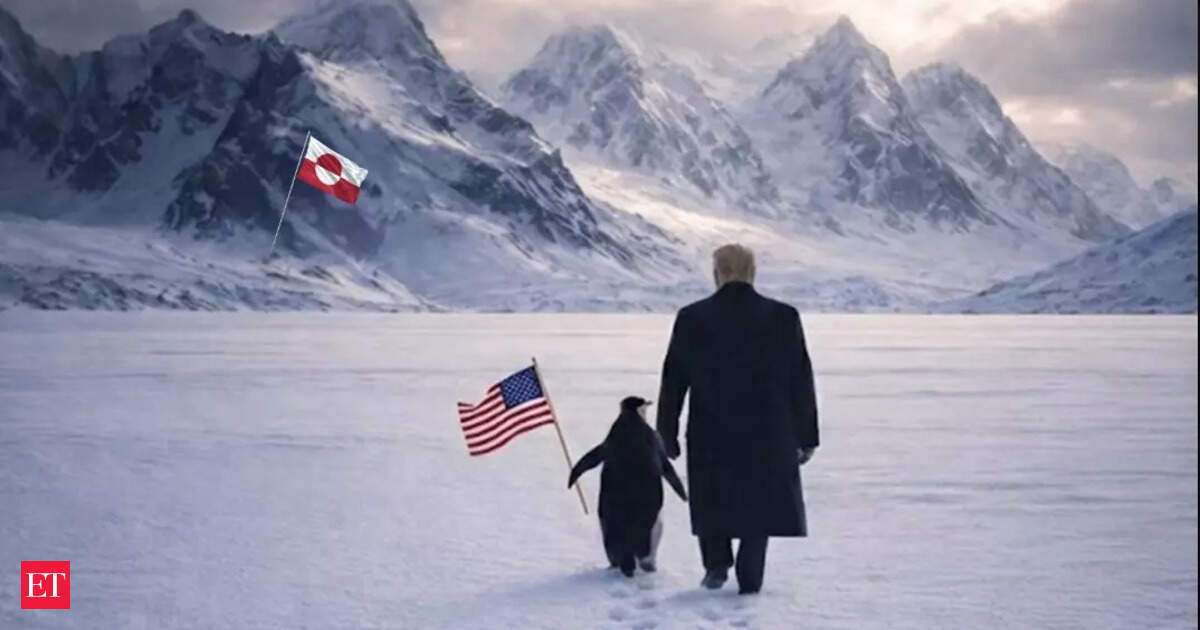
The White House escalated its ongoing Greenland messaging campaign Saturday with an unusual social media post featuring an AI-generated image of President Donald Trump walking across an icy landscape alongside a penguin. The official White House X account shared the image, which included Greenlandic imagery in the background, with the cryptic caption “Embrace the penguin.”
The post quickly drew widespread attention and mockery online, as social media users pointed out a glaring geographical error: penguins are native to Antarctica in the Southern Hemisphere, not Greenland, which lies in the Northern Hemisphere. Many responded with memes highlighting this biological inaccuracy.
The image references what internet users know as the “Nihilist Penguin” meme, originating from Werner Herzog’s documentary “Encounters at the End of the World.” The film features footage of a lone Adélie penguin wandering away from its colony in Antarctica, a moment that online communities adopted to symbolize existential drift and defiance long before its current political repurposing.
Despite the factual error, the post serves a familiar purpose: reinforcing the administration’s persistent narrative that Greenland holds strategic importance to the United States. Trump has consistently argued that control of the Arctic territory is essential for American national security interests, citing its geopolitical significance and location.
The timing of the social media push is notable, coming just days after Washington appeared to ease economic pressure on Europe. The administration recently stepped back from proposed tariffs linked to its Greenland ambitions following discussions between President Trump and Mark Rutte at the World Economic Forum in Davos. Following those talks, Trump indicated that a framework for a future arrangement involving Greenland would be announced “in due course.”
Relations with Denmark, which governs Greenland as an autonomous territory, remain complex. Earlier rhetoric from Washington—including suggestions that military force could be an option if negotiations failed—prompted Denmark and allied European nations to strengthen their presence on the island. Danish officials continue to express concern about American intentions, even as formal diplomatic channels remain open.
This latest social media effort reflects a broader digital strategy by the Trump administration regarding Greenland. In recent weeks, the White House has increasingly turned to visual content and AI-generated imagery to amplify its message. Trump previously shared images portraying Greenland as a future U.S. territory, including one depicting him alongside Vice President JD Vance and Secretary of State Marco Rubio next to a sign declaring Greenland part of the United States.
Another controversial post showed an altered map expanding U.S. borders to include Greenland and other regions, fueling debate over whether these visual messages represent serious policy intentions, diplomatic posturing, or provocative negotiating tactics.
The administration’s pivot to social media for promoting its Greenland ambitions, particularly through contentious or humorous visuals, suggests a deliberate strategy to maintain public awareness of the issue while formal diplomatic discussions continue out of the spotlight. The approach keeps the conversation alive in mainstream discourse, even as substantive negotiations proceed through traditional channels.
Greenland, the world’s largest island, has become increasingly important in geopolitical calculations due to its strategic location, mineral resources, and the effects of climate change opening new shipping routes. As Arctic ice recedes, the region has drawn growing attention from global powers including Russia and China, further heightening its significance in U.S. strategic planning.
Fact Checker
Verify the accuracy of this article using The Disinformation Commission analysis and real-time sources.

13 Comments
Hmm, the White House’s cryptic Greenland messaging seems a bit off the mark. Penguins in Greenland? That’s a geographical stretch, even for this administration.
I agree, the penguin imagery is an odd choice. Maybe they’re trying too hard to be quirky and relevant on social media?
The White House’s Greenland messaging is getting more bizarre by the day. Penguins in the Arctic? That’s a new level of absurdity, even for this administration.
No kidding. I’m surprised the fact-checkers haven’t had a field day with this one. Greenland and Antarctica are on opposite ends of the globe!
As someone who follows the mining and energy sectors, I’m keeping a close eye on the developments in Greenland. The geopolitical implications could be significant, even if the White House’s social media tactics seem a bit bizarre.
As someone with an interest in mining and energy, I’m curious to see if this Greenland saga has any real implications for those industries. The geopolitical maneuvering is certainly interesting to follow.
This Greenland story is definitely raising some eyebrows. The penguin imagery feels a bit off-base, but I suppose it’s par for the course with this administration’s approach to foreign policy.
I have to say, the White House’s Greenland messaging is getting more and more puzzling. Penguins in the Arctic? That’s a new one. I wonder what they’re trying to achieve with this strange tactic.
The White House’s ‘Embrace the Penguin’ message is a strange one, to say the least. I wonder if there’s any deeper meaning behind the cryptic imagery, or if it’s just another social media gimmick.
The ‘Embrace the Penguin’ message is certainly an attention-grabbing one, but I can’t help but question the logic behind it. Penguins and Greenland just don’t seem to go hand-in-hand. I wonder what the real motivation is here.
I’m curious to see how this Greenland story develops. There seems to be a lot of political maneuvering and misinformation going on around the region.
Absolutely. This ‘Embrace the Penguin’ message feels more like a distraction than a coherent policy. I wonder what the real agenda is here.
This Greenland saga is certainly an interesting one to follow. The White House’s social media tactics may be unconventional, but I’m curious to see if there’s a deeper strategy at play, especially when it comes to mining and energy interests in the region.