


Listen to the article
Trump’s Iran Warnings Signal Potential for Wider Middle East Conflict
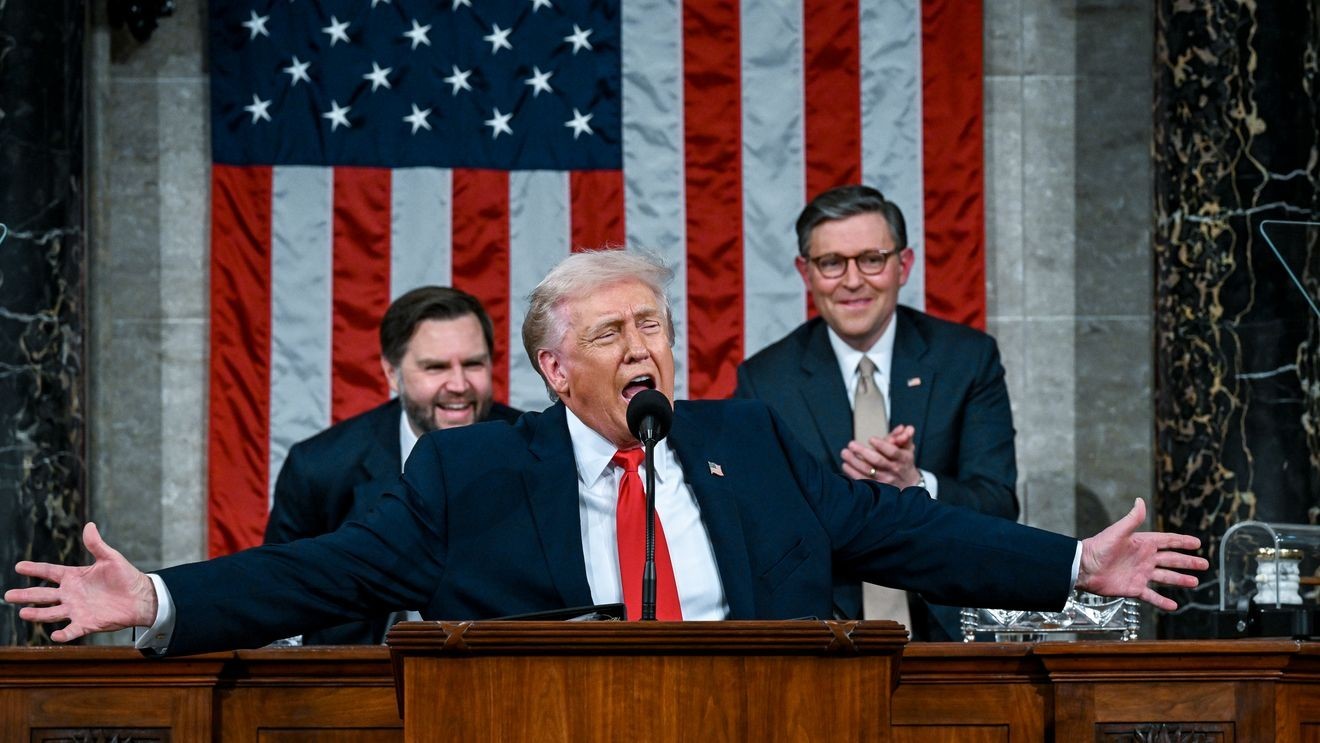
President Donald Trump dedicated only a few minutes to Iran during his record-breaking State of the Union address this week, but his message delivered a clear warning that the administration views Tehran as a persistent threat to regional stability.
During his one hour and 47-minute speech, Trump accused Iran of attempting to restart its nuclear ambitions despite previous U.S. military actions intended to deter such efforts.
“They were warned to make no future attempts to rebuild their weapons program, yet they continue and are at this moment again pursuing their sinister ambitions,” Trump stated, according to the official transcript reported by The Associated Press.
The president emphasized his preference for a diplomatic solution while maintaining that military action remains a viable option should Iran continue pursuing nuclear weapons development.
Beyond a Bilateral Confrontation
Security analysts warn that any direct military engagement between the United States and Iran would likely expand far beyond a contained bilateral conflict, potentially engulfing the entire Middle East region.
According to experts at the Institute for National Security Studies, Iran might avoid direct confrontation with the United States, instead targeting American allies in the region. One scenario suggests Tehran could launch missile or drone attacks against Israel to impose costs without triggering an immediate full-scale American response.
However, such actions would almost certainly draw Israel into the conflict and could necessitate logistical or defensive support from other Western partners, further widening the scope of hostilities.
Iran’s extensive network of regional proxies represents another significant factor in potential conflict scenarios. Tehran could activate Hezbollah in Lebanon, various militias in Iraq and Syria, and the Houthi movement in Yemen to open multiple fronts across the Middle East, according to the Council on Foreign Relations’ Global Conflict Tracker.
While Russia and China would likely avoid direct military involvement, both powers could provide Iran with diplomatic cover and economic support, substantially raising the geopolitical stakes of any conflict.
Dual-Track Approach
Despite the escalating rhetoric, the Trump administration continues to pursue diplomatic channels. U.S. envoy Steve Witkoff and presidential adviser Jared Kushner are expected to meet with Iranian representatives in Geneva for negotiations.
Simultaneously, the Pentagon has deployed what officials describe as one of the largest U.S. military shows of force in the region in decades, signaling Washington’s willingness to back its diplomatic efforts with military pressure.
This dual-track approach has raised concerns among some foreign policy analysts. Max Boot of the Council on Foreign Relations argues that the administration may be significantly underestimating the potential for dangerous escalation.
Boot points out that Iran maintains the capacity to strike U.S. military bases throughout the region, target critical oil infrastructure in Gulf states, or disrupt maritime shipping through the Strait of Hormuz—a vital chokepoint through which approximately 20% of global oil supply passes. Any such disruption could trigger a worldwide energy crisis and price surge.
Additionally, Boot warns that a prolonged campaign against Iran could deplete U.S. precision-guided munitions stockpiles and divert critical resources from other global priorities, without guaranteeing Iranian capitulation or providing Washington with a clear exit strategy.
Learning from Past Interventions
The 2003 U.S. invasion of Iraq stands as the most recent example of full-scale American military intervention in the Middle East. While the United States has conducted various military operations in the region since then—including the campaign against ISIS beginning in 2014, airstrikes in Yemen, and targeted actions against Iran-backed groups—none have approached the magnitude of the Iraq War.
The human and financial toll of that conflict remains a sobering reminder of the potential costs of major military operations. According to Brown University’s Costs of War Project, the Iraq War’s price tag exceeded $2 trillion, with over 4,400 American troops killed, approximately 32,000 wounded, and hundreds of thousands of Iraqi civilian casualties.
As tensions with Iran continue to simmer, these historical lessons cast a long shadow over current policy deliberations in Washington.
Fact Checker
Verify the accuracy of this article using The Disinformation Commission analysis and real-time sources.
